Codex + GPT in Practice: A Complete Breakdown of Building a Corporate Website from Scratch in One Hour

AI programming tools Codex and GPT complete in one hour what traditionally takes weeks of corporate website development.
Through a real-world case study of a tea company corporate website, this article demonstrates how the OpenAI Codex and GPT collaborative workflow compresses weeks of traditional web development into just one hour. The project covers a complete tech stack including Vue frontend, Node.js backend, and MySQL database, delivering a dynamic website system with frontend-backend separation that features CMS content management, product display, news publishing, message management, and other complete functionalities ready for direct delivery to small and medium-sized businesses.
Traditional Web Development Takes Weeks, AI Programming Takes One Hour: Where's the Efficiency Gap?
Building a fully functional corporate website — complete with frontend display, backend management, and database design — typically requires a small team working for several weeks under the traditional approach. But now, with the collaborative workflow of OpenAI Codex paired with GPT, a single person can complete the entire process from zero to one in just one hour.
OpenAI Codex is a large language model fine-tuned specifically for code generation tasks based on the GPT architecture. Its training data encompasses billions of lines of open-source code from GitHub, enabling it to understand and generate dozens of programming languages including Python, JavaScript, TypeScript, and SQL. Codex serves as the underlying engine for GitHub Copilot and is one of the most representative tools in the AI-assisted programming space today. In practical development workflows, GPT handles high-level architecture planning and requirement decomposition (the "planning mode"), while Codex focuses on translating specific requirements into runnable code — together they form a "brain + hands" division of labor, which is the fundamental logic behind the efficiency leap demonstrated in this article.
This article is based on a real-world case study — a tea company corporate website — and breaks down step by step how to use Codex for AI-assisted development, covering the complete tech stack of Vue frontend pages, a Node.js backend management system, and a MySQL database.
Project Results: More Than Just Static Pages
This AI-assisted corporate website is not a simple HTML template but rather a full dynamic website system with frontend-backend separation and complete CMS functionality.
Frontend-backend separation is the mainstream architectural paradigm in modern web development. Its core concept is decoupling the user interface (frontend) from business logic and data processing (backend), with data exchange through RESTful APIs. The advantage of this architecture is that frontend and backend can be developed, deployed, and scaled independently. CMS (Content Management System) refers to a system that allows non-technical users to manage website content through a visual interface — WordPress is the world's most well-known CMS, powering approximately 43% of websites on the internet. The lightweight custom CMS backend in this project avoids the learning curve and performance overhead of introducing heavy systems while covering the core content management capabilities needed for a corporate website.
Frontend Display Layer Feature List
The website frontend runs on port 5173 (Vite dev server) and includes the following core modules:
- Homepage: Carousel image display, with both images and text dynamically manageable through the backend
- About Us: Company profile, mission & vision, cover images — all editable from the backend
- Product Center: Product category filtering, keyword search, and product detail viewing
- News Center: News list and detail pages, with content published and managed through the backend
- Cases & Certifications: Centralized display of company cases
- Contact Us: Message submission functionality with data flowing directly into the backend management system

In terms of feature completeness, this is already a website system ready for direct delivery to small and medium-sized businesses. What's more noteworthy is the system's high versatility — by simply replacing content assets, it can be quickly adapted into a home goods website, a tech company site, or any other type of corporate website.
Backend Management System Feature Details
The backend service runs on port 3000 and provides a complete CMS admin panel. The default admin account is admin with password admin123456. Backend feature modules include:
- Site Settings: Centralized management of website name, tagline, company address, email, and other basic information
- About Us Editor: Rich text online editor supporting image insertion and layout adjustments
- Product Management: Product category management, CRUD operations for products
- News Management: News publishing, editing, and list management
- Carousel Management: Upload and replacement of homepage carousel images
- Cases & Certifications Management: Adding and maintaining case content
- Message Management: Viewing messages submitted by users through "Contact Us"
- Image Management: Unified management of uploaded image resources
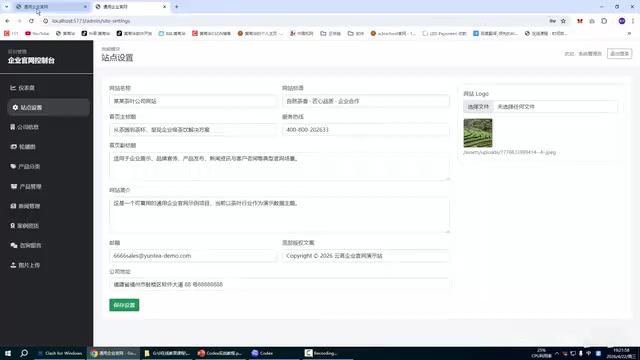
The backend site settings and frontend display are linked in real-time. For example, after changing the website name to "XX Tea Company Website" and setting a tagline in the backend, refreshing the frontend page immediately shows the header and footer information updated accordingly — the frontend-backend data flow is fully connected.
Technical Architecture and Database Design
Tech Stack Overview
The overall technical architecture is evident from the project's running ports and toolchain:
| Layer | Technology | Description |
|---|---|---|
| Frontend | Vue + Vite | 5173 is Vite's default dev port |
| Backend | Node.js | Running on port 3000, providing RESTful APIs |
| Database | MySQL 8 | Managed visually using Navicat for MySQL |
| AI Tools | OpenAI Codex + GPT | Core engine for code generation and debugging |
Vue.js is a progressive JavaScript frontend framework created by Evan You, known for its gentle learning curve and flexible component-based development approach. It enjoys extremely high adoption among the Chinese developer community. Vite (French for "fast"
Related articles
 Tutorials
ChatGPT Plus Subscription Guide: Are GPT-5.5, image-2, and Codex Worth the Upgrade?
A detailed look at ChatGPT Plus features — GPT-5.5, image-2, and Codex — with a Plus vs Pro comparison and a complete step-by-step subscription guide for users outside the US.
 Tutorials
Harness AI Engineering in Practice: Using Claude Code to Master Enterprise-Level E-Commerce Development
Deep dive into Harness AI Engineering: master enterprise e-commerce development with Claude Code using the Rules, Skills, Wiki, and Changes framework.
 Tutorials
Cursor + Codex Dual-IDE Collaboration: A Practical Methodology for Open-Source Project Customization
A complete methodology for open-source project customization based on real-world experience, detailing the Cursor+Codex dual-IDE workflow, seven-stage process, MVP validation, and AI source code reading techniques.