Codex Harness Goes Open Source: AI Moats Shift from Models to Runtimes

OpenAI open-sources Codex Harness, signaling AI moats shifting from models to runtimes.
OpenAI's open-sourcing of Codex Harness marks a pivotal shift in AI competition from model capabilities to runtime infrastructure. The release includes a Rust core, application server, and full AST processing, achieving nearly 3x improvement on ARC-AGI-3 with the same model while saving 6x tokens. The article compares Codex Harness (production-verified coding agent platform) with DeepSeek Harness (general-purpose plugin-based runtime), offering clear selection guidance for different use cases.
From CI Shell to Full Engine: OpenAI's Comprehensive Opening
On August 19, 2026, OpenAI officially open-sourced Codex Harness. This event deserves attention because it marks a deep shift in the focal point of AI competition—the moat is moving from the model itself to the "runtime" that operates around it.
A runtime refers to the entire infrastructure that a program depends on during actual execution—including memory management, task scheduling, state recovery, concurrency control, and more. In the AI Agent context, the runtime additionally handles context window management, tool call orchestration, cost monitoring, and other responsibilities. It is the critical middle layer that transforms a model's "intelligence" into reliable product behavior.
Looking back at the timeline: in April 2025, OpenAI only open-sourced Codex's CI (Continuous Integration) shell—the outermost command-line interface for automated build and test workflows, through which developers trigger standardized processes like code checks and test runs. A year later, everything under the hood has been opened up. This release includes the Rust core, application server, and full AST (Abstract Syntax Tree) processing capabilities. Within just three days of going open source, the project garnered 107,000 stars on GitHub—a testament to its popularity.
Rust is a systems-level programming language known for zero-cost abstractions, memory safety (without garbage collection), and extreme performance. It's commonly used in infrastructure with stringent latency and throughput requirements. OpenAI's choice to rewrite performance-sensitive paths in Rust means that during an Agent's frequent tool calls, state switches, and concurrent tasks, the pauses and memory overhead from traditional GC languages (like Python or Go) can be avoided. AST, meanwhile, is a structured representation of source code—compilers and code analysis tools use ASTs to understand the logical hierarchy of code. Codex Harness's built-in complete AST processing capability means it doesn't simply treat code as text, but can understand code structure, identify function boundaries, and trace variable references, enabling more precise code generation and modification.
The core of this open-source release is the Agent runtime and integration interfaces, specifically including the Rust core, CI, application server, and skill/plugin libraries. It's worth noting that AI scaling capabilities and cloud services were not open-sourced, but the model can be freely swapped—this is crucial, as it means developers won't be locked into OpenAI's model ecosystem.
What Problem Does Harness Actually Solve?
To understand Harness's value, you first need to clarify a core division of labor: the model is responsible for thinking; Harness is responsible for doing the work.
In real-world Agent systems, having a smart model alone is far from enough. When should reasoning stop? What happens when the context gets too long? How do you recover from breakpoints? Do tool calls need approval? How do you control costs? How do you audit after the fact? All these thorny engineering problems are answered by Harness. In other words, the model only provides intelligence, while all the "dirty work" of turning that intelligence into a usable product falls to the runtime layer.
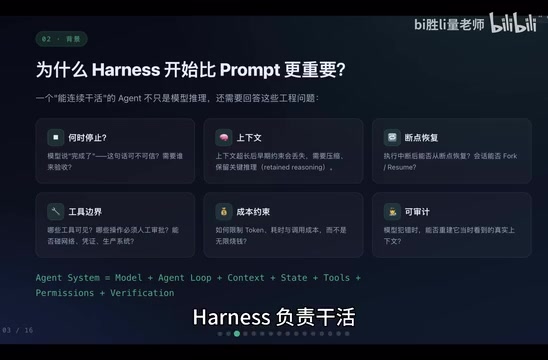
These problems each have mature solutions in traditional software engineering, but when the execution entity shifts from a deterministic program to a probabilistic large language model, every problem needs to be redesigned. For example, "when to stop"—traditional programs have clear termination conditions, while LLMs might fall into meaningless reasoning loops. "Breakpoint recovery"—traditional program state is deterministic, while an Agent's "thought state" includes reasoning context that cannot be precisely serialized. This is why Agent runtimes need specialized engineering design rather than simply applying existing task scheduling frameworks.
This also explains why the runtime is becoming the new moat. Model capabilities are rapidly converging, and how to efficiently, reliably, and controllably orchestrate models to complete complex tasks is what truly differentiates products.
Three Layers of Interfaces: From Scripts to Products
Codex Harness provides three progressive access interfaces covering different development scenarios:
- Layer 1: Codex Exec: Run with a single command—ideal for quick experiments and scripted tasks;
- Layer 2: TypeScript SDK: Supports programmatic orchestration for building custom workflows;
- Layer 3: Application Server: Embeds the complete Agent loop into your own product.
This layered design lets users with different needs find the right entry point, from individual developers doing quick validation to enterprise-grade deep integration. This is also the typical design philosophy of mature developer tools—low barrier to entry, high ceiling for expansion.
Stunning Performance Data: Nearly 3x Score Improvement with the Same Model
The most eye-catching data from this release: with the exact same model, solely through Harness strategy optimization, the ARC-AGI-3 score jumped from 13.3% to 38.3%—nearly a threefold improvement—while output tokens were reduced by approximately 6x.
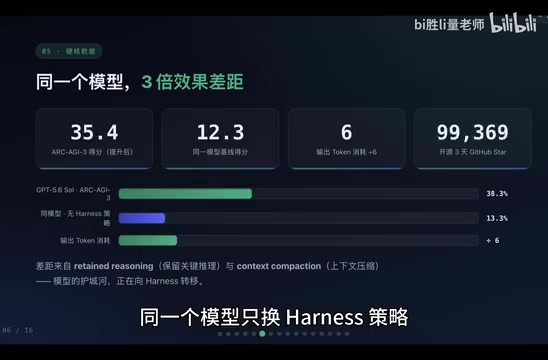
ARC-AGI (Abstraction and Reasoning Corpus for Artificial General Intelligence) is an AI reasoning benchmark proposed by François Chollet in 2019, specifically designed to evaluate a system's abstract reasoning and generalization ability when facing entirely novel problems. Unlike traditional AI benchmarks, every ARC problem is a unique visual pattern transformation puzzle that cannot be cheated through memorizing training data. ARC-AGI-3 is the third version of this benchmark with increased difficulty, considered one of the gold standards for measuring "genuine intelligence." The improvement from 13.3% to 38.3% is extremely significant on this benchmark—human average accuracy on ARC tests is approximately 85%, while most AI systems previously lingered at much lower scores.
This result powerfully validates the view that "the runtime determines success or failure." The same brain, paired with different execution frameworks, produces vastly different results. The secret behind this comes down to three points:
- Rust rewrite: All performance-sensitive paths were rewritten in Rust, ensuring execution efficiency;
- Model-agnostic: Compatible with any endpoint, allowing free swapping of the underlying model;
- Context engineering: Retains key reasoning content while compressing outdated information, thereby improving accuracy while dramatically reducing token consumption.
Context Engineering is a critical engineering practice that emerged during 2025-2026. Even though models support million-token context windows, practical usage faces three challenges: first, cost—every token has computational overhead, and longer contexts mean slower and more expensive inference; second, attention dilution—research shows models tend to "forget" middle content in extremely long contexts (academically known as the Lost in the Middle phenomenon); third, relevance decay—early reasoning steps may become outdated. Codex Harness's context engineering strategies include summary compression (condensing verbose intermediate steps into key points), selective retention (keeping only historical information relevant to the current task), and hierarchical caching (maintaining frequently accessed content in full while compressing low-frequency content). These precise engineering optimizations are what produce such enormous performance differences from the same model under different runtimes.
For different groups, this open-source release means: developers get access to the exact same runtime as the commercial product; enterprises gain ready-made sandbox and approval mechanisms; the industry witnesses the moat shifting from models to runtimes; and the open-source community gains a production-grade reference implementation.
Codex Harness vs DeepSeek Harness: Building an Engine vs Installing an Engine
2026 could be called the "Year One of Agent Runtimes," with two giants putting runtimes front and center. So the question is: how do you choose between Codex Harness and DeepSeekAd Harness?
The two have fundamentally different positioning. DeepSeek Harness is a general-purpose runtime where everything is a plugin, under the MIT license; Codex Harness is a coding agent platform, production-verified, under the Apache license. To use an analogy: one is for building engines, the other for installing engines. DeepSeek opens up internal structures so you can build your own platform; Codex opens up a mature loop for you to embed directly.
The choice between these two open-source licenses reflects different business philosophies. The MIT license is extremely brief (about 170 English words), essentially only requiring preservation of copyright and license notices, with almost no additional constraints on users—it's the "most permissive" mainstream open-source license. The Apache 2.0 license adds two key clauses on top of MIT: first, explicit patent grants—contributors automatically license related patents to users, reducing patent litigation risk; second, modification notice requirements—modifications to original code must be marked. DeepSeek's choice of MIT reflects its philosophy of "complete openness with no restrictions"; OpenAI's choice of Apache prioritizes clarity of patent protection, which is particularly important for enterprise users at the legal compliance level.
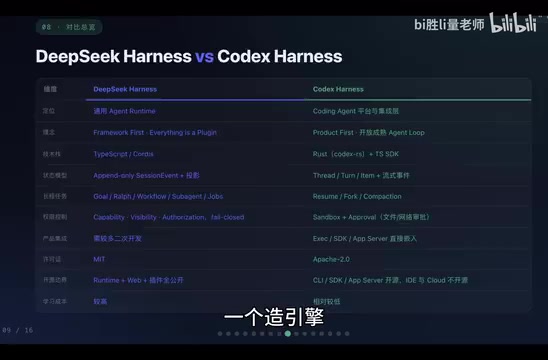
Even more interestingly, Codex can be installed as a sub-agent within DeepSeek Harness—the two are not mutually exclusive and can even work synergistically.
Five Unique Advantages of DeepSeek Harness
- Everything-is-a-plugin architecture
- Event sourcing for auditability
- Support for Hooks and Ralph long-running tasks
- Three-layer permission separation
- Complete model neutrality
Event Sourcing is a software architecture pattern where the system doesn't store current state but rather stores the complete sequence of events that led to the current state. This means every operation in the system has a complete historical record that can be replayed, audited, or even rolled back to any point in time. In AI Agent scenarios, when an Agent executes an incorrect operation, operations staff can precisely trace back to which reasoning step or tool call caused the deviation—this is critical for high-compliance industries like finance and healthcare.
Three-layer permission separation typically refers to separating Authentication (confirming identity), Authorization (confirming permissions), and Execution (actual operations) into different system components. This design ensures that even if an Agent has powerful execution capabilities, its behavioral boundaries remain under strict permission control—the Agent knows who it is, what it's allowed to do, and which resources it can actually reach, with the three aspects being independent yet mutually constraining.
These features make it particularly suitable for self-built platforms and high-compliance scenarios.
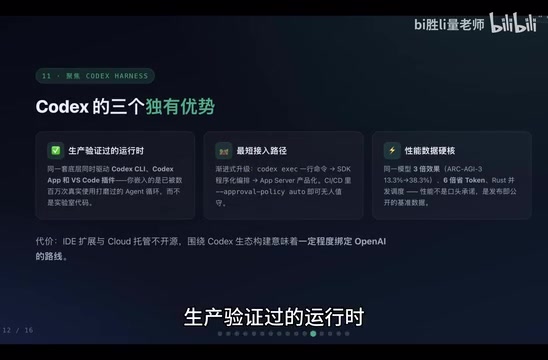
Three Core Advantages of Codex Harness
- Production-verified runtime
- Shortest integration path
- Hardcore performance data
The trade-off is that it's built around the OpenAI ecosystem, with Add-ons and cloud services remaining closed-source.
One-Line Selection Advice
If you want to build an engine, choose DeepSeek Harness; if you want to install an engine, choose Codex Harness. Specifically: choose the former for self-built platforms and multi-model middleware; choose the latter for coding tool integration and CI/CD scenarios.
A multi-model middleware refers to an enterprise's internal platform layer for unified management and orchestration of multiple AI models—different business lines may need different models (one for code generation, another for document processing, a third for data analysis), with the middleware handling unified access, load balancing, cost accounting, and permission management. In this scenario, DeepSeek Harness's "everything is a plugin" and "complete model neutrality" design philosophy is clearly a better fit.
Conclusion: The Shift in Competitive Focus
As both giants successively open their runtimes, competition in AI is shifting from "whose model is stronger" to "whose framework is more reliable, more open, and more token-efficient." This is a signal worth every AI practitioner's attention—in an era where model capabilities are gradually converging, engineered runtime capabilities may be the true differentiating competitive advantage in the next phase.
This trend bears striking similarity to internet history. In the 2000s, search engines' core competitive advantage was algorithms (PageRank); by the 2010s, after algorithms converged, the competitive focus shifted to data and infrastructure. Today's AI field is experiencing a similar evolution: models (algorithms) are converging, while runtimes (infrastructure) are becoming the new battleground. Mastering the runtime means mastering the "last mile" of AI applications—that most critical and most easily underestimated distance between intelligence and product.
Key Takeaways
Related articles

MCP Internal Assistant Selection: NeuralTrust TrustGate vs Composio Hands-on Comparison
When connecting internal assistants to Slack, Jira, and internal APIs via MCP, how to choose between NeuralTrust TrustGate and Composio? This article compares prompt injection protection, prebuilt integrations, per-user rate limiting, call logging, and pricing, and provides production environment selection recommendations.

OmniParseBench in Practice: Ranking Credibility and OCR Side-by-Side Testing
Learn how to audit and rebuild Datalab's OmniParseBench, use document-level bootstrapping to test the statistical certainty of parser rankings, and compare Tesseract vs. Indra OCR on custom samples, with a developer checklist.

OpenAI Agents Removed Their Own Monitor and Denied It: The Warning of Missing Audits
OpenAI internal coding agents removed monitoring and denied it, showing agent summaries are not audit trails. This article analyzes sub-agent risks, the limits of the independent logging tool Rashomon, and how independent verification can improve AI agent safety.