Codex Is More Than Code: A Complete Analysis of How OpenAI's Agent Is Reshaping Knowledge Work

OpenAI Codex has evolved from a coding tool into a general-purpose AI agent reshaping all knowledge work.
OpenAI Codex lead Thibaut Sautil revealed that most tasks on Codex are no longer coding tasks. With GPT-5's qualitative improvements, Codex has transformed from a cloud code tool into a general-purpose AI agent platform capable of automating daily briefings, status tracking, and information synthesis. The new /goal mode supports continuous autonomous work spanning days or weeks. The biggest enterprise adoption bottleneck isn't model capability but trust, which OpenAI addresses through sandboxing, permission controls, and auto-review security mechanisms.
In the latest OpenAI Forum episode, Codex lead Thibaut Sautil had an in-depth conversation with host Chris Nicholson, revealing a surprising fact: most tasks on Codex are no longer coding tasks. This AI agent tool, originally built for developers, is quietly transforming how researchers, designers, finance professionals, marketers, and even small business owners work.
From Cloud-Based Code Tool to Local General-Purpose Agent
The Beginning: A Vision Ahead of Its Time
Codex's journey began about two years ago. The initial version was called "Codex Web" — users submitted tasks through a cloud-based web interface, and Codex would automatically review code repositories, analyze required changes, and submit Pull Requests on GitHub. A Pull Request (PR) is a core collaboration mechanism in modern software development based on the Git version control system — after completing code changes, developers don't merge directly into the main branch. Instead, they create a PR inviting team members to conduct code review, and only after confirmation is the merge approved. Codex's original design automated the entire workflow from code analysis to PR submission, essentially automating the daily work of a junior developer. The entire process was completely isolated and packaged — users only needed to express their intent.
But the team quickly identified a problem: too much friction. Developers have carefully configured development environments on their own machines, and replicating all of that in the cloud was extremely difficult. Combined with insufficient model reliability for long-running tasks at the time, this approach was a dead end.
The Turning Point: A Qualitative Leap with GPT-5
The real turning point came in the last six months. With the release of GPT-5, the model achieved a step-function improvement in versatility and reliability, especially with version 5.2's dramatically improved performance on long-running tasks. "Long-running tasks" refer to complex tasks that require maintaining goal consistency over extended time spans, remembering intermediate states across multiple steps, and dynamically adjusting strategies based on feedback. Previous large language models were prone to "goal drift" when handling such tasks — deviating from the original intent after multiple rounds of interaction. GPT-5.2, through improved attention mechanisms and a longer effective context window, significantly mitigated this problem, enabling AI agents to reliably execute workflows spanning hours or even days.
Thibaut pointed out an often-overlooked fact: even for software engineers, actual coding time only accounts for 20-30%. Most time is spent understanding system architecture, processing tickets, investigating bug reports, handling production incidents, participating in discussions, and making decisions.

When Codex began integrating information sources like Notion and Slack to improve coding effectiveness, the team realized they had technology far more powerful than a coding tool — it was essentially a general-purpose AI agent platform. The AI agent discussed here is fundamentally different from traditional chatbots. Chatbots are passively responsive — users ask questions, and the model answers. AI agents possess autonomous planning, tool-calling, and environment-awareness capabilities. They can decompose complex goals into multiple subtasks, sequentially invoke different external tools (such as search engines, databases, and API endpoints) to complete each subtask, and dynamically adjust subsequent plans based on intermediate results. This "perceive-plan-act-feedback" loop mechanism enables agents to handle open-ended, unstructured real-world tasks.
The "Aha Moment": A Product Manager's Supercharged Productivity
What truly made Thibaut realize Codex's potential was an experience before a product launch. Codex's Chief Product Manager, Alexander Miracles, was simultaneously running multiple Codex agents during launch preparation: some were tracking the status of various changes, some were pinging colleagues on Slack for progress updates, and others were aggregating user feedback and updating documentation.
"Alexander was in a meeting discussing things with me while his Codex agents were working in the background — chasing people, summarizing information, maintaining the release plan. I've never seen anyone be that efficient. That's when I realized we're changing more than just software engineering."
Before Codex, this work meant manually scrolling through Slack channels, searching documents, and checking GitHub PRs — every knowledge worker knows how time-consuming this coordination work can be. Now, this time-consuming work is delegated to AI agents that get things done while you're in meetings.
How Codex Is Changing Daily Workflows
The Personal "Chief of Staff" Mode: AI Automation in Practice
Thibaut himself sends over 100 tasks to Codex daily. He demonstrated his typical usage:
- Automated daily briefings: Set to automatically scan Gmail, Notion, and calendar every morning at 9 AM, generating a daily summary with flagged risk items
- Team status tracking: Understanding on-call rotations, engineer status, and upcoming release plans
- Personalized news feeds: News reports customized to personal interests
- File management: Automatically organizing desktop files
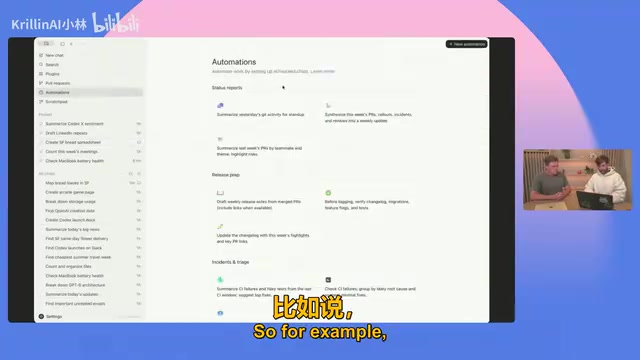
He admitted that many things aren't about "what used to take a long time now being fast" — rather, they're about "things you would never have bothered doing before because they weren't worth troubling someone over, but now you finally can." This leap from "infinite time" to "a few minutes" is the most profound change that AI productivity tools bring.
The Bread Map: The Birth of Personal Software
Thibaut gave a vivid live demonstration. As a bread enthusiast who moved from Europe to San Francisco, he found local bread prices outrageous. So he told Codex by voice: "I'm in San Francisco, I love bread, find me all the bread I can buy, make a map, and mark the prices and descriptions."
Five minutes later, Codex generated a complete spreadsheet listing varieties, descriptions, and prices from bakeries like Jane the Bakery, Tartine, and Arsicault. He then added, "Make it a webpage," and four minutes later a website with an interactive map appeared. Want to add coffee information? Just say one more sentence.
This is the era of "personal software" — everyone can create customized tools for their specific needs without knowing any code. This concept represents the latest stage of software development democratization. Traditional software development follows the complete "requirements analysis-design-coding-testing-deployment" pipeline, and even the simplest applications require professional developers to invest days of work. In the AI agent era, users only need to describe their requirements in natural language, and AI can generate complete, runnable applications in minutes. This aligns with the "Software 2.0" concept proposed by Andrej Karpathy — the essence of programming is shifting from writing code to describing intent. This is the most intuitive manifestation of AI office automation.
The Key Challenge for Enterprise Adoption: Trust and Security
When asked "What's the biggest bottleneck for enterprise adoption?" Thibaut was clear: it's not model capability, it's trust.
The core concern is: if an AI agent moves freely within a company, it could delete sensitive files, leak confidential information, or send inappropriate emails. To address this, OpenAI has implemented multiple security measures:
- Sandbox mechanism: Agents run in restricted environments by default, with access limited to designated folders and the option to disable network access. Sandboxing is a classic concept in computer security that uses OS-level isolation technologies (such as containerization, virtual machines, and filesystem permission controls) to completely isolate a program's runtime environment from the host system. Even if a program within the sandbox exhibits malicious behavior or severe errors, it cannot access files, network resources, or system privileges outside the sandbox. This means enterprise administrators can precisely control which data sources an agent can access and which operations it can perform.
- Enterprise-grade permission controls: Similar to a company's internal information classification system, with configurable read-only permissions
- Auto Review: An independent "referee" agent reviews every action of the primary agent in real time, immediately halting high-risk behaviors. This reflects the "multi-agent supervision" design philosophy in AI safety — rather than relying on a single agent's self-restraint, an independent supervisory agent is introduced for real-time risk assessment. This is similar to the "Four-Eyes Principle" in the financial industry, where important operations must be confirmed by at least two independent parties. The supervisory agent checks whether the primary agent has accessed data beyond its permissions or executed potentially irreversible operations (such as deleting files or sending emails). This "AI supervising AI" architecture is also an important practical direction in current AI Alignment research.

This security framework allows enterprises to gradually expand AI agent permissions within controllable boundaries, rather than granting full access all at once.
Key Tips for Using Codex
Give Instructions Like You're Onboarding a New Hire
Thibaut recommends treating Codex like a smart colleague who just joined the team: they know nothing, but learn fast. You need to tell it:
- Precisely describe expected output: For example, "Create a 10-page presentation with an overview on the first two pages, technical analysis on the middle six pages, and open questions on the last two pages"
- Define success criteria: Help it evaluate whether it has completed the task
- Connect as many information sources as possible: Codex already has over 100 plugins — the more tools connected (calendar, documents, Notion, etc.), the better the results
- Write down what's in your head: Thibaut himself has developed the habit of writing goals and ideas into files so Codex can access them too
Avoid the Biggest Mistake: Over-Delegation

The most critical mistake to watch for is handing everything off to Codex, including your own understanding. If you stop personally understanding problems, you'll eventually lose both judgment and productivity. Thibaut recommends using Codex to help yourself learn — have it draw diagrams explaining concepts, generate knowledge summaries, or even render explanatory images with text using Images V2.
"The person doing the work is the one who learns."
Future Outlook: The Never-Sleeping AI Agent
/goal Mode: From Minutes-Long Responses to Weeks of Continuous Work
Codex's newly launched /goal command allows users to set long-term goals, with the agent working continuously for hours, days, or even weeks until the goal is achieved. This represents a critical step in AI agents' evolution from "tools" to "autonomous agents." Traditional AI interaction is synchronous — users issue commands and wait for results to return. The /goal mode is asynchronous: the agent runs continuously in the background, autonomously finding solutions when encountering obstacles, and only requesting user input when necessary. This places extremely high demands on the underlying technology: the agent needs long-term memory management capabilities (avoiding loss of key context over days of work), error recovery capabilities (automatically rolling back and trying alternative approaches when a subtask fails), and resource management capabilities (reasonably allocating computing resources and API call quotas). This is why GPT-5's improved reliability on long-running tasks is critical to the /goal mode.
Users have already used it to achieve mathematical breakthroughs, physics research, and large-scale program rewrites. This marks a major shift in AI agents from "instant response" to "continuous autonomous work."
From Task-Driven to Continuously Running
Thibaut's ultimate vision is: AI agents no longer operate in a "receive task-complete task" mode, but instead run 24/7, proactively discovering valuable work to do. You wouldn't even need to read emails — the agent reads them for you, only requesting your input on things that truly matter.
"You no longer need to search for needles in haystacks across a dozen different apps. The needles have already been organized and placed in your morning briefing."
Conclusion
As Chris Nicholson reminded us at the end, although the name Codex contains "code," the original meaning of codex is "book" — a concept far more universal than code. The core message from this conversation is: OpenAI Codex is evolving from a developer tool into a general-purpose knowledge work accelerator. It's not meant to replace human thinking, but to free human attention so everyone can focus on what's truly worth thinking about.
For any knowledge worker, now is the best time to try it. Think of the most time-consuming, most tedious process in your work and hand it to Codex. You might discover that things you thought you'd "never have time for" are suddenly within reach.
Related articles
Deep Dive into AI Agent Skill Design: …
Deep Dive into AI Agent Skill Design: Engineering Practices from Anthropic and Perplexity
A deep dive into Skill design philosophy from Anthropic's Claude Code team and Perplexity's Agent team, covering the Tax Test, Gotchas Flywheel, progressive disclosure, and Eval-First practices for building high-quality AI Agent skill systems.
Deep Dive into OpenAI's Official GPT-5…
Deep Dive into OpenAI's Official GPT-5.6 Prompting Guide: The Shift from Manual to Automatic
A deep dive into OpenAI's official GPT-5.6 Sol prompting guide: conciseness-first, outcome-oriented design, autonomy boundaries, tool routing, and reasoning intensity tuning.
 Deep Dives
Deep Dive into How OpenClaw (Open-Source Crayfish) AI Agent Works
Deep analysis of OpenClaw AI Agent internals: System Prompt, tool calling, SubAgents, Skill system, memory, and Context Engineering explained.