Codex on AWS Bedrock Billing Bug: Why Bills Are Surging 10x and How to Respond

AWS Bedrock users report 10x billing anomalies when calling Codex models, with analysis and prevention tips.
Reports have surfaced of severe billing anomalies when using Codex models through AWS Bedrock, with some users seeing charges up to 10x expected amounts. Possible causes include token metering errors, retry-induced duplicate charges, and streaming response billing flaws. Teams should set up cost alerts, preserve logs, and implement independent usage tracking to protect against such issues.
Incident Overview
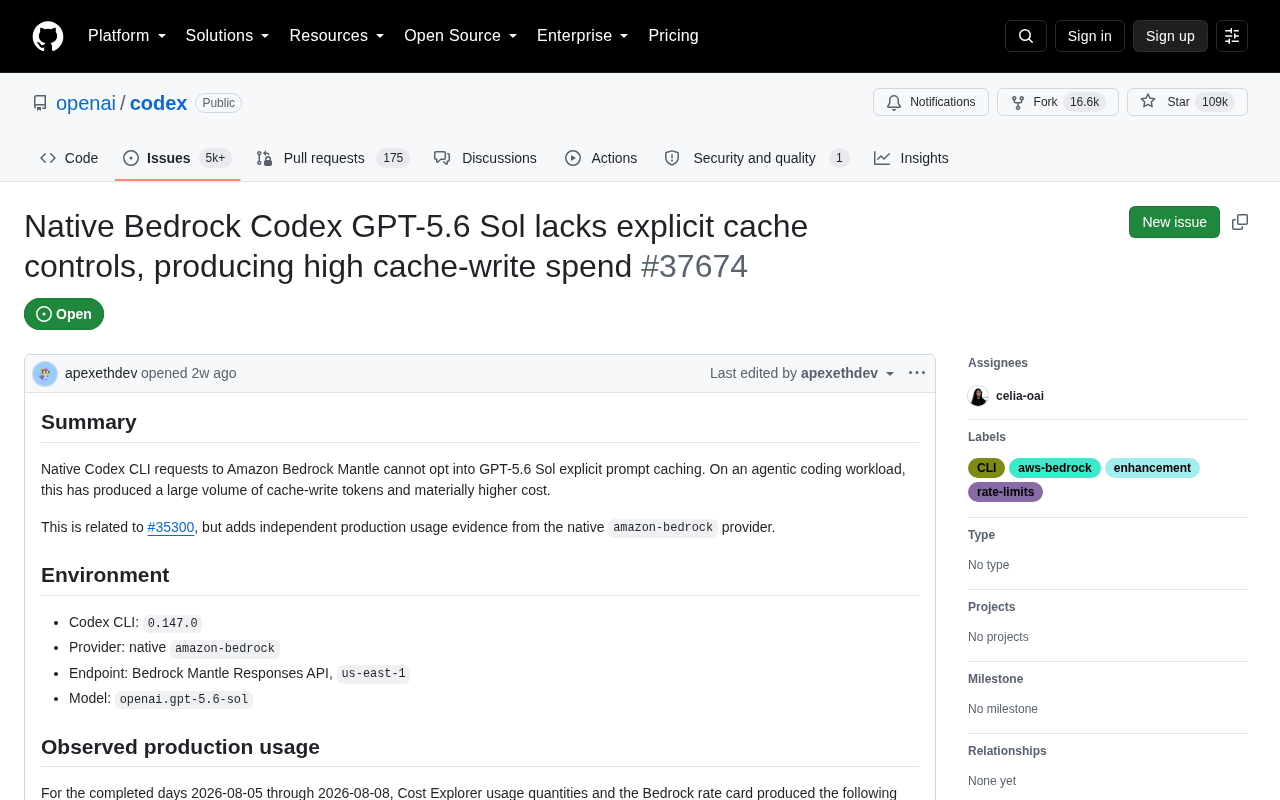
Recently, a report about severe billing anomalies when running Codex on AWS Bedrock drew attention on Hacker News. According to the report, some users calling Codex-related models through AWS Bedrock experienced abnormal charges up to 10 times the expected amount. If confirmed, this represents a significant cost risk for developers and enterprises relying on cloud-hosted LLM services.
Although the discussion thread is still in its early stages (9 upvotes, 1 comment), billing anomalies tend to have a delayed impact—many users only discover inflated bills at the end of the month. This makes it worth raising awareness for all teams currently using Bedrock-hosted models.
Background: AWS Bedrock + Codex
What Role Does AWS Bedrock Play?
AWS Bedrock is Amazon's managed generative AI service that allows developers to call foundation models from multiple providers through a unified API, without managing underlying infrastructure. Its billing model typically charges based on input/output token count or inference duration—precisely the areas where billing anomalies are most likely to occur.
From an architectural perspective, AWS Bedrock reached General Availability (GA) in 2023. Its underlying infrastructure uses a multi-tenant shared inference model, providing users with a serverless model invocation experience through Amazon's proprietary inference optimization layer (including Inferentia and Trainium chips as well as traditional GPU instances). Billing breaks down into three main modes: On-Demand inference charged per input/output token; Provisioned Throughput charged hourly for guaranteed inference capacity; and Batch Inference offering discounted pricing for offline tasks. In on-demand mode, input and output tokens are priced differently (output tokens are typically 2-4x the cost of input tokens). This asymmetric pricing structure inherently increases billing system complexity and creates potential for metering errors.
Codex Model Use Cases
Codex is a model series focused on code generation and understanding, widely used for code completion, automated programming, and script generation. When Codex capabilities are delivered through Bedrock, developers often embed them into CI/CD pipelines, IDE plugins, or automated agents. In these high-frequency, batch-calling scenarios, if the per-call billing unit is incorrectly inflated, the cumulative effect can be staggering.
Possible Technical Causes of the 10x Bill Surge
While the original report didn't disclose detailed technical specifics, from an engineering perspective, a "10x billing" figure typically points to several common issues:
Token Metering Unit Conversion Errors
The billing system may inflate charges due to unit conversion errors when counting tokens—such as mistaking character count for token count, or accumulating counts multiple times. A clean 10x multiplier especially suggests some form of duplicate billing within batch processing or loop calls.
It's worth noting that tokens are not simply equivalent to words or characters. Modern LLMs universally use tokenization algorithms like BPE (Byte Pair Encoding) or SentencePiece to split text into subword units. Different models use different tokenizers, and the same text can produce significantly different token counts across models—for example, GPT-4's cl100k_base tokenizer and Claude's tokenizer have completely different segmentation strategies for Chinese text and code. On a multi-model hosting platform like Bedrock, the billing system needs to maintain independent token metering logic for each model, and this complexity is a breeding ground for errors. Additionally, code content (Codex's primary input) tends to tokenize less efficiently than natural language due to special characters, indentation, and syntax structures—meaning code of equal length consumes more tokens, further complicating cost estimation for users.
Retry Mechanisms Causing Duplicate Charges
In distributed systems, automatic retries after request timeouts are standard design patterns. If retry logic and billing logic lack proper idempotency handling, a single actual request may be recorded multiple times by the billing system, causing multiplicative fee stacking.
Idempotency is a core principle in distributed system design, meaning an operation produces the same effect regardless of how many times it's executed. In AWS's billing architecture, a request passes through multiple layers after leaving the user's client: API Gateway, load balancers, inference services, and the Metering Service. Timeouts or network jitter at any layer can trigger retries. AWS's metering service typically relies on unique Request IDs for deduplication, but if the client SDK generates a new Request ID on retry, or if an intermediate layer's retry mechanism bypasses the deduplication logic, the same inference call gets billed multiple times. Similar cases have occurred with AWS services like SQS and Lambda—this is a classic distributed systems challenge.
Billing Logic Flaws in Streaming Responses
Codex-class models commonly use streaming output. If Bedrock has defects in how it counts output tokens for streaming responses—such as repeatedly billing the full context for each chunk—this would also cause abnormal fee inflation.
From a technical implementation standpoint, streaming responses use Server-Sent Events (SSE) or similar chunked transfer mechanisms to push model output token-by-token or chunk-by-chunk to the client, reducing Time to First Token (TTFT). In Bedrock's implementation, each stream chunk typically contains incremental output (delta) along with cumulative usage statistics. Correct billing logic should either charge once at stream end based on the final usage field, or only accumulate incremental token counts from each chunk. But if the implementation is flawed—for example, if each chunk carries the cumulative token count from the start of the stream to the current position, and the billing system treats each cumulative value as an increment to be added—this produces an arithmetic series summation amplification effect (1+2+3+...+n = n(n+1)/2), potentially resulting in charges several to dozens of times the actual usage.
Real-World Impact on Developers and Enterprises
For individual developers, a 10x bill might mean an unexpected expense of tens to hundreds of dollars. But for enterprises with Codex deeply integrated into production environments, this amplification effect could generate thousands or even tens of thousands of dollars in additional costs within a short period.
The deeper issue is one of trust. A core value proposition of cloud services is the predictability of "pay-per-use" billing. When the billing system produces inexplicable anomalies, it directly undermines user confidence in managed AI services, prompting some teams to reconsider self-hosted alternatives.
Industry Precedents and Structural Risks
Billing anomalies are not isolated incidents in cloud services. In 2023, multiple OpenAI API users reported that GPT-4 Turbo token counts didn't match expectations, which was ultimately confirmed as a bug where system prompts were being counted multiple times. Earlier still, Google Cloud's Vertex AI caused abnormal bills for some customers due to metering errors in batch prediction jobs. These cases reveal a structural problem: when AI inference service billing granularity reaches the token level with call frequencies of hundreds per second, any tiny error in the metering system gets dramatically amplified through multiplication effects. This is why FinOps (Cloud Financial Operations) is becoming increasingly important in the AI era—enterprises need dedicated tools and processes to continuously monitor the reasonableness of AI spending.
Response Measures and Long-Term Prevention
Emergency Steps After Discovering Anomalies
- Audit billing details: Teams currently using Bedrock + Codex should immediately review recent bills and verify whether actual call volumes match billed amounts.
- Set up cost alerts: Use AWS Budgets and CloudWatch to configure spending threshold alerts, preventing anomalous charges from accumulating unnoticed.
- Preserve call logs: Complete request logs are critical evidence for filing disputes with AWS and requesting refunds.
Building Long-Term Cost Protection
- Track usage independently at the application layer: Don't rely solely on cloud provider billing data. Record token consumption independently at the application layer for cross-validation. Use the corresponding model's open-source tokenizer library (e.g., tiktoken) to pre-calculate expected token counts locally for each request and compare against billing data.
- Control concurrency and retry strategies: Set reasonable rate limits and idempotency keys for automated agents to prevent duplicate charges from retries. Specifically, include a client-generated unique identifier with each API call and reuse the same identifier on retries.
- Establish FinOps practices: Incorporate AI service cost monitoring into your team's daily operations workflow. Assign dedicated personnel to regularly audit AI-related spending and build automated anomaly detection pipelines.
Conclusion
This issue is still in the early community exposure stage and awaits official confirmation and resolution from AWS. But it serves as yet another reminder: while embracing the convenience of cloud-hosted LLMs, billing transparency and cost controllability are engineering concerns that cannot be ignored. For any team integrating AI capabilities into production pipelines, building an independent usage monitoring system is always more reliable than filing disputes after the fact.
Note: This article is based on a single community report from Hacker News. The specific scope and root cause of the billing anomaly still await further official verification.
Related articles

Why Does the Tesla Roadster Need to Fly? A Deep Dive into Musk's Wild Demo
Tesla's Roadster launch showed wall-climbing, upside-down driving, and flying stunts—but The Vergecast notes the demo car may lack a battery, the Rocket version is invite-only and not street-legal, and the website terms don't guarantee delivery. After nine years of delays, why does this car still need to exist?

AI Is Not a Replacement: Human-AI Collaboration Through the Lens of Factory Root Cause Analysis
Starting from factory root cause analysis, this article explains how AI accelerates evidence chain construction rather than replacing human experts, exploring the pragmatic implementation logic and business value of 'AI supporting people rather than replacing them.'

AI Agent Decision Auditing: Building an Evidence Chain in Regulated Workflows
Starting from a Reddit discussion, this article analyzes three core issues in AI agent decision auditing within regulated workflows: what fields audit records should contain, how to handle feedback latency for erroneous decisions, and how to continuously calibrate LLM judge consistency with human judgment.