Codex Plans, Claude Codes: 3.6K-Star Open-Source Project Enables Multi-AI Collaborative Development

Open-source CCB uses Codex to plan and review, Claude to code, and shared memory for multi-Agent development.
The open-source project CCB (Claude Codex Bridge), shared by a Bilibili creator, has 3.6K GitHub stars. Its core is having Agents from different vendors divide the work: Codex generates plans and reviews code, while Claude Code codes according to the plan, automatically delegating tasks via an ask mechanism and sharing project memory to form a develop-review-fix loop. The article covers CCB's visual configuration, one-command installation, and mobile remote control, and documents a test where Codex planned and DeepSeek v4 powered Claude Code to ultimately generate a 3D car showcase page. The author considers this approach helpful for mitigating single-model hallucinations, but notes the small task scale and the need for more validation of multi-Agent latency, token consumption, and complex topology stability.
Single-model coding is prone to hallucinations—so what happens when you let two AIs divide the work? A Bilibili creator shared an open-source project where Codex handles planning and review while Claude Code handles coding, using shared memory and automatic delegation to build a 3D car showcase page. The project, called CCB (Claude Codex Bridge), has already gained 3.6K stars on GitHub and also supports Gemini, Kimi, Qwen, Cursor, Copilot, and other Agents.
Core Features: More Than Just Dual-Model Collaboration
According to the creator, CCB's core capability is cross-vendor Agent collaboration. It supports common Agents like Codex, Claude, Gemini, Kimi, Qwen, Cursor, Pi, and OpenCode, and allows building complex collaboration topologies such as A calling B calling C, AB calling C, or A calling both B and C.
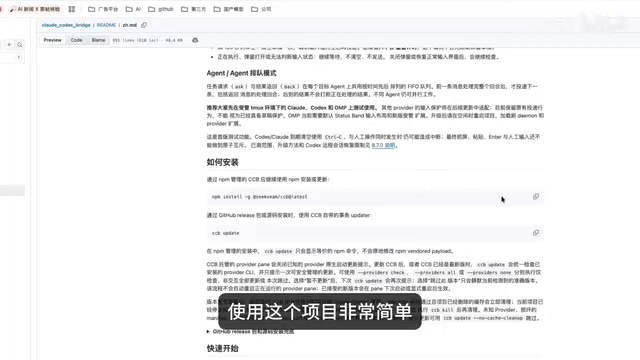
Task handoffs are handled through an ask mechanism, reducing manual copy-pasting. Multiple Agents share common project memory—the key to achieving a closed "plan-develop-review" loop. The project also offers auxiliary features: visual workspace configuration and remote control from your phone, letting users operate CCB directly from mobile to handle collaborative tasks.
Visual Configuration: Build a Collaboration Environment in Ten Minutes
Installation requires just one command; enter the project directory and run ccb to start. The creator demonstrated the settings panel: on the right, the Agent area lets you add multiple windows, customize names, and select corresponding models (Codex, Claude, Gemini, etc.), with support for adding and removing. The left sidebar lets you set position and width and control whether the terminal area is enabled.
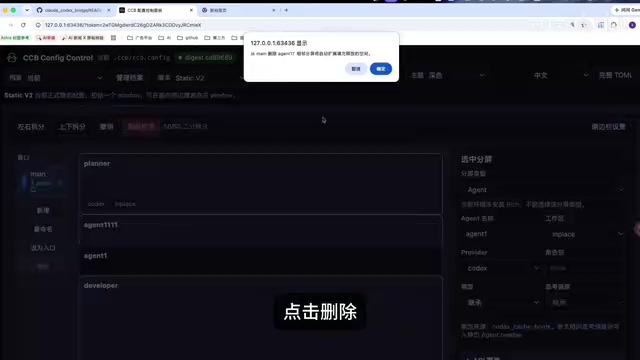
The creator configured two Agents: one using Codex (model selected as GPT-6.1.4.5) and another using Claude Code (actually calling the DeepSeekAd v4 model). Once the configuration is saved, you can proceed to collaboration testing.
The relationship between Agents and models: Codex, Claude Code, Gemini, Cursor, and others mentioned in the article are Agent products or coding assistants from different vendors, while the underlying models that actually drive them can be swapped. For example, the creator had Claude Code actually call DeepSeek v4, showing that an Agent is more like a "shell" with tool-calling, file read/write, and task-loop capabilities, while the model is its reasoning core. This decoupling lets users flexibly combine Agents and models based on cost, capability, or availability—and it's also the foundation for CCB's cross-vendor collaboration.
Hands-On Test: Codex Plans, Claude Develops, Automatic Acceptance
The test task was to create a "whistle-shaped 3D effect" webpage. After entering the prompt, Codex first generates a plan and asks about options like interactive webpage and style recommendations. After the user selects the recommended configuration, Codex completes the task planning and automatically delegates development to Claude.
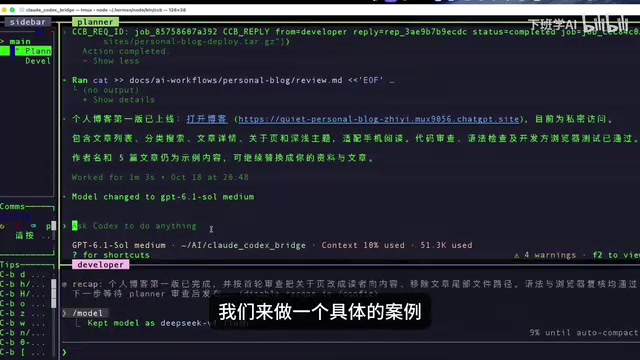
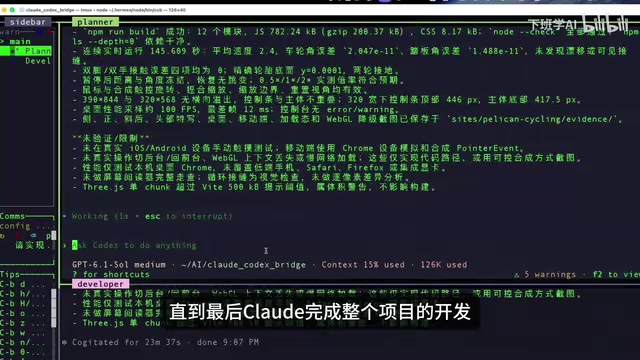
After Claude finishes coding, it notifies Codex for acceptance testing. Codex checks and finds issues, then sends fix tasks back to Claude, forming a "develop-review-fix" loop until Codex passes acceptance. The creator noted that both Agents share memory within the same project, and this collaboration approach helps mitigate single-model hallucinations.
The final output is a 3D car showcase page. The creator commented that "at first glance it looks pretty good—a bit like GPT's style," with wheel rotation, footlights and pedals, near and far views, and shadow effects all fairly realistic. Interestingly, the page was generated by the DeepSeek model while planning and review were done by Codex, showing that cross-model combinations can produce usable complex interactive pages.
The Value and Limitations of Multi-Agent Collaboration
From the demo, CCB solves the problem of "separating planning from execution." Codex excels at breaking down tasks and reviewing code, while Claude (or other integrated models) excels at generating code according to the plan, and the two reduce context-transfer loss through shared memory.
But the creator's test also revealed some boundaries: the task scale was small, and the number of review rounds and fix quality weren't detailed; there are no quantified data on multi-Agent communication latency and token consumption; and the actual stability of complex topologies (A calling B and C) still needs more validation. For developers wanting to try it out, this project offers a low-cost multi-model collaboration approach, suitable for personal projects and small-task experiments.
The project is open-sourced on GitHub with one-command installation; readers interested in multi-Agent collaboration can deploy and try it themselves.
What is "hallucination": In the context of large language models, hallucination refers to a model generating content that seems plausible but is factually incorrect or unsupported. In code generation tasks, hallucinations may manifest as calling non-existent APIs, inventing library functions, ignoring edge cases, or writing code that is logically self-consistent but actually cannot run. A single model often struggles to find its own errors because it lacks an independent external verification perspective.
Why separating planning from execution mitigates hallucinations: When one model is only responsible for breaking down tasks and reviewing results, and another model is only responsible for implementing according to the plan, the reviewer doesn't share the executor's generation path, making it easier to spot deviations from the requirements. This "generation-verification" separation is similar to code review practices in software engineering, reducing the probability of single-point errors being overlooked by introducing an independent perspective.
The role of shared memory: In multi-Agent collaboration, shared memory means each Agent can access the same project context (such as file state, task plans, and historical messages), avoiding the need to retransmit all background information at every handoff. It reduces errors from context loss and repeated descriptions, but also brings issues of context length inflation and increased token consumption.
One-line Summary
Open-source project CCB uses Codex for planning and review, Claude for coding, and shared memory to enable multi-Agent collaborative development.
Paragraph Summary
Open-source project CCB (Claude Codex Bridge), shared by a Bilibili creator, has gained 3.6K stars on GitHub. Its core is letting Agents from different vendors divide the work: Codex generates plans and reviews code, while Claude Code codes according to the plan, automatically delegating tasks through an ask mechanism and sharing project memory to form a "develop-review-fix" loop. The article covers CCB's visual configuration, one-command installation, and mobile remote control, and documents the creator's test where Codex planned and DeepSeek v4 powered Claude Code to ultimately generate a 3D car showcase page. The author believes this approach helps mitigate single-model hallucinations, but the task scale was small, and multi-Agent communication latency, token consumption, and complex topology stability still need more validation.
Related articles

iPhone Duo Hands-On: Is the $2,000 Small-Screen Foldable Worth It?
YouTube's Allison shares her iPhone Duo hands-on: dual-screen multitasking doubles efficiency, great video viewing, nice matte finish—but thick body, small outer screen, and a $2,000 luxury price.

Sentry's Ad Cracks Up Developers: Can On-call Actually Be Fun?
Sentry's ad short film taps into developers' on-call anxiety, using humorous dialogue to showcase its observability platform—errors, logs, traces, metrics, replays, and releases in one place.

LLM App Getting Worse With Every Change? Build an Effective Evaluation System in Three Steps
How do you know if your LLM app is getting better or worse? A Reddit-based guide to test sets, automated regression evaluation, LLM-as-judge scoring, and structured agent tracing.