Codex vs Claude Code Cost Test: Where Does the $0.30 vs $0.90 Gap Come From?

The same coding task costs 90%+ less through third-party Thrift channels, but the two sides still differ by about 3x.
Based on a hands-on test video, the article compares the cost of the same 30-minute heavy coding session on two tools: GPD 6.1 SOL on Codex via the OpenAI Thrift channel at about $0.30, and Clawed Opus 5.5 on Claude Code via the Clawed Thrift channel at about $0.90, versus official prices of $8 and $16. The low prices come from credit conversions at 96% and 94% discounts, with the gap mainly due to model pricing tiers rather than channel discounts. The author suggests dividing work: light, fast edits on GPD 6.1 SOL with its 0.2x burn rate multiplier, and deep multi-file refactoring on Clawed Opus 5.5, configuring both tools with one GEDECAN switch login. Check the Wanchu 30-minute health bar before starting; prices and status refresh every 60 seconds. Note that quotes change frequently, and short-window success rates don't guarantee long-session stability.
Same coding task, 3x difference on the bill
A 30-minute heavy coding session costs about $0.30 to run on Codex and about $0.90 on Claude Code. At official list prices, the same tasks would cost $8 and $16 respectively. The gap doesn't come from model capability — it comes from the channel and the way quota is converted.
In a hands-on test video, a YouTube channel put GPD 6.1 SOL on the left running Codex and Clawed Opus 5.5 on the right running Clawed Code, with price data taken from the live quote rows in the model marketplace. The logic of the comparison is clear: look at the unit price first, then the total bill, and finally give switching advice.
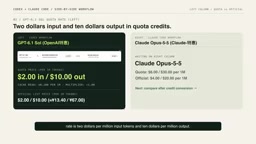
Left side: the cost structure of GPD 6.1 SOL running Codex
GPD 6.1 SOL goes through the OpenAI Thrift channel, with quota pricing of $2 per million input tokens and $10 per million output tokens. The key is the GEDECAN credit conversion ratio — $1 of credits converts to 0.25 yuan, so the actual payment works out to about 0.50 yuan for input and 2.50 yuan for output, 96% lower than the official rate.
This model's burn rate multiplier is 0.2x that of the GPT-6 Astra reference model, meaning the same call volume consumes less quota. Over the 30-minute window, the video shows its per-minute health bar at a 100% success rate throughout.
Calculating a heavy session of 3 million input tokens plus 200,000 output tokens, the left side totals 2 yuan, which at the page's exchange rate of 6.7 yuan to 1 dollar is about 30 cents, versus the official price of $8.
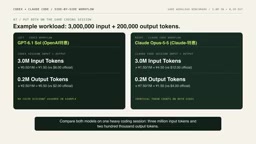
Thrift channel and quota conversion: The "Thrift channel" that appears repeatedly in the article refers to a third-party relay or shared-quota-pool style of API access. Its pricing isn't directly based on the model's official price list; instead, call volume is first converted into a platform-internal "quota" (such as GEDECAN credits), then settled according to the conversion ratio set by the channel. As a result, the same model can differ wildly in actual unit price across different channels. The final bill is the product of three factors: the quota conversion ratio, the burn rate multiplier, and the credit-to-dollar exchange rate — adjusting any one of them changes the total cost. The low prices of such channels usually stem from bulk purchasing, shared quota, or promotional subsidies rather than a price cut by the model vendor, so stability and rate limits become risk factors that need separate evaluation.
Burn rate multiplier: The burn rate multiplier is a coefficient that quota-based platforms use to measure how quickly different models "eat" quota, usually with some reference model set at a 1x baseline. A multiplier of 0.2 means the same token call volume deducts only 20% of the reference model's quota, equivalent to another 80% discount at the quota level. It's a separate dimension from the unit price discount: the unit price determines the nominal price per million tokens, while the multiplier determines the actual deduction amount — only the two combined give the real cost. Models with low multipliers suit high-frequency, quick-turnaround calls; models with high multipliers burn through quota faster on long-context, multi-turn reasoning tasks, so quota needs to be allocated according to task weight.
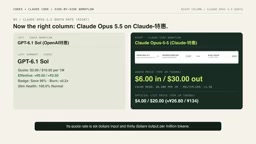
Right side: the cost structure of Clawed Opus 5.5 running Claude Code
The right side goes through the Clawed Thrift channel, with quota pricing of $6 per million input tokens and $30 per million output tokens. After the same credit conversion, the actual payment is about 1.50 yuan for input and 7.50 yuan for output, 94% lower than the official list price of $4.20.
At the same session volume, the right side totals 6 yuan, about 90 cents, versus an official price of $16. The unit price is about 3x higher, and the total bill is about 3x higher too — the discount levels of the two channels are close, and the gap mainly comes from the model's own pricing tier.
When to use which: switching by task type
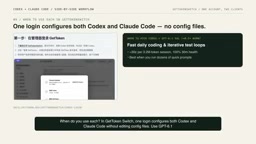
The video's advice is to divide the work: GPD 6.1 SOL's 0.2x burn rate multiplier suits quick everyday editing — low cost, low consumption; for deep multi-file refactoring, switch to Clawed Opus 5.5.
As for how to switch, GEDECAN switch lets you configure both Codex and Clawed Code with a single login, with no need to manually edit config files. For people using both tools at once, this saves the effort of maintaining two separate environments.
Check the health bar before you start
Before starting a session, the video advises checking the live 30-minute health bar on the Wanchu platform. If a particular thrift channel shows instability, the stable channel is right below it and you can switch directly. Prices and health status refresh every 60 seconds.
The implicit premise of this approach is that the low price comes from third-party channel quota conversion, not an official model price cut. Channel stability directly affects real-world usability, so the health bar isn't optional — it's a necessary check before using these low-price channels.
Health bar and success-rate monitoring: The health bar is a status indicator that visualizes the request success rate over a time window; a common approach is to count the proportion of successful responses among all requests in the last 30 minutes and color it by minute. For third-party channels, it reflects whether a channel is currently usable better than price does: when a channel becomes unstable, it usually shows up as a sudden drop in success rate or more timeouts rather than direct errors. Since prices and status usually refresh on a 60-second cycle, the health bar only reflects performance in a short window and can't represent stability midway through a long session. In practice you can treat it as a quick pre-run screening; for long tasks you still need to watch interruption rates and retries yourself.
A few takeaways
The value of this comparison isn't in the $0.30 figure itself, but in showing that the cost of the same task across different models and channels can differ by an order of magnitude. For developers who use coding agents heavily, allocating models by task weight saves more money than sticking with one model.
Keep in mind that the prices, credit conversion ratios, and discount levels in the video are based on the channel quotes at the time, and such numbers change frequently — always go by the live page in actual use. Also, the health bar shows the success rate within a short window, so the stability of long sessions still needs to be observed yourself.
Related articles

Nothing CMF Buds 2A Drops to $17.89 on Black Friday: A New Low for ANC Earbuds
Nothing CMF Buds 2A wireless earbuds Black Friday deal: just $17.89 on Amazon, about $11 off retail and a record low. ANC earbuds at an entry-level price.

When AI Creation Gets Accused of "Spitting": Hacker News Heats Up Over the Glaude Controversy
A Hacker News post, "Spitting in the Face of Glaude," sparks debate on AI creation transparency and attribution ethics. This analysis examines the blurred creator identity behind the controversy and offers practical advice for AI content production.

Akai Embraces Custom Firmware: MPC Sample 1.4 Lets Users AI-Program Their Sampler
Akai embraces the modding community with MPC Sample 1.4 firmware, supporting vibe-coded custom firmware and effects. We analyze the impact of this open strategy on music hardware and AI-assisted programming.