Codity: A Compound-Interest Codebase Intelligence Platform That Ends Siloed Analysis
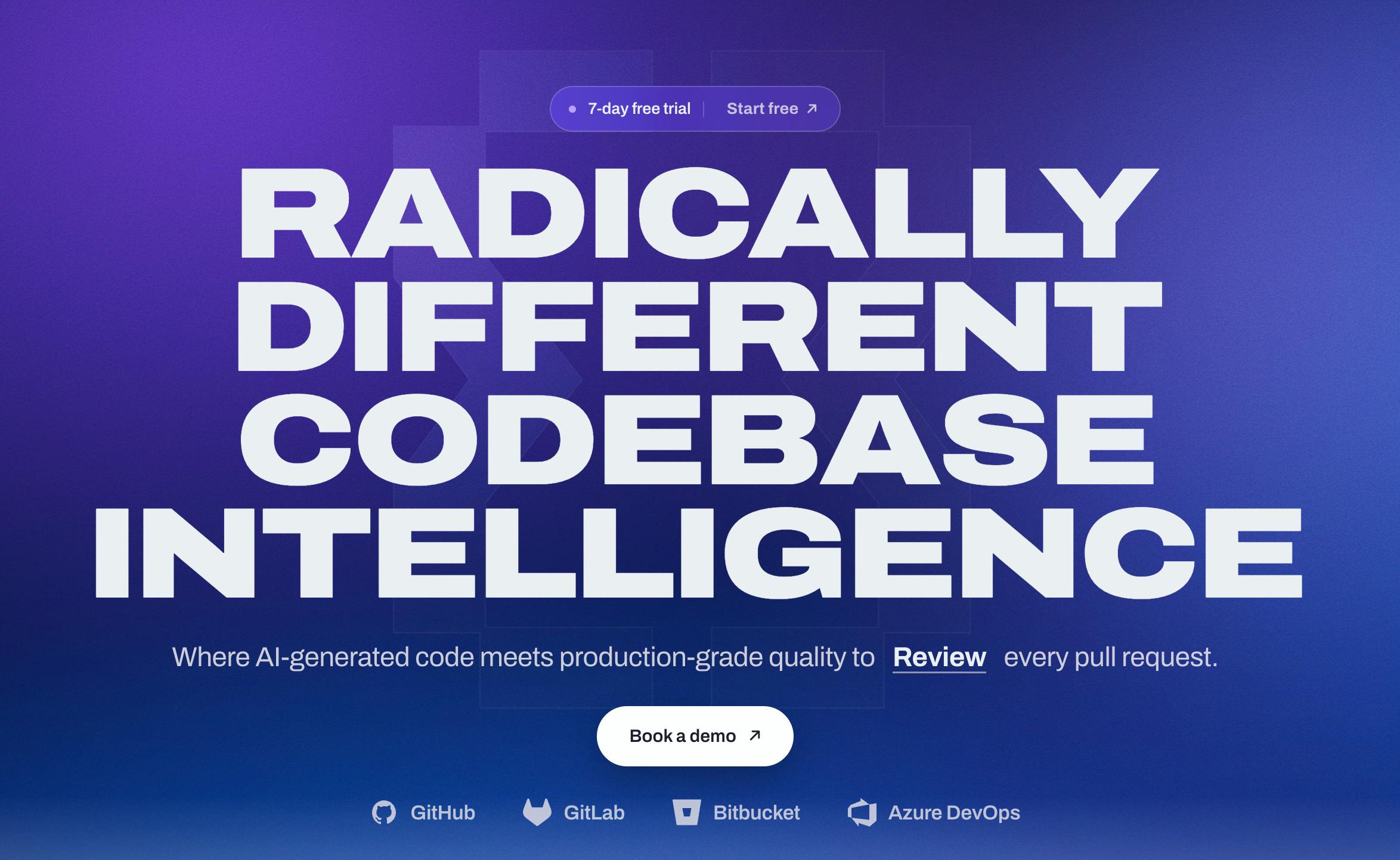
Codity builds persistent, compound-interest codebase intelligence by unifying all dev lifecycle signals.
Codity is a newly launched codebase intelligence platform that unifies code reviews, commits, tickets, security findings, and production outages into a single persistent knowledge system. Unlike traditional tools that lose context after each session, Codity's intelligence compounds over time, learning from a software's entire lifecycle to deliver increasingly precise insights. While the vision is compelling, challenges around heterogeneous data modeling, accuracy, and enterprise data security remain key hurdles.
From Siloed Analysis to Continuous Evolution: What Problem Is Codity Solving?
In an era of increasingly abundant software development tools, code analysis, code review, and security scanning tools have become standard team equipment.
The evolution of code analysis tools has gone through three major phases. The first generation consisted of static code analysis tools (like Lint and SonarQube), focused on finding code defects and rule violations. The second generation introduced dynamic analysis and security scanning (like Snyk and Checkmarx), capable of detecting vulnerabilities at runtime. The third generation integrated AI capabilities (like GitHub Copilot and Codex), offering intelligent code completion and generation. However, these tools universally suffer from a "stateless memory" problem — each analysis is independent and unable to learn from history. This forces teams to repeatedly handle similar issues, making knowledge accumulation highly inefficient.
These tools mostly share a common pain point: they handle each task in isolation, and once the current session ends, all accumulated context vanishes into thin air. Codity, which recently launched on Product Hunt, takes direct aim at this industry-wide chronic issue with a fundamentally different approach — letting codebase intelligence accumulate over time, growing like compound interest. Codity is attempting to pioneer a fourth-generation tool paradigm: an intelligent system with persistent memory and cross-dimensional correlation capabilities.
Codity's core slogan is "Radically Different Codebase Intelligence." The product currently has 60 upvotes on Product Hunt, ranking 19th, and is categorized under SaaS, Developer Tools, and Tech.
Codity's Core Design: A Unified Platform That Connects Everything
Codity's most compelling design philosophy is unifying all types of signals across the development lifecycle into a single platform.
In a typical software development lifecycle, different stages use different tool systems: Jira for requirements management, GitHub/GitLab for code hosting, Jenkins/CircleCI for CI/CD, Datadog/New Relic for monitoring, and dedicated SAST/DAST tools for security scanning. These systems operate in silos, creating severe data islands. A production incident might be related to a code review comment from three months ago, but traditional tools cannot establish this kind of cross-temporal correlation. Research shows that development teams use an average of 15–20 different tools, and engineers switch between 8–10 systems daily. This fragmentation not only reduces efficiency but also leads to the loss of critical contextual information.
According to the official description, every code review, every commit, every ticket, every security finding, and even every production outage is incorporated into a single shared, persistent codebase understanding system.
This means Codity no longer treats these events as disconnected, isolated tasks. Instead, it views them as components of a single "living knowledge" base. When a production outage occurs, the system not only records the event itself but also correlates it with related historical commits, review comments, and security alerts, forming a complete causal chain. This cross-dimensional correlation capability is precisely what traditional single-point code analysis tools lack.
Context Persistence: No More Vanishing with the Session
The Codity team states plainly in their introduction: "Most products analyze each task in isolation — their context disappears when the session ends." This statement precisely identifies a major weakness of current AI-assisted development tools.
The context window limitation of AI models is a fundamental technical constraint. Even GPT-4's 128K token window is far from sufficient for large codebases (which typically contain millions of lines of code). Traditional AI coding assistants use "session-level" context — once the conversation ends, all understanding is wiped clean. To deliver the "persistent understanding" Codity promises, several core technical challenges must be addressed: how to efficiently encode and retrieve massive codebase information (vector database technology), how to build long-term memory architectures (similar to LangChain's Memory module), and how to dynamically recall relevant historical context during inference (RAG — Retrieval-Augmented Generation technology). The engineering implementation of these technologies is extremely challenging, requiring a delicate balance between accuracy, real-time performance, and cost.
Whether it's code completion, bug detection, or automated review, many tools operate on a "use and forget" basis, unable to build long-term cognition about a specific codebase.
By contrast, Codity emphasizes that its intelligence "compounds over time." In other words, the longer a team uses it, the deeper its understanding of the codebase becomes, and the more precise its decision recommendations get. This represents a product philosophy evolving from "disposable tool" to "knowledge asset."
Learning from the Entire Software Lifecycle: Codity's Deeper Ambition
Codity's official positioning statement carries significant weight: "Codity doesn't just observe your software — it learns from your software's entire lifecycle and turns that knowledge into better decisions every day."
This statement reveals the product's deeper ambition. Traditional static code analysis tools focus on "what the code looks like right now," while Codity aims to understand "how the code evolved to its current state." It treats the development process itself — including the team's decision trails, the emergence and resolution of defects, and architectural iterations — as learnable material.
The "compound growth" Codity proposes is essentially about building a dynamically evolving code knowledge graph. In this graph, code modules, developers, commit records, bug reports, security vulnerabilities, and architectural decisions are all nodes, connected by edges representing causal relationships, temporal sequences, and semantic similarity. Over time, this graph continuously expands and strengthens: each incident analysis enhances the ability to recognize "fragile code patterns," and each successful refactoring accumulates "best practice" cases. This is similar to how human experts grow — the more experience they gain, the sharper their intuition becomes. Technically, this requires combining graph neural networks (GNN), temporal analysis, and causal inference, among other AI technologies. The challenge lies in preventing the accumulation of incorrect knowledge (similar to AI's "hallucination" problem) and handling knowledge migration after major codebase refactors.
Why Persistent Understanding Matters for Engineering Teams
For medium to large engineering teams, a codebase is often a complex system that has been maintained for years and passed through countless hands. Difficulty onboarding new members, inability to trace historical decisions, and recurring similar bugs — these are all common efficiency black holes. An intelligent platform that continuously accumulates and shares codebase understanding could, in theory, significantly reduce a team's "knowledge attrition" cost.
When a security vulnerability is fixed, that experience gets remembered by the system; when a similar pattern appears again, Codity can proactively raise an alert. This ability to learn from history and deliver forward-looking insights is the key value proposition that distinguishes it from one-time code analysis tools.
A Sober Assessment: The Gap Between Concept and Execution
As a new product that just debuted on Product Hunt, Codity currently showcases more of a product vision and philosophy than a mature capability validated at scale. The data points of 60 upvotes and 2 comments also indicate it's still in the early stage of gaining attention.
Several questions deserve deeper consideration:
- Heterogeneous data modeling: How can reviews, commits, tickets, security findings, and incidents — fundamentally different data types — be effectively unified in a single model?
- Balancing accuracy and noise: How can persistent "shared understanding" strike the right balance between accuracy and information noise?
- Data security and trust costs: In an era of growing emphasis on data security and privacy, how will teams evaluate the trust cost of aggregating their entire development lifecycle data onto a single platform?
Aggregating a company's complete development lifecycle data onto a single SaaS platform involves significant security and compliance risks. First, there's intellectual property protection: core code and architectural decisions are among an enterprise's most valuable assets, and any leak could be fatal. Second, there's privacy compliance: code commit records may contain personal information that must be strictly controlled under regulations like GDPR and CCPA. Third, there's supply chain security: AI training data poisoning, model backdoors, and other emerging attack vectors are attracting attention from security researchers. For heavily regulated industries like finance and healthcare, using cloud-based code analysis services may face regulatory scrutiny. Codity needs to offer enterprise-grade security features such as private deployment, data anonymization, audit logs, and zero-knowledge proofs to win the trust of large customers. This is also why GitHub Copilot's enterprise version emphasized that "your code won't be used to train public models."
These are all critical factors determining whether Codity can evolve from a "beautiful concept" into a "productivity tool." That said, the direction of "compound-interest codebase intelligence" it proposes genuinely addresses a real need in AI-era software engineering — what we need isn't just smarter one-time analysis, but engineering intelligence that can accompany teams long-term and grow continuously.
Conclusion: Codity Represents the Next Direction for Developer Tools
Codity represents a noteworthy evolutionary trend in the developer tools space: moving from isolated, ephemeral code analysis toward connected, persistent, compound-interest intelligence accumulation. In a landscape flooded with AI coding assistants, how to make tools truly "remember" and "understand" a team's codebase may be the core battleground for the next phase of competition.
Whether Codity can deliver on its promise of "radically different codebase intelligence" remains to be proven by time and practice, but the questions it raises are worth deep reflection across the entire industry.
Related articles
AI Agent Cost Optimization in Practice: Engineering Wisdom That Saved $1 Million in One Hour
Databricks eliminated $1M/year in wasted AI Agent spend in just one hour. Learn the root causes of Agent cost overruns and key strategies like model tiering, context pruning, and caching.
How the FDA Is Building an AI-Ready Data Foundation on Databricks
Explore how the FDA leverages Databricks for Government to build a unified Lakehouse architecture and AI-ready data foundation while meeting federal security and compliance standards.
The Power of Security Collaboration: Why Vulnerability Discovery Cannot Do Without Human Intelligence
Explore how security collaboration outperforms tool dependency, the value of vulnerability stories, cross-team knowledge sharing practices, and building stronger defenses by investing in people and collaboration.