Cognition Devin vs Cursor: How to Choose the Right AI Coding Agent

Devin is an AI engineer you delegate tasks to; Cursor is a smart editor that collaborates alongside you—choose by team habits.
The article compares Cognition Devin and Cursor: Devin delegates complete tasks—receiving tasks from Slack or Linear, planning, coding, testing in a browser, and opening PRs—Pro at $20/month; Cursor is a VS Code-based smart editor with Tab-predicted edits, Plus from $8/month. They overlap heavily in browser testing, cloud agents, PR review, model options, and SOC 2. The real difference is entry point and workflow. Devin's living wiki and cross-session memory differentiate it. Choose by whether your team "assigns work" or "edits hands-on," and validate first with free plans.
Two Starting Points, One Goal: AI Writes Code for You
When AI agents start participating in software development, tool choice is no longer just a matter of editor preference. Both Cognition's Devin and Cursor bring AI agents into the coding workflow, but their design philosophies are fundamentally different—one is an "AI engineer" to whom you hand off complete tasks, the other is a "smart editor" that writes code alongside you. According to a comparative analysis by the YouTube channel Agentic Index, understanding this fundamental difference is the first step in making a choice.

AI Agent in this context refers to a software system capable of autonomously planning, executing multi-step operations, and adjusting based on feedback—unlike a chatbot that only responds to a single prompt. Coding agents typically have tool-calling capabilities (reading/writing files, executing commands, browsing the web) and can independently complete the loop from understanding requirements to submitting code. Both Devin's and Cursor's agents run in cloud sandboxes or local environments, but the former uses "tasks" as its unit of interaction, while the latter uses "editor sessions." Understanding the agent's degree of autonomy (whether human step-by-step confirmation is required) and where it runs (local or cloud) is key to judging which workflow it suits.
Cognition Devin: The AI Engineer You Delegate Tasks To
Devin's positioning is clear: you throw it a task from Slack, Linear, or a chat window, and it plans the steps, writes the code, tests in its own browser, and finally opens a Pull Request. It maintains a "living wiki" for each repository and remembers developer preferences across sessions.
On pricing, Devin Pro is $20/month and includes a certain quota, with prepaid credits beyond that; there's a free plan; the Max tier is $200/month; and the Teams plan starts at $80/month. This model suits teams that want to delegate whole chunks of work and get back a tested PR.

Pull Request (PR) is the merge-request mechanism on code hosting platforms (such as GitHub): a developer submits changes on a branch, requests they be merged into the main branch, and thereby triggers code review, automated tests, and discussion. For an AI agent, opening a PR means it not only generates code but also follows the repository's branching conventions and commit message formats, and accepts the same review process as human developers. By using PRs as its deliverable, Devin effectively embeds itself in the existing code review culture—teams can control merge permissions through approval rules and guardrails, which is one of the governance aspects enterprises care most about when adopting AI coding tools.
Cursor: The Editor That Fights Alongside You
Cursor is built on VS Code, and its core experience is Tab predicting your next edit, while the agent can collaborate with you inside the editor or in the cloud. According to the source material, since October Cursor has been sold as part of the X subscription lineup, alongside Grok.
The pricing structure is more granular: Plus at $8/month includes only Grok models; Premium at $30/month includes Cursor's own Grok and Composer models, with other models billed at API list prices; Super at $100/month; Ultra at $200/month; Teams from $30/seat/month. If your team mainly uses Claude, GPT, or Gemini, you'll need to pay by usage—these external models have no quota included in the plans.
Tab-predicted edits are Cursor's core interaction innovation: the model predicts the code the developer is about to write based on cursor position, recent edits, and repository context, presenting it as gray ghost text that you accept by pressing Tab. Unlike traditional autocomplete (which only completes the current line or symbol), it can predict multi-line changes, jump to related locations in another file, and even infer tests or type definitions that need to be updated in sync based on the code just changed. This "next-edit prediction" pulls AI out of the chat window and back into the typing flow, reducing the cost of context switching—and it's the experiential foundation that distinguishes Cursor from task-delegation agents.
Underlying Capabilities Overlap Heavily
The differences between the two lie more in the entry point and workflow than in underlying capabilities. The source material points out that both test work results in a real browser, both can launch cloud background agents from Slack, GitHub, or scheduled tasks, both support PR review, approval rules and guardrails, optional Anthropic/OpenAI/Google models, and both have SOC 2 and single sign-on. In other words, gaps in security and automation infrastructure don't constitute a decisive factor.
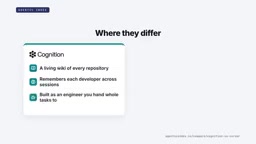
Decision Logic: Task Delegation or Editor Enhancement
According to Agentic Index's recommendation, if you want to delegate complete tasks and get back tested PRs, choose Cognition; if you want developers to have a better editor with Tab-predicted edits, manage a fleet of cloud agents from a single agent window, and a model of starting at $8/month for Grok models with other models billed at API prices fits your procurement habits, choose Cursor.
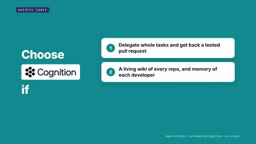
One notable detail: the source material mentions that "if there's no living wiki available, you can use Cursor to implement it"—hinting at a gap in knowledge-capture capability, with Devin's repository-level memory being its differentiating selling point.
A Key Judgment the Source Material Obscures
Agentic Index claims its research covers over a thousand AI agent vendors and does not accept paid rankings; this is one of 120 coding agent comparisons. But a caveat: the source material's conclusion section contains a large amount of repetitive text, and some statements (such as "added to X subscription in October") lack year context, so readers should refer to official pricing pages when consulting it.
The real decision variable is actually the team's working habits: teams accustomed to "assigning work" will benefit from Devin's end-to-end delivery; teams accustomed to "hands-on editing" will find their rhythm in Cursor's in-editor collaboration. Both have free plans—running a round with real tasks is more reliable than looking at any comparison table.
SOC 2 is a service organization controls audit standard developed by the American Institute of Certified Public Accountants (AICPA), focusing on evaluating a company's controls over security, availability, processing integrity, confidentiality, and privacy. For AI coding tools, a SOC 2 Type II report means their cloud agent runtime environments, code data processing, and access controls have undergone independent audit—a common compliance threshold in enterprise procurement. Single sign-on (SSO) allows teams to centrally manage accounts and permissions through identity providers (such as Okta or Google Workspace). Together they form the infrastructure requirements for enterprise-level procurement, and they're also the area where Devin and Cursor heavily overlap in underlying capabilities.
One-line Summary
Devin is the AI engineer you delegate tasks to; Cursor is the smart editor that collaborates alongside you—the choice depends on team habits.
Paragraph Summary
The article compares the design philosophies of two AI coding tools: Cognition Devin and Cursor. Devin is positioned as an AI engineer to whom you can delegate complete tasks—after receiving a task from Slack or Linear, it automatically plans, codes, tests in a browser, and opens a PR, with Pro at $20/month. Cursor is a smart editor built on VS Code, known for Tab-predicted edits and agent collaboration, with Plus starting at $8/month. The two overlap heavily in browser testing, cloud background agents, PR review, model optionality, and SOC 2 compliance; the real difference lies in the entry point and workflow. Devin's repository living wiki and cross-session memory are its differentiating capabilities. The article recommends teams choose based on whether their working habit is "assigning work" or "hands-on editing," and validate with real tasks using the free plans first.
Related articles

OpenAI Partners with Shield: How the Astra Agent Revolutionizes IT Troubleshooting
OpenAI and Shield launch the Astra agent, which autonomously logs into computers and legacy systems to fix IT issues in real time, 35-40% faster than traditional models, with humans involved only when judgment is needed.

iPhone Duo Battery Life Tested: One Charge a Day Is Unavoidable, and the Large Screen Is the Culprit
iPhone Duo battery test: heavy use needs at least one charge a day, and about 30% remains after 6.5 hours of screen-on time. How often the large screen is unfolded is key; a MagSafe battery pack helps, and long-term degradation is also worth watching.

Kimi K3.1 Pro Open-Sourced: 2.8 Trillion Parameters Close In on Opus
Moonshot releases the open-source MoE model Kimi K3.1 Pro, with 2.8T total parameters and 104B activated, trailing Opus 5.5 by under 1 point on Terminal Bench 4.0.