Commanding AI to Write Code via Walkie-Talkie: A walkai-talkai Hands-On

Command AI coding by voice via walkie-talkie, local Whisper transcription for privacy, buyout-model geek tool
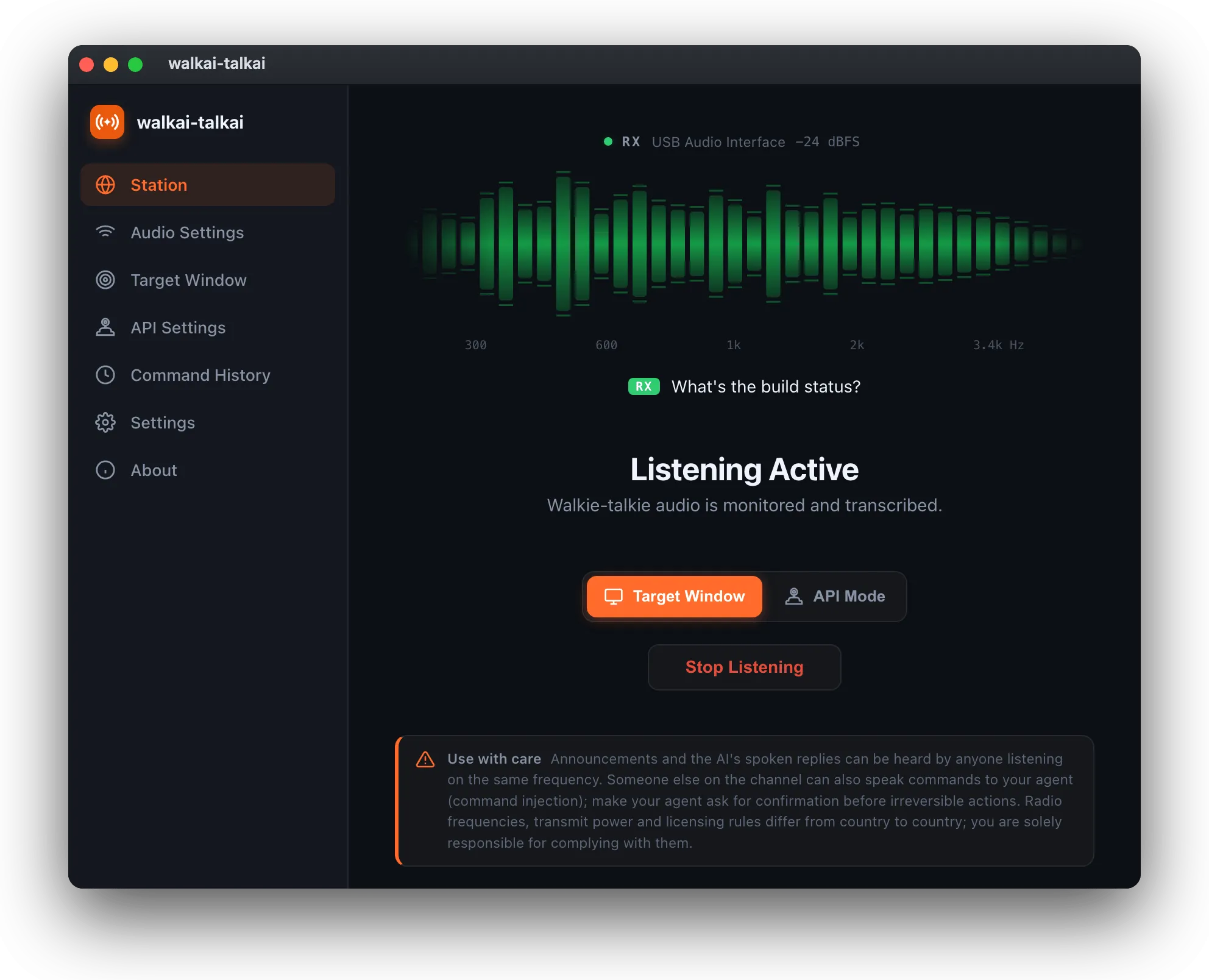
walkai-talkai is a new product that drives AI coding tools with a walkie-talkie PTT button: the user holds the walkie-talkie and speaks, the Mac locally uses Whisper to convert speech to text, then inputs it into Cursor, Claude Code, Antigravity, or directly calls the APIs of OpenAI, Anthropic, Gemini, DeepSeek, or Ollama. The AI's answer is synthesized into neural speech and "spoken" back over the radio waves, accompanied by VOX prompt tones and a roger beep. Its core selling point is a local-first privacy design—audio never leaves the machine, and only text commands go to the cloud; choosing Ollama enables a fully offline workflow. The product supports only macOS 13+ Apple Silicon, is a one-time buyout with no subscription, and received 73 upvotes on Product Hunt. Speech transcription accuracy and the readability of code when spoken remain key to the experience.
Press the PTT button on a walkie-talkie, speak your request into it, and a few seconds later the AI coding assistant not only understands your instruction but also "speaks" the answer back to you over the radio waves—this isn't science fiction, but the real experience delivered by a new tool called walkai-talkai.
When AI Programming Meets the Walkie-Talkie
The core idea behind walkai-talkai is simple: use the most "primitive" interaction method—voice push-to-talk—to drive the most cutting-edge AI coding tools. The user presses the PTT (Push-To-Talk) button on any handheld walkie-talkie and speaks; the tool transcribes the speech to text locally on the Mac using the Whisper model, then feeds the command into Cursor, Claude Code, or Antigravity, or directly calls the APIs of OpenAI, Anthropic, Gemini, DeepSeekAd, or Ollama. The AI's response is converted into neural speech and "spoken" back over the radio waves, complete with a VOX prompt tone and the classic roger beep at the end.
This design may seem "retro," but it actually targets a real pain point: programmers often find it inconvenient to type when debugging, brainstorming, or when their hands are occupied. The walkie-talkie-style interaction turns the "input—wait—read" loop into a purely voice-based real-time conversation, completely freeing up the hands.
Whisper is an automatic speech recognition (ASR) model open-sourced by OpenAI in 2022. It supports multilingual transcription and translation and comes in multiple sizes ranging from tiny to large. Its biggest feature is robustness—it maintains relatively high accuracy in noisy environments, with accent differences, and against background noise. Whisper can run fully offline; once the model weights are downloaded, inference requires no internet connection, making it the preferred solution for local, privacy-sensitive scenarios. On Apple Silicon Macs, with optimized implementations such as Core ML or whisper.cpp, transcription speed can approach real time. walkai-talkai leverages Whisper's local inference capability to convert speech to text on the Mac, sending only the text commands to the cloud model.
PTT (Push-To-Talk) means "press to talk," the classic interaction method of radio walkie-talkies: while the button is held, the microphone is on and a signal is transmitted; releasing it stops transmission. Its companion VOX (Voice-Operated Exchange) requires no button press—it automatically starts transmitting when sound is detected. The roger beep is a short tone sent at the end of a communication, originating from early radio communication etiquette to signal the other party that "the message has ended and you may reply." walkai-talkai replicates these audio feedback cues not merely for nostalgia, but to use auditory signals in place of visual confirmation, so that users in a purely voice-driven loop clearly know "the AI has started answering" or "the answer has ended," reducing cognitive load when their hands are occupied.
Local-First Privacy Design
What you may not have noticed is its approach to privacy. According to the product description, all radio audio never leaves your Mac—speech transcription is done entirely locally via Whisper, and only the transcribed text commands are sent to the cloud model (if you choose a cloud API). This means that even if you use OpenAI or Anthropic, your voice data is never uploaded.
For developers who care about the privacy of their code and conversations, this is a rather attractive compromise: it retains the capabilities of cloud large models while keeping the most sensitive audio data local. Of course, if you choose Ollama as the backend, the entire workflow can run completely offline—even the text commands never leave the machine.
Ollama is an open-source framework for running large models locally. It supports one-click download and execution of open-source models such as Llama, Mistral, Gemma, and DeepSeek on Mac, Linux, and Windows, and provides a local API interface similar to OpenAI's. Choosing Ollama as the backend means both speech transcription (Whisper) and text inference are performed on the local machine, with the entire pipeline requiring no network requests—suitable for scenarios with extremely high code confidentiality requirements. However, the code generation capability of local models is usually weaker than that of cloud flagship models such as GPT-4 or Claude, so users must weigh privacy against capability. walkai-talkai supports both cloud APIs and Ollama, precisely leaving this trade-off to the user.
Compatibility and Barriers to Use
In terms of hardware and software requirements, walkai-talkai is limited to Macs with macOS 13 or later and Apple Silicon chips. This limitation is reasonable but not exactly friendly—Intel Mac users and Windows/Linux developers cannot use it for now. Considering that the target users are users of modern AI coding tools like Cursor and Claude Code, Apple Silicon Macs have high coverage, so this trade-off is understandable.
The supported AI backends are quite rich: in addition to the three coding agents mentioned earlier—Cursor, Claude Code, and Antigravity—it can also connect directly to the APIs of five mainstream models. This "agent + direct connection" dual-mode design lets users flexibly switch based on task complexity—simple Q&A goes directly to the model, while complex coding tasks are handed to a dedicated coding agent.
Apple Silicon refers to the ARM-based self-designed chips (M1, M2, M3, M4 series) that Apple has used in Macs since 2020. Its unified memory architecture and Neural Engine are extremely friendly to local AI inference, and models such as Whisper run far more efficiently on Apple Silicon than on Intel Macs. macOS 13 (Ventura) is the system version released in 2022, which introduced several framework updates related to machine learning. Requiring macOS 13+ and Apple Silicon essentially means requiring a device with sufficient local inference performance and newer system APIs, which also explains why Intel Mac and Windows/Linux users are excluded—local Whisper transcription is an indispensable part of this tool.
Pricing and Market Positioning
walkai-talkai adopts a one-time purchase lifetime license model with no subscription fee. In today's environment where SaaS subscriptions are rampant, this feels rather refreshing—especially for a personal productivity tool, the buyout model lowers long-term usage costs and avoids "subscription fatigue."
According to Product Hunt data, the product received 73 upvotes, ranking 14th for the day, and is categorized under Developer Tools, Radio, and Vibe coding. The vote count isn't explosive growth, but the "Vibe coding" label precisely captures the current trend—using natural language and even voice to drive programming, making the development process feel more like a conversation than typing.
A Few Questions Worth Considering
The actual efficiency of walkie-talkie interaction in programming scenarios remains to be verified. The accuracy of speech transcription, the readability of AI answers when spoken (how well do code snippets come across when "spoken" aloud), and recognition performance in noisy environments are all key to whether the experience succeeds. The product claims to use neural speech and VOX prompt tones to optimize auditory feedback, but whether highly structured content like code is suitable for purely voice output remains an open question.
Another question is the depth of workflow integration. How exactly is the command "input into Cursor" implemented—keyboard simulation or some kind of API? This determines whether it can stably adapt to changes in Cursor's interface. The original material doesn't provide details, so actual experience may require users to verify for themselves.
Nevertheless, walkai-talkai represents an interesting kind of exploration: at a time when AI coding tools are becoming increasingly homogeneous, innovation in interaction methods may change developers' daily experience more than tiny improvements in model capability. Commanding AI to write code via a walkie-talkie sounds like a geek toy, but the product logic behind it—"free your hands, voice first"—may be a slice of the future of programming interaction.
One-line Summary
Command AI coding by voice via walkie-talkie, local Whisper transcription for privacy, buyout-model geek tool
Paragraph Summary
walkai-talkai is a new product that drives AI coding tools with a walkie-talkie PTT button: the user holds the walkie-talkie and speaks, the Mac locally uses Whisper to convert speech to text, then inputs it into Cursor, Claude Code, Antigravity, or directly calls the APIs of OpenAI, Anthropic, Gemini, DeepSeek, or Ollama. The AI's answer is synthesized into neural speech and "spoken" back over the radio waves, accompanied by VOX prompt tones and a roger beep. Its core selling point is a local-first privacy design—audio never leaves the machine, and only text commands go to the cloud; choosing Ollama enables a fully offline workflow. The product supports only macOS 13+ Apple Silicon, is a one-time buyout with no subscription, and received 73 upvotes on Product Hunt. Speech transcription accuracy and the readability of code when spoken remain key to the experience.
Related articles

A New Paradigm for Text Editing in Compose: TextFieldState Replaces the Old API
Jetpack Compose introduces the TextFieldState API to fix dropped characters and cursor jumps from async input. The old value/onValueChange callbacks will be deprecated in 1.13. This article covers InputTransformation, OutputTransformation, four state hoisting patterns, and new formatted text editing capabilities.

Remote Compose: A New Document-Driven Paradigm for Cross-Platform UI on Android
Remote Compose transmits compact binary documents instead of screen pixels, enabling efficient UI rendering on remote surfaces like Wear OS and widgets. This article covers its document creation API, expression animations, size optimization techniques, and Wear OS progress.

How Crashlytics Eliminates Android Memory and Responsiveness Issues
Through the Chroma Clip case study, this article explains how Firebase Crashlytics uses Application Exit Info, Profiling Manager, GWP ASAN, and ARM MTE to pinpoint ANRs, OOMs, memory limit terminations, and native memory corruption—solving the challenge of stack traces that don't point to the real culprit.