Commodore 64 Hardware-Level Emulator: Burn Chips and Pins, Watch the Results in Real Time

A C64 hardware-level emulator where you can "break things," making chip and pin faults hands-on verifiable.
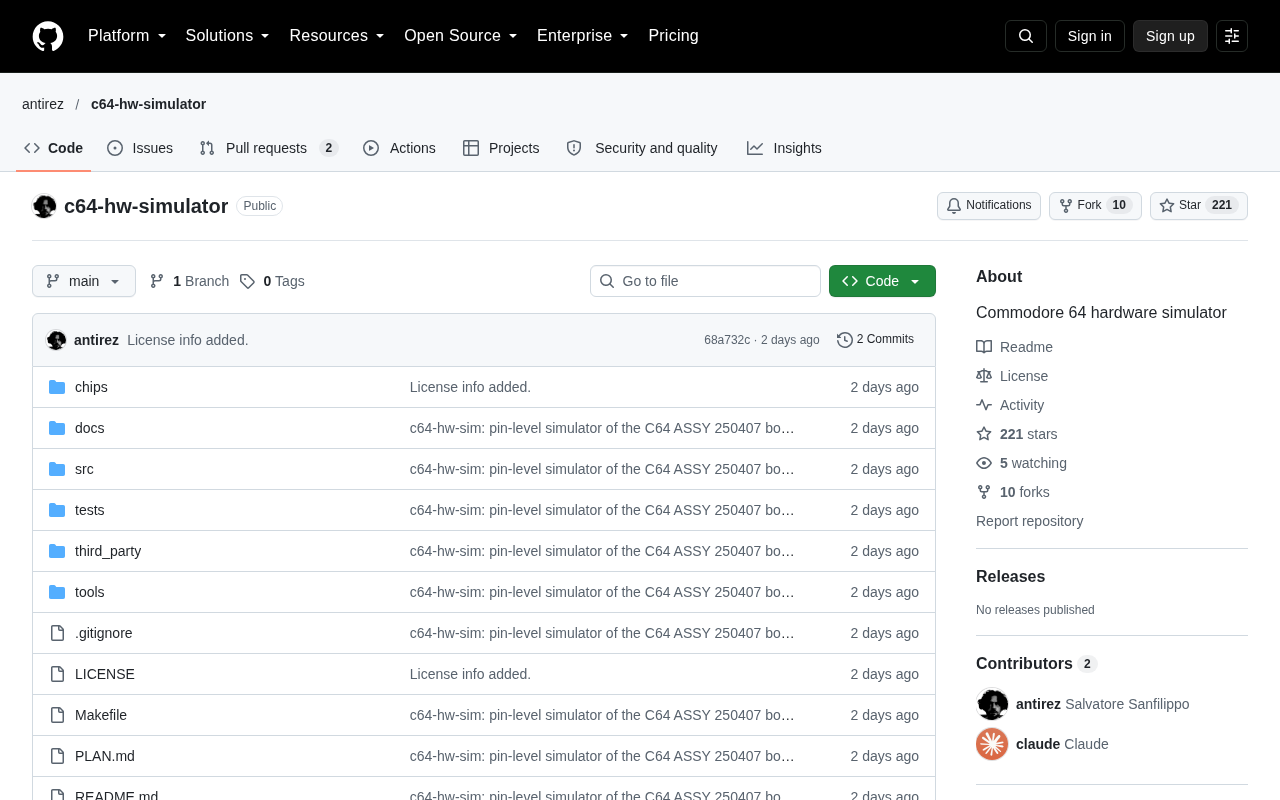
This hardware-level emulator for the Commodore 64 pushes abstraction from software behavior down to chips and pins, letting users disconnect wires, create bus contention, and even simulate chip burnout while watching screen, program, and bus reactions in real time. Unlike software-focused emulators like VICE, it serves the need to "understand the machine." Its value lies in digital circuit teaching, fault injection research, and debugging intuition for retro hardware—turning high-risk experiments requiring real machines into a zero-cost, repeatable web sandbox. Accuracy depends on modeling scope, so it's better for teaching than real repair.
A hardware-level emulator for the Commodore 64 has drawn attention in the tech community. It doesn't just run software—it lets you "destroy" chips and pins and immediately observe how the system reacts. For retro computing enthusiasts and hardware learners, it's like putting an infinitely resettable C64 motherboard in your browser.
From Software Emulation to Hardware-Level Emulation
Common C64 emulators (like VICE) aim to faithfully run old games and programs on modern devices, focusing on CPU, memory, and I/O behavior at the software level. This emulator pushes the abstraction level down to chips and pins: every logic chip and every signal line has its own independent state, and users can actively introduce faults.
According to discussions on Hacker News, the value of such projects is turning "what happens if this wire breaks" into a question you can verify hands-on, rather than leaving it to speculation on a schematic.
VICE (VersatIle Commodore Emulator) is the most mainstream software emulator in the C64 community—cross-platform and open source, aimed at running commercial software and games with high compatibility on modern systems. It emulates the CPU and some custom chips with cycle accuracy, but typically uses behavioral-level abstraction for the discrete logic chips on the motherboard—that is, it only cares about functional correctness and doesn't track the voltage level of every trace. Hardware-level emulation is different: it models every 74-series logic gate, every bus, and every tri-state output as an independent object, so it can express real electrical phenomena like signal contention, floating pins, and short circuits. The trade-off between the two is performance versus observability: behavioral-level emulation is fast and easy to maintain, while hardware-level emulation is computationally heavy but can answer questions like "what happens physically."
What Burning Chips and Pins Means
The emulator lets users disconnect pins, make chips output conflicting signals, and even simulate chip burnout. The system provides real-time feedback: whether the screen glitches, whether the program crashes, whether the bus enters an abnormal state.
This brings two direct uses. The first is education: concepts like "bus contention" and "tri-state gates" in digital circuit courses are costly and risky to demonstrate on real hardware, but in the emulator they're zero-cost and repeatable. The second is training debugging intuition: when repairing old machines, faults often come from some inconspicuous pin, and the emulator lets people build causal intuition first.
A tri-state buffer is key to understanding bus contention. A regular logic gate outputs only high or low, while a tri-state gate adds a high-impedance state, effectively "disconnecting" the output from the line, allowing multiple devices to share the same bus and take turns driving it. If two tri-state gates are enabled simultaneously and output opposite levels, bus contention occurs: one pulls high, the other pulls low, producing large currents and indeterminate levels, which on real hardware can cause heat and even damage chips. In the emulator, this contention can be safely reproduced, and users can observe how the bus level is pulled toward an intermediate value, what downstream chips read, and how the system ultimately behaves abnormally—exactly the part of digital circuit teaching that's hard to demonstrate with physical hardware.
Why the Retro Hardware Community Cares
The C64's hardware documentation is highly public—schematics, chip datasheets, and memory maps are all available, which provides fertile ground for hardware-level emulation. There's a long-standing need in the community: not "playing old games" but "understanding this machine."
According to feedback in the Hacker News comment section, similar tools are valuable for homebrew hardware, FPGA recreations, and fault injection research. It lowers the barrier to hardware experimentation from "needing a real machine and a pile of spare parts" to "opening a webpage."
Fault injection is a systematic reliability research method: intentionally introducing breaks, shorts, bit flips, or timing skews into a circuit and observing whether the system can detect, tolerate, or recover. It's widely used in aerospace, automotive, and server chip validation, but usually relies on expensive test platforms. The C64 hardware-level emulator brings the same idea to a consumer-level setting: researchers can inject pin-level faults in bulk, record system responses, and use them to build fault models or validate diagnostic algorithms. The FPGA recreation community benefits too—testing extreme conditions in the emulator before porting schematics into programmable logic can reveal flaws in design assumptions early.
Limitations and Positioning
The accuracy of hardware-level emulation depends on the scope of modeling. Whether the analog behavior and timing details inside chips are complete directly determines whether the emulation results correspond to real faults. Currently, such projects are better suited as teaching and exploration tools than as replacements for real repair diagnostics.
For ordinary users, its appeal may be limited; but for those who want to understand how the C64 actually works, it's a rare sandbox where you can "break things."
Key Points
- Emulation level goes down to chips and pins, supporting active fault injection
- Real-time feedback makes digital circuit concepts hands-on verifiable
- Suitable for teaching, fault injection research, and understanding retro hardware
- Accuracy is limited by modeling scope; not yet a substitute for real repair
One-line Summary
A C64 hardware-level emulator where you can "break things," making chip and pin faults hands-on verifiable.
Paragraph Summary
This hardware-level emulator for the Commodore 64 pushes the abstraction level from software behavior down to chips and pins, allowing users to disconnect wires, create bus contention, and even simulate chip burnout while observing screen, program, and bus reactions in real time. Unlike emulators like VICE that aim to run software, it serves the need to "understand the machine." Its value centers on digital circuit teaching, fault injection research, and training debugging intuition for retro hardware, turning high-risk experiments that once required real machines and spare parts into a zero-cost, repeatable web sandbox. However, its accuracy depends on modeling scope, making it better suited for teaching and exploration than as a replacement for real repair diagnostics.
Related articles

Gemini 4 Argon Hands-On: AI Builds Board Games, Constructs Temples, and Trains Robots Autonomously
Gemini 4 Argon hands-on roundup: AI autonomously builds a desk racetrack and temple in Blender, writes a ray tracing engine, trains a humanoid robot to sink 7 shots, plus API pricing and developer access.

The Magic Octagonal Coin: Why Only 9% of People Can Predict Its Flip?
Only 9% of people can correctly predict the Magic Octagon coin flip. This article explains its spatial rotation mechanism, common cognitive pitfalls, and a new hypothesis based on Relevance Theory, exploring the limits of human spatial reasoning.

Sam Altman: AI Is Entering the Era of Scientific Discovery — Math Breakthroughs Will Replicate in Biology and Energy
Sam Altman says AI is entering the era of scientific discovery — math breakthroughs will replicate in biology, materials science, and energy to help develop new drugs and energy sources.