Communicating Uncertainty to Large Models: A New Use for Auxiliary Evidence

Communicating the uncertainty of auxiliary evidence to foundation models significantly improves downstream classification decisions.
This paper systematically studies the value of communicating the uncertainty of auxiliary information to foundation models in prompts. Traditional prompt engineering treats auxiliary evidence as established fact, discarding its source and confidence. Using zero-shot image classification, the researchers evaluated uncertainty from human judgment and learned models across three datasets and five foundation models. Communicating uncertainty improved macro-averaged F1 by up to 26.18 points, and auxiliary uncertainty itself carries predictive information about decision correctness. The authors call for systematically considering uncertainty communication in inference pipelines and note that open-ended generation tasks and general expression formats remain to be explored.
What Do Traditional Prompts Leave Out?
When we ask a large language model (LLM) or vision-language model (VLM) a question, we often attach some contextual information as auxiliary evidence. For example, we might ask the model to classify an image while providing a text description as a reference. But there is a long-overlooked problem here: this auxiliary information may itself be uncertain—it may come from a human's fuzzy judgment or from the probabilistic output of some learned model.
Conventional prompt engineering usually hands auxiliary information to the model directly as established fact, discarding the uncertainty associated with it. A new paper systematically points out that this practice wastes valuable information. The researchers are the first in the literature to demonstrate that communicating uncertainty alongside the information to foundation models can provide additional clues for downstream decisions and yield performance gains across a wide range of scenarios.
Foundation models refer to large models pre-trained on large-scale, diverse data, such as large language models (LLMs) and vision-language models (VLMs), which can be adapted to a variety of downstream tasks through prompts. In prompt engineering, auxiliary information is often directly restated as a deterministic natural-language statement, such as "there is a cat in the image," without indicating whether the description comes from fuzzy human judgment or the output of a probabilistic model. This "determinization" processing discards the information's source, credibility, and uncertainty, preventing the model from adjusting its reasoning weights accordingly.
Experimental Design: Validating the Value of Uncertainty with Image Classification
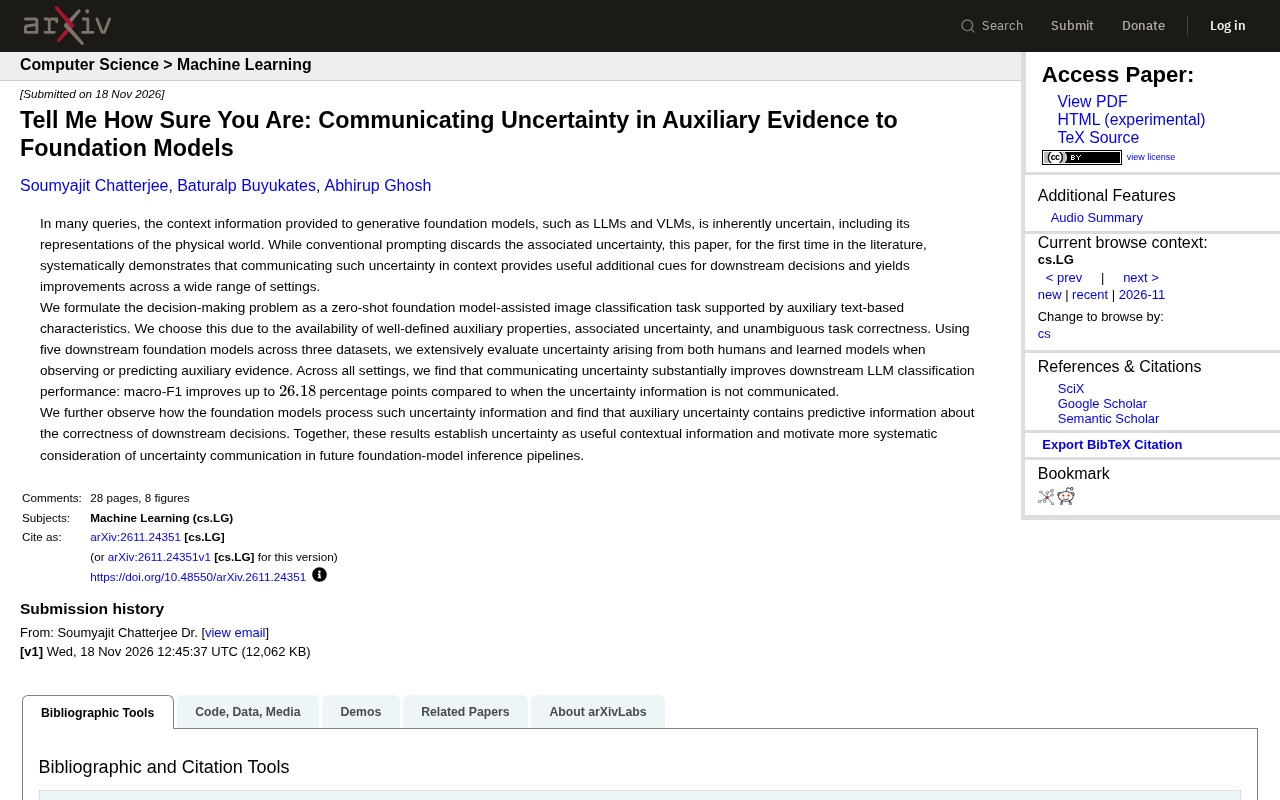
To cleanly validate this idea, the researchers formalized the problem as a zero-shot foundation-model-assisted image classification task, supported by textual auxiliary features. The reasons for choosing this setting are practical: auxiliary attributes are clearly defined, the associated uncertainty is quantifiable, and judgments of task correctness are unambiguous.
The experiments covered three datasets and five downstream foundation models, and evaluated uncertainty from two sources—uncertainty generated by humans when observing or predicting auxiliary evidence, and uncertainty generated by learned models when predicting auxiliary evidence. This dual-source design makes the conclusions more general rather than valid only for one particular way of generating uncertainty.
Macro-averaged F1 is a commonly used comprehensive evaluation metric in classification tasks: precision and recall are first calculated separately for each class to obtain the F1 score for each class, and then an arithmetic mean is taken across all classes. Compared with micro-averaging, macro-averaging treats each class equally, so it better reflects the model's overall performance under class imbalance. This paper uses macro-averaged F1 as the primary metric to facilitate consistent horizontal comparisons across multiple datasets and models.
Key Finding: Uncertainty Brings Significant Gains
Across all experimental settings, communicating uncertainty substantially improved the downstream LLMs' classification performance. Compared with not communicating uncertainty information, the macro-averaged F1 score improved by up to 26.18 percentage points. This magnitude is considerable for classification tasks, indicating that uncertainty is not noise but carries decision-relevant signal.
The study further examined how foundation models process this kind of uncertainty information and found that auxiliary uncertainty itself contains predictive information about the correctness of downstream decisions. In other words, the model can not only use uncertainty to make better judgments, but uncertainty can also serve as a kind of "confidence cue" to help identify which decisions may be wrong.
Zero-shot classification refers to the model making predictions directly without fine-tuning or training for the target task. In this paper's setting, the foundation model undergoes no additional training and relies solely on the task instructions provided in the prompt and textual auxiliary features to perform image classification. This setting rules out confounding factors from training-data leakage and fine-tuning, enabling a cleaner measurement of the impact of uncertainty communication itself on downstream decisions.
Implications for Inference Pipelines
These results establish uncertainty as a useful form of contextual information and call for more systematic consideration of uncertainty communication in future foundation-model inference pipelines. Current prompting practice often pursues "clean" inputs, but this study shows that appropriately preserving and expressing uncertainty can instead enable models to make wiser decisions.
For developers, this means that when designing pipelines such as retrieval-augmented generation and multimodal reasoning, confidence descriptions can be attached alongside auxiliary evidence rather than flattened into deterministic statements. However, the paper also notes that the way uncertainty is expressed needs to match the task and the model—simply attaching a number is not enough to make it work.
Limitations and Directions for Future Exploration
The paper focuses on image classification, a task that can be rigorously evaluated; the effectiveness of uncertainty communication in open-ended generation tasks remains to be verified. In addition, different foundation models may differ in their sensitivity to uncertainty information, and how to design a general format for expressing uncertainty is a question that subsequent research needs to answer.
One-line Summary
Communicating the uncertainty of auxiliary evidence to foundation models can significantly improve downstream classification decision performance.
Paragraph Summary
This paper systematically studies the value of communicating the uncertainty of auxiliary information to foundation models in prompts. Traditional prompt engineering treats auxiliary evidence as established fact, discarding information about its source and confidence. Using zero-shot image classification as the validation scenario, the researchers evaluated uncertainty from two sources—human judgment and learned models—across three datasets and five foundation models. The results show that communicating uncertainty improves macro-averaged F1 by up to 26.18 percentage points, and that auxiliary uncertainty itself contains predictive information about decision correctness. The authors accordingly call for systematically considering uncertainty communication in inference pipelines and note that open-ended generation tasks and general expression formats remain to be explored.
Related articles

Jensen Huang Returns to Nvidia: The Power Game Behind an "Aggro Reset"
Nvidia's board reappointed Jensen Huang as CEO less than two weeks after his scandal-driven resignation. This analysis explores the board's decision-making, Trump's political intervention, media power failure, and market reaction behind the dramatic return.

Why Voice AI Can't Understand Kenyans' Everyday Conversations
Swahili speech recognition hits 3.24% error on read text, but everyday Kenyan speech mixes English, Sheng slang, and accents—leaving mainstream voice AI struggling.

Data Centers Build Their Own Natural Gas Plants: AI Compute's Breakout Around a Decade-Long Grid Wait
Grid interconnection approvals can take a decade, so xAI and others are building off-grid natural gas plants to power AI clusters. This article analyzes the drivers, costs, and impact of behind-the-meter generation on AI infrastructure.