Comparing Three Self-Hosted AI Agents: How to Choose Between OpenClaw, Odysseus, and Hermes

Comparing OpenClaw, Odysseus, and Hermes to help you pick the right self-hosted AI agent type.
OpenClaw, Odysseus, and Hermes are three very different self-hosted AI agents. OpenClaw is an always-on messaging assistant, Odysseus a centralized private workspace, and Hermes a self-improving agent with rollback. This guide compares their positioning, strengths, and critical security considerations to help you choose the right type.
In the world of self-hosted AI agents, OpenClaw, Odysseus, and Hermes are the three names attracting the most attention right now. Many people tend to line them up side by side and try to crown a single "winner." But this approach is fundamentally misguided—these three tools don't serve the same kinds of tasks; they represent three completely different product forms.
The real mistake is never picking the worst one—it's picking the wrong type for what you actually need. Once you choose wrong, you might burn an entire weekend building a system that can't meet your requirements at all. This article will help you clarify each tool's core positioning, its true strengths, and the security essentials you must understand before deploying.
OpenClaw: The Always-On Assistant Living in Your Messages
OpenClaw is the most well-known of the three, and it's the one that kicked off this wave of self-hosted AI assistants. Its core positioning is a self-hosted AI assistant built for instant messaging.
Once deployed, you can connect it to Telegram, Discord, WhatsApp, Slack, or nearly any chat app. From then on, you'll have an AI assistant that can send and receive messages just like a real person—and it doesn't just chat, it actually gets work done for you: managing schedules, executing tasks, browsing the web, and handling email, all within the chat interface you're already used to.
Its growth has been staggering, accumulating hundreds of thousands of GitHub stars in just a few months and becoming one of the fastest-growing open-source AI projects. That massive user base has produced the richest community plugin ecosystem of the three—thousands of plug-and-play add-ons covering almost any scenario you can imagine.
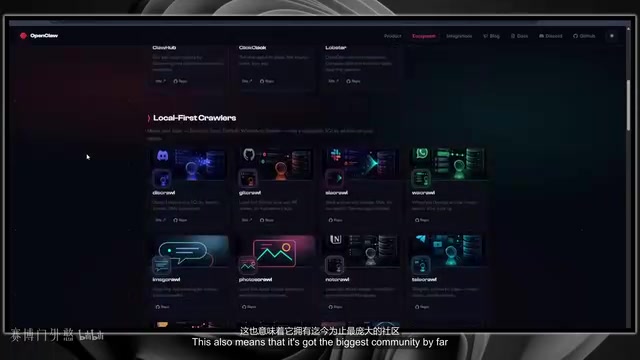
In short, if you want an assistant that's "always online, ready to message anytime, and something anyone on your team can talk to," and you value a huge plugin library, OpenClaw is the best fit.
Odysseus: A Centralized Private Workspace
If OpenClaw lives in your message stream, Odysseus is the exact opposite—it gives you a dedicated space to get work done in one place.
Odysseus comes from the PewDiePie project and is a self-hosted AI workspace. Unlike OpenClaw, which hides behind your messages, it opens a clean dashboard on your own machine and integrates all its features into a single window: chat, a knowledge library, deep research, a document editor, notes, tasks, calendar, email, model comparison—it's all there.
It supports connecting to any model, whether local or cloud-based. It also took off quickly after launch, gathering tens of thousands of GitHub stars within its first few days.
Its core value lies in completing an end-to-end workflow loop: use the deep research feature to investigate a topic, turn it into a written document, save the key points as notes, create follow-up tasks, and keep moving forward—all within a private workspace fully under your control, without copying and pasting back and forth across five different apps. This is precisely the core advantage of the "AI workspace" form.
Hermes: The Self-Evolving AI Agent
Hermes may be the hardest of the three to understand, because its capability model really is different from the other two. Developed by a well-known research lab, it's positioned as an AI agent capable of self-improvement.
Like OpenClaw, Hermes runs in the background, connects to your messaging apps, and automatically executes tasks. But its true defining feature is its learning loop mechanism.

Every time Hermes completes a complex task, it enters a "reflection phase"—analyzing its own execution process, summarizing which steps worked, and then writing itself a reusable skill file. As a result, unlike ordinary agents that start every task from scratch, Hermes gets better at handling your day-to-day work the more you use it.
With this concept, it too has grown rapidly, surpassing 100,000 stars on GitHub within just a few weeks. Here's a concrete example: you ask it to check a certain project every morning, summarize the overnight changes, and send you a digest. Over time, it will solidify this process into a skill that runs faster and more accurately. This cumulative effect is its biggest differentiating selling point.
In addition, Hermes offers an optional checkpoint system that can create a snapshot of an entire project before performing destructive operations. If something goes wrong, you can roll back to a previous state—a genuinely effective safety net, and a capability neither of the other two tools currently implements in the same way.
Security: More Important Than Any Feature
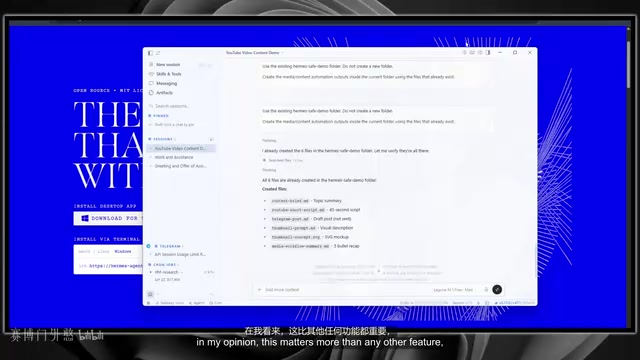
Security matters more than any of the features above. The reason is straightforward: all three tools can run code and reach your real accounts and files—which is exactly what makes AI agents so powerful, and so dangerous, especially when they run on your own machine.
OpenClaw: The Largest Exposure, the Highest Risk
As the largest and most widely deployed tool, OpenClaw's security issues are also the most prominent. It grew too fast, and its design leaned too heavily toward ease of use, leading many users to run it on public servers with open ports. Documented security concerns include:
- The existence of one-click remote code execution vulnerabilities;
- Security audits finding hundreds of malicious plugins in its community marketplace—at peak, roughly one in every eight or nine had problems;
- Major security firms identifying tens of thousands of publicly exposed OpenClaw instances on the internet, and explicitly advising against running it on your primary work machine.
This doesn't mean it's unusable—the development team has since released substantial fixes, adding mandatory authentication and an "emergency stop" option. But it does mean you must configure it carefully and never expose it directly to the public internet.
Hermes and Odysseus: A Relatively Smaller Attack Surface
Hermes has notably fewer reported security incidents, but to be fair, part of the reason is that it hasn't been battle-tested enough, so you can't conclude it's theoretically flawless. It has the most complete security documentation of the three, with mechanisms like dangerous-command approval, container isolation, and optional checkpoints, and its default configuration is relatively sound—though overall it remains a fairly new tool.

Because Odysseus is a single-user local workspace rather than an always-on server agent, its attack surface is inherently smaller. But its developers also explicitly caution: be sure to enable authentication, don't expose ports to the public internet, and carefully manage the agent's access to your local machine.
A Universal Security Checklist for All Three Tools
No matter which one you choose, follow these principles strictly:
- Keep authentication enabled;
- Start from the principle of least privilege;
- Keep human-approval prompts for any high-risk operations;
- Audit any third-party plugin before installing it;
- Never expose any of these tools directly to the public internet.
The hardest part of self-hosted AI has never been the AI itself—it's how to operate it safely. Treat these tools as powerful assistants that need oversight, not as black-box systems you can just let loose.
How to Make Your Choice
Back to the original question: you don't need to crown the "strongest"—you need to choose the right "type."
- Want an always-on AI assistant that's reachable via chat anytime and has the richest plugin ecosystem → choose OpenClaw (be sure to lock down its security configuration);
- Want a private AI workspace that centralizes research, writing, and task management → choose Odysseus;
- Want a self-improving agent that keeps evolving as you use it and comes with a rollback safety net → choose Hermes.
Think through your needs clearly before you start deploying, and your time won't go to waste.
Related articles

Gemini 3.7 Flash Spotted in Google Cloud Console — Launch Countdown Begins
Developers spot Gemini 3.7 Flash in Google Cloud Console, sparking discussion about its relationship to Pro and Google's model distillation strategy.

AI-Memory: Building a Cross-Tool Long-Term Memory System for Coding AIs
AI-Memory is a Rust-based open-source project providing long-term memory for Claude Code, Cursor, Aider and other Agent coding CLIs, enabling seamless handoff between vendors.

Bullet Enters the Stage: YC Newcomer Bets on a Faster Coding Agent
YC S26 startup Bullet launches a speed-focused coding Agent targeting developer latency pain points. Analysis of its differentiation, acceleration techniques, and market opportunity against Cursor and Claude Code.