Complete AI Comic Drama Production Tutorial: From Script Generation to Video Synthesis in 5 Steps

A complete technical breakdown of AI comic drama production workflow with realistic industry analysis
This article provides a detailed technical breakdown of the complete AI comic drama production workflow, covering tool preparation and licensing, script generation and character extraction, character image generation, scene management, and video synthesis. It explains core technical principles including diffusion models, character consistency, and conditioned video generation. The article also offers a sober assessment of real challenges facing AI comic dramas: severe content homogenization, fading platform dividends, limited monetization paths, and copyright risks.
Introduction: The Reality of AI Comic Dramas
Social media platforms have recently been flooded with "AI comic drama success stories," with accounts boasting hundreds of thousands of likes tempting many to jump in. But behind the glamorous numbers, how deep does this space really go? Today, instead of selling dreams of wealth, we'll break down the complete AI comic drama production workflow from a technical, hands-on perspective, giving you a clear-eyed understanding of this field.
Tool Preparation & License Acquisition
Leveraging Free Resources
Creating AI comic dramas requires a core tool. The tool provides 200 free "popcorn" credits (creation credits) daily for image generation and video production. What you might not realize is that the earlier steps—script generation, character extraction, and character descriptions—are completely free. Credits are only consumed during the image and video generation stages.
The Importance of Proper Licensing
The tool features a built-in "Creative IP" section containing officially licensed IP materials across various genres, including period dramas, supernatural stories, post-apocalyptic tales, silver-haired characters, romance, and ancient romance. For beginners, starting with shorter works is recommended to lower the creative barrier.
It's worth noting that copyright issues surrounding AIGC (AI Generated Content) remain in a legal gray area globally. China released the "Interim Measures for the Management of Generative AI Services" in 2023, requiring both training data and generated content to comply with regulations. The built-in "Creative IP" licensing section essentially means the platform has pre-signed derivative creation license agreements (typically non-exclusive) with copyright holders, and users are considered to have received sublicensing rights when using materials within the platform. However, these licenses are usually limited to publishing within the platform—cross-platform commercial monetization may trigger additional copyright terms, which is the underlying reason why "copyright risk" always persists.
Script Generation & Character Extraction
Step 1: Generate a Standard Script with AI
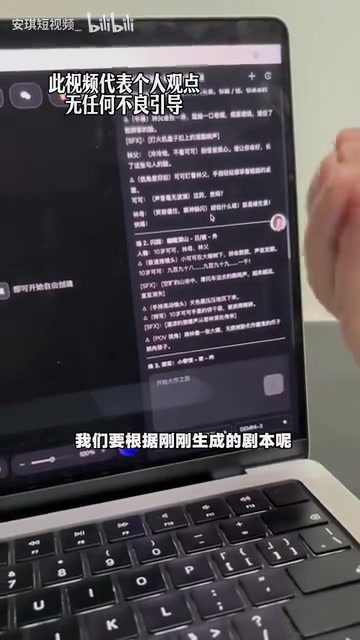
After selecting a work, copy the first chapter's content and enter the creation interface. Use the "Script Converter" function (free), and the system will automatically transform the original text into a standard script format including scene descriptions, character close-ups, and dialogue.
Step 2: Extract Characters and Generate Appearance Descriptions
Paste the generated script into the dialogue box and use the "Character Extraction" function. The system will automatically identify all characters that appear. Then use the "Character Image Generation" function to generate detailed appearance description prompts for each character.
Here's a key tip: if the prompt contains signature descriptions like "gaze" or "expression," it's advisable to remove them. The reason is simple—it's impossible for every scene to feature the same expression. Characters need to display different emotional states according to the plot.

Character Image Generation
Style Selection & Parameter Settings
When generating character images, several key parameters require attention:
- Style selection: For realistic series, add the keyword "hyper-realistic" to your prompts
- Aspect ratio: Choose 9:16 for vertical/portrait content
- Model reference: If you see someone else's model style that looks great, you can screenshot and upload it for AI to reference that style

AI Image Generation Detail Quality
Current AI image generation tools are primarily built on Diffusion Models, one of the most important breakthroughs in generative AI in recent years. Compared to earlier GANs (Generative Adversarial Networks), diffusion models generate images through progressive denoising, offering significant advantages in detail reproduction and style consistency. Mainstream tools like Stable Diffusion and Midjourney are all based on this principle. Prompt engineering is the core method for controlling generation results—keywords like "hyper-realistic" essentially guide the model toward specific style regions in latent space, which explains why carefully crafted prompts can produce dramatically different visual effects.
As a result, current AI tools deliver impressive detail quality. Generated characters not only have clear facial features, but can even precisely render fine details like wrinkles and chipped nail polish. This level of detail is one of the key factors that makes AI comic dramas attractive to audiences.
Scene Generation & Asset Management
Creating a Character Asset Library
One of the biggest technical challenges in AI comic drama production is Character Consistency—maintaining uniform appearance for the same character across different scenes and poses. Traditional diffusion models sample independently each time, inherently lacking cross-image consistency. The "character asset library" + "face verification" workflow essentially encodes a character's facial features as reference vectors, injecting them into each subsequent generation process through techniques like IP-Adapter or ControlNet, achieving cross-shot character locking. This is also why face verification is a necessary step—the system needs to extract high-quality facial feature baselines.
After character generation, you need to create an asset library and submit face verification. Face verification submitted through this tool is almost always approved instantly, and subsequent video production rarely requires queue waiting, significantly improving creative efficiency.
Scene Prompt Generation
Input the script content into the "Scene Extraction" function, and the system will generate corresponding environmental description prompts for each scene. When generating scene images, note: reference the character style but don't include the characters themselves, ensuring scene independence and consistency.

Video Generation & Synthesis
Dynamic Video Production
The final step is converting static images into dynamic video. Use the "C-Dance 2.0" function to map each script description to its corresponding scene and character nodes.
Converting static images to dynamic video (Image-to-Video, I2V) is one of the mainstream paradigms in current AI video generation. Representative technologies include the Runway Gen series, Kling, Sora, and others. These models learn temporal motion patterns between video frames, adding reasonable dynamic effects to static images while maintaining visual style consistency. The technical approach used by "C-Dance 2.0" takes script text descriptions as motion instructions, combined with character asset node binding, to drive corresponding characters to produce plot-appropriate actions and lip-sync movements—a process also known as Conditioned Video Generation.
Key operational points:
- Character binding: Ensure that characters appearing in each shot are correctly linked to their corresponding character assets to avoid character confusion
- Parameter settings: Video duration can be set to 15 seconds, resolution at 720P, aspect ratio 9:16 vertical
- Audio toggle: Make sure to enable the audio option so characters can "speak"
Sober Reflection: The Reality of AI Comic Dramas
Although the entire workflow doesn't appear overly complex, several issues deserve clear-eyed recognition:
- Severe homogenization: The root cause of homogenization in AI comic dramas lies in the highly standardized toolchain. When large numbers of creators use the same models, the same prompt templates, and the same script sources, content converges in visual style and narrative structure. From a platform algorithm perspective, recommendation systems on Douyin, Kuaishou, and other short-video platforms perform "deduplication" processing, downranking content with excessive similarity. The real competitive moat has shifted from "knowing how to use the tools" to "building unique creative perspectives and topic strategies on top of the tools."
- Platform dividends fading: Early entrants have already captured traffic advantages, and customer acquisition costs for latecomers have risen significantly
- Limited monetization paths: High view counts don't equal high income—both ad revenue sharing and e-commerce conversion have ceilings
- Copyright risks: Even when using licensed materials, the boundaries of derivative creation remain blurry, and cross-platform commercialization requires particular caution
Rather than blindly chasing "viral success," creators should approach this space with realistic expectations and focus on building genuine creative differentiation.
Related articles
 Tutorials
ChatGPT Plus Subscription Guide: Are GPT-5.5, image-2, and Codex Worth the Upgrade?
A detailed look at ChatGPT Plus features — GPT-5.5, image-2, and Codex — with a Plus vs Pro comparison and a complete step-by-step subscription guide for users outside the US.
 Tutorials
Harness AI Engineering in Practice: Using Claude Code to Master Enterprise-Level E-Commerce Development
Deep dive into Harness AI Engineering: master enterprise e-commerce development with Claude Code using the Rules, Skills, Wiki, and Changes framework.
 Tutorials
Cursor + Codex Dual-IDE Collaboration: A Practical Methodology for Open-Source Project Customization
A complete methodology for open-source project customization based on real-world experience, detailing the Cursor+Codex dual-IDE workflow, seven-stage process, MVP validation, and AI source code reading techniques.