Complete Breakdown of Core Competencies for AI Agent Engineers: From Demo to Production-Grade Systems

A complete breakdown of skills needed to build production-grade AI Agent systems beyond simple demos.
This article dissects the four core competencies that separate production-ready AI Agent engineers from demo builders: business decomposition with human-in-the-loop design, high-availability multi-Agent architecture with fault tolerance, quantitative evaluation with runtime protection mechanisms, and engineering delivery with CI/CD and canary releases. It covers ReAct execution, context compression, circuit breakers, LLM-as-Judge evaluation, and distributed tracing.
From Demo to Production System: A Severely Underestimated Gap
Recently, many hiring managers at major tech companies have reported an awkward phenomenon: when recruiting AI Agent development engineers, nine out of ten candidates have impressive resumes, but the moment you ask "how does the system auto-degrade when a third-party API goes down" or "how do you compress context under high concurrency," they immediately go silent. Companies are offering 30K-40K monthly salaries yet can't find engineers capable of solving production crash issues.
The core contradiction behind this is that most developers' capabilities remain stuck at the "Demo stage." When we typically learn about Agents, we basically just run open-source community templates: configure a weather-checking API, input a prompt, the model outputs a result—and we consider it mission accomplished. But enterprises never deal with toys; they face real commercial systems like "intelligent supply chain scheduling with automated anomaly handling."
Since 2024, AI Agents have become the core paradigm for large model application deployment. According to Gartner's prediction, by 2028, 33% of enterprise software will integrate AI Agent capabilities. However, the industry currently faces severe talent mismatch: a large number of developers are familiar with the basic usage of open-source frameworks like LangChain and AutoGPT, but lack the engineering capability to deploy Agent systems to production environments and ensure 7×24 stable operation. "Production-grade" means the system must withstand real-world uncertainty—network jitter, API degradation, concurrency spikes, model hallucinations—none of which barely appear in local development environments.

The gap is specifically reflected in environmental harshness. When running Demos on our own machines, we assume APIs are always available, manually test two or three cases, feel good about it, and call it done. But in production environments: networks disconnect, APIs timeout, large models hallucinate at any moment, and thousands of users are online simultaneously. Using visual tools to drag-and-drop workflows only means crossing the beginner threshold. Being able to design production-grade Agent systems with high concurrency, low latency, self-correction, and fallback capabilities is what truly separates the high-value engineers from the rest.
Business Decomposition and Human-AI Collaboration Design
In real business scenarios, your boss won't write technical details into the requirements document—they'll often just throw you a vague overarching goal, like "help me reduce the operational costs of the customer service department." If you jump straight into coding and calling models, you'll most likely end up with a self-serving Demo.
The correct first step is to translate business objectives into engineering logic: identify the high-risk decision points within them, then convert those decision points into quantifiable, automatically executable technical metrics.
There's a core design philosophy here—Human-in-the-Loop (HITL). HITL is a design pattern that embeds human judgment at critical nodes of automated workflows. Its theoretical foundation originates from the "supervisory control" concept in cybernetics: automated systems handle routine tasks, while human experts only intervene when system confidence falls below a threshold or decision risk exceeds preset levels. In AI Agent scenarios, typical HITL implementations include: decision approval gateways, confidence score threshold triggers, and asynchronous ticket queuing mechanisms. This design not only reduces business risk from AI misjudgments but also satisfies compliance requirements in heavily regulated industries like finance and healthcare.
In real business, it's impossible to hand all decisions entirely to a large model. In high-risk scenarios involving large refunds or VIP client contracts, if the model makes an incorrect judgment, the losses are irreversible.
Therefore, a reliable automated execution pipeline needs to be designed: routine low-risk matters are handled automatically and efficiently by the Agent system; once a preset high-risk decision point is triggered, the system automatically suspends the Agent state, generates a ticket for human approval, and resumes the Agent after approval. It's like shopping at a store—small card payments go through directly, while large purchases require a manager's signature, instantly providing a sense of security.
High-Availability Tool Chains and Multi-Agent Architecture
ReAct Deep Execution and Task Decomposition
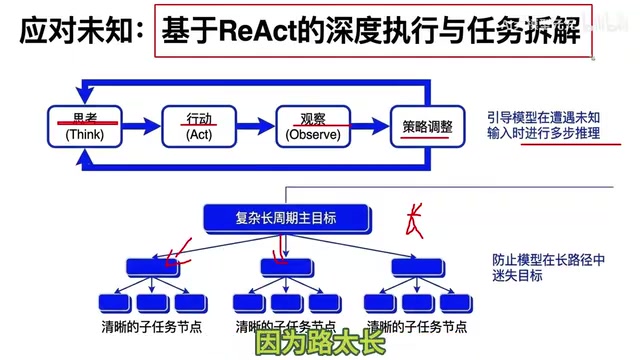
To prevent large models from getting stuck or giving irrelevant answers, a ReAct-based deep execution mechanism needs to be introduced. ReAct (Reasoning + Acting) is a framework proposed by Princeton University and Google Research in 2022, published at ICLR 2023. Its core idea is to interleave the large model's reasoning capability (Chain-of-Thought) with external tool-calling capability (Acting): the model first generates a reasoning text (Thought), decides on the next action based on it (Action), observes the result after execution (Observation), then begins a new round of reasoning based on the observation. Compared to pure chain-of-thought reasoning, ReAct enables models to dynamically acquire external information, correct erroneous judgments, and significantly reduce hallucination rates.
In production systems, the ReAct loop typically has a maximum iteration limit set, combined with Task Decomposition strategies, guiding the model to perform "Think → Act → Observe → Adjust Strategy" cycles like a human. For massive tasks with long execution cycles, AI Agent engineers must help break down the goal into clear sub-task nodes behind the scenes—because the path is too long, and the model easily loses direction midway (known as the goal drift phenomenon).
Two Key Techniques for Tool Calling
To ensure accurate tool calling under high concurrency, there are two tried-and-true methods:
- Constrained Input: Provide the model with extremely clear, unambiguous tool descriptions—like furniture assembly instructions that specify even screw models and card orientations, naturally minimizing the chance of incorrect assembly.
- Behavioral Alignment: For complex business logic, prepare several classic demonstrations (Few-Shot) directly in the prompt, teaching it how to precisely fill in parameters under various conditions.
High-Fault-Tolerance Execution Pipeline
Third-party servers can lag at any time, and when tool execution fails, the system must never freeze. The standard approach has three phases:
- Intercept: Capture underlying error messages without passing them directly to users;
- Exponential Backoff Retry: Don't retry frantically within a second like spam-clicking refresh (which would actually crash the other server). Instead, retry at 1 second, 2 seconds, 4 seconds, 8 seconds with progressively longer intervals. Exponential Backoff is a classic strategy for handling transient failures in distributed systems, originally widely applied in Ethernet's CSMA/CD protocol. Its core formula is: wait time = base × 2^n + random_jitter, where n is the retry count and random_jitter is a random jitter amount. The introduction of random jitter is crucial—if numerous clients encounter failures simultaneously and retry at identical intervals, they'll form a "Retry Storm" that actually intensifies server pressure. Major cloud providers like AWS and Google Cloud have built-in exponential backoff with jitter in their SDKs. In AI Agent systems, the maximum retry count is typically set to 3-5 times, with total timeout controlled within 30 seconds, triggering degradation logic when exceeded;
- Silent Degradation Fallback: If multiple retries still fail, invoke a local backup rule base and return a safe default response. It's like when WeChat Pay goes down, the cashier lets you scan Alipay or swipe a bank card instead.
Multi-Agent Collaboration and Context Compression
In complex enterprise scenarios, a single Agent's capacity isn't sufficient, requiring an upgrade to multi-Agent architecture. The master Agent acts like a department manager responsible for understanding intent and dispatching tasks, while sub-Agents handle their respective domains (inventory management, finance management).

But multi-Agent "meetings" have a headache-inducing problem: with everyone talking, the context window quickly overflows, token costs skyrocket, and the model's memory starts getting fuzzy. Although the context windows of large language models keep expanding (GPT-4 Turbo supports 128K tokens, Claude 3 supports 200K tokens), in practice, overly long contexts cause three problems: first, attention dilution (the "Lost in the Middle" phenomenon, where the model's attention to information in middle positions significantly decreases); second, inference latency grows linearly; third, API call costs billed per token cause expenses to soar.
The solution is context compression: first, dynamic extraction—like highlighting key points, extracting the most core semantics from conversation history, using embedding models (like text-embedding-3-small) for semantic summary extraction and storing them in a vector database; second, sliding window—directly clearing old content irrelevant to the current task. In multi-Agent scenarios, a shared vector database (like Pinecone or Milvus) can also serve as "external memory," with each Agent retrieving on demand rather than passing the full context. This saves token costs while avoiding the "forgetful VIP" problem.
Quantitative Evaluation and Runtime Protection
When the system goes live, you can no longer rely on the mystical assessment of "I tested it a few times and it felt fine"—big companies want hard metrics. Here are three gold standards:
- Task Completion Rate: The end-to-end success ratio, typically required to be above 95%;
- Tool Call Anomaly Rate: The ratio of incorrect calls, timeouts, and format errors, to be controlled within one per thousand;
- P99 Response Latency: The latency in the slowest 1% of cases, for example, firmly kept under 500 milliseconds. P99 is a percentile latency metric that, compared to average latency (Avg Latency), better reflects system performance under extreme conditions. In industry, Service Level Agreements (SLAs) typically use percentile latency as core metrics: P50 reflects typical user experience, while P95 and P99 measure tail performance. For AI Agent systems, P99 latency is influenced by multiple factors: large model inference time (typically 60-80%), tool call network latency, context serialization overhead, etc. Keeping P99 under 500 milliseconds usually requires combining streaming output, inference result caching, and small model routing (routing simple queries to lightweight models).
Runtime also requires real-time protection. The biggest production fear is the model's logic going haywire and entering infinite loops, frantically calling APIs. Therefore, deadlock timers and execution depth detection must be implemented—forcefully interrupting once an endless loop is detected. Additionally, design an API call circuit breaker mechanism—the Circuit Breaker Pattern was systematically described by Michael Nygard in the book Release It!, inspired by electrical engineering circuit breakers. Its core state machine contains three states: Closed (normally passing requests), Open (rejecting all requests and directly returning degraded results), and Half-Open (tentatively passing a small number of requests to detect whether the service has recovered). In AI Agent systems, circuit breaking is particularly critical—large model APIs are billed per call, and if an Agent enters an infinite loop due to logic errors and calls frantically, thousands of dollars in charges can accumulate within hours. Once an abnormal call frequency is detected in an extremely short period, it immediately cuts off and enters a safe protection state with alerting—otherwise, hundreds of paid API calls overnight will cause the company to hemorrhage money. Netflix's open-source Hystrix and Alibaba's Sentinel are classic implementations of this pattern that can serve as references for Agent system development.
An Agent system without observability and anomaly fallbacks running in production is like a ticking time bomb hanging in mid-air.
Engineering Delivery and Continuous Iteration
Using LLMs to Evaluate LLMs
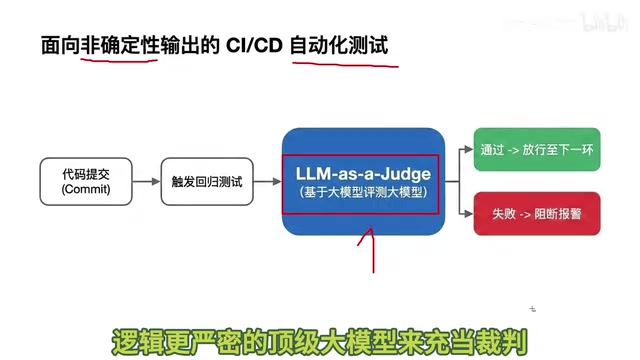
Traditional software testing takes input A and expects a fixed output B—just compare strings. But large models are non-deterministic; the tone and vocabulary may differ every time. The solution is to introduce the LLM as Judge mechanism. LLM as Judge is an AI system evaluation paradigm that has emerged in recent years, with its theoretical foundation from the 2023 UC Berkeley paper Judging LLM-as-a-Judge. Traditional deterministic assertions (assert output == expected) cannot accommodate the randomness and diversity of large model outputs—for the same question, the wording of answers may differ every time, yet all could be correct.
The specific approach: after developers commit new code, the backend automatically triggers regression tests, using a top-tier large model with stronger comprehension (such as GPT-4o) as the judge, scoring the evaluated Agent's output across multiple preset dimensions (such as factual accuracy, logical coherence, tool call correctness, safety compliance), assessing the new version Agent's response quality and logical paths—passing allows deployment, failure triggers alerts. This method has been proven to achieve over 80% correlation with human expert evaluations. In practice, it's typically embedded into the CI/CD pipeline, with automatic regression evaluation triggered on every code change.
Canary Release: Controlling the Blast Radius
Even if tests pass, you cannot directly deploy to all users. You need to master the technique of "controlling the blast radius." Canary Release gets its name from the practice of using canaries in mines to detect toxic gases—let a small number of "scouts" bear the risk first, and only expand after confirming safety.
Employ dual-track traffic routing: through traffic scheduling gateways (like Nginx, Istio, AWS ALB), implement fine-grained traffic distribution with both new and old Agent service versions running simultaneously in production. The vast majority of users still go through the stable old version, with only about 5% of traffic routed to the new version for covert observation. Monitoring systems compare core metrics (error rate, latency, user satisfaction) between the two versions in real-time. Once monitoring detects a spike in error rates, anomaly triggers automatically switch traffic back to the old version within seconds, achieving zero-loss rollback. This way, even if there's a bug, only that small portion of test traffic is affected, shrinking the "blast radius" of release risk from all users to a minimal number of test users.
Model Migration and Distributed Tracing
Foundation models iterate extremely fast. When migrating to a new model, prompts written for the old model may suddenly fail (new and old models have different "temperaments"), so an engineering migration workflow for prompts and chains needs to be established.
Additionally, multi-Agent call chains are too long, making production incident localization difficult. Distributed tracing must be introduced. The theoretical foundation of distributed tracing comes from Google's 2010 Dapper paper. Its core idea is to assign a globally unique trace ID to each external request. As the request flows through the system, each service node generates a span (containing metadata like service name, start/end time, status code), and all spans are connected through parent-child relationships to form a complete call chain tree.
In multi-Agent systems, a single user request might go through: master Agent intent recognition → sub-Agent A querying inventory → sub-Agent B calculating price → tool calling external APIs → result aggregation and return, involving a dozen or more asynchronous steps. After introducing standardized tracing frameworks like OpenTelemetry, regardless of which sub-Agent the master routes to, which API was called, how long it took, or what error occurred, everything can be traced as clearly as tracking a delivery package, greatly reducing the Mean Time to Repair (MTTR) for production incidents.
Four Skill Puzzle Pieces: The Complete Competency Landscape for AI Agent Engineers
To grow from a beginner who can only run open-source Demos into a senior AI Agent engineer sought after by companies offering premium salaries, what you need to fill in isn't memorizing some framework's API by rote, but assembling four domains into a complete skill map:
- Business Decomposition and Human-AI Collaboration Process Design
- High-Availability Tool Chains and Multi-Agent Architecture
- Quantitative Evaluation and Runtime Stability Protection
- Engineering Delivery and Continuous Iteration Workflows
When these four parts come together completely, you truly possess the core capability to design and deliver industrial-grade production Agent systems. Whether you're interviewing at major tech companies or taking on million-dollar projects, you'll have the confidence and composure to handle it all.
Key Takeaways
Related articles

Poison-Resistant Concept Anchoring: A New Approach to Defending Against AI Data Poisoning
Deep dive into Poison-Resistant Concept Anchoring, defending against data poisoning via signed anchors and bounded updates. Experiments show 62% poison isolation with 0% false rejection rate.

Hungarian Algorithm Explained: Principles, Complexity, and Engineering Implementation Guide
In-depth explanation of the Hungarian Algorithm: core principles, O(N³) time complexity advantages, and engineering implementation. Covers assignment problem definition, step-by-step algorithm walkthrough, Python/C++ libraries, and applications in multi-object tracking and resource scheduling.
OpenAI's First Enterprise AI Report: H…
OpenAI's First Enterprise AI Report: How ChatGPT Is Changing the Way Organizations Work
OpenAI's first enterprise AI report reveals three key traits of ChatGPT Enterprise adoption: the shift from novelty to necessity, writing and coding as top use cases, and data governance as a core prerequisite.