Complete Guide to AI Learning Path: A Systematic Skill Tree from Python Basics to AI Agents
Systematic AI skill tree from Python basics to AI Agents with structured learning partner approach
A comprehensive AI learning roadmap addressing the challenge of information overload through systematic progression across four layers: Foundation (Python, math, data), Core (ML, deep learning, Transformers), Application (generative AI, RAG, agents), and Engineering (MLOps, deployment). Emphasizes learning partnerships, project-driven practice, and bridging technical depth with business value.
Why You Need a Structured AI Learning Path
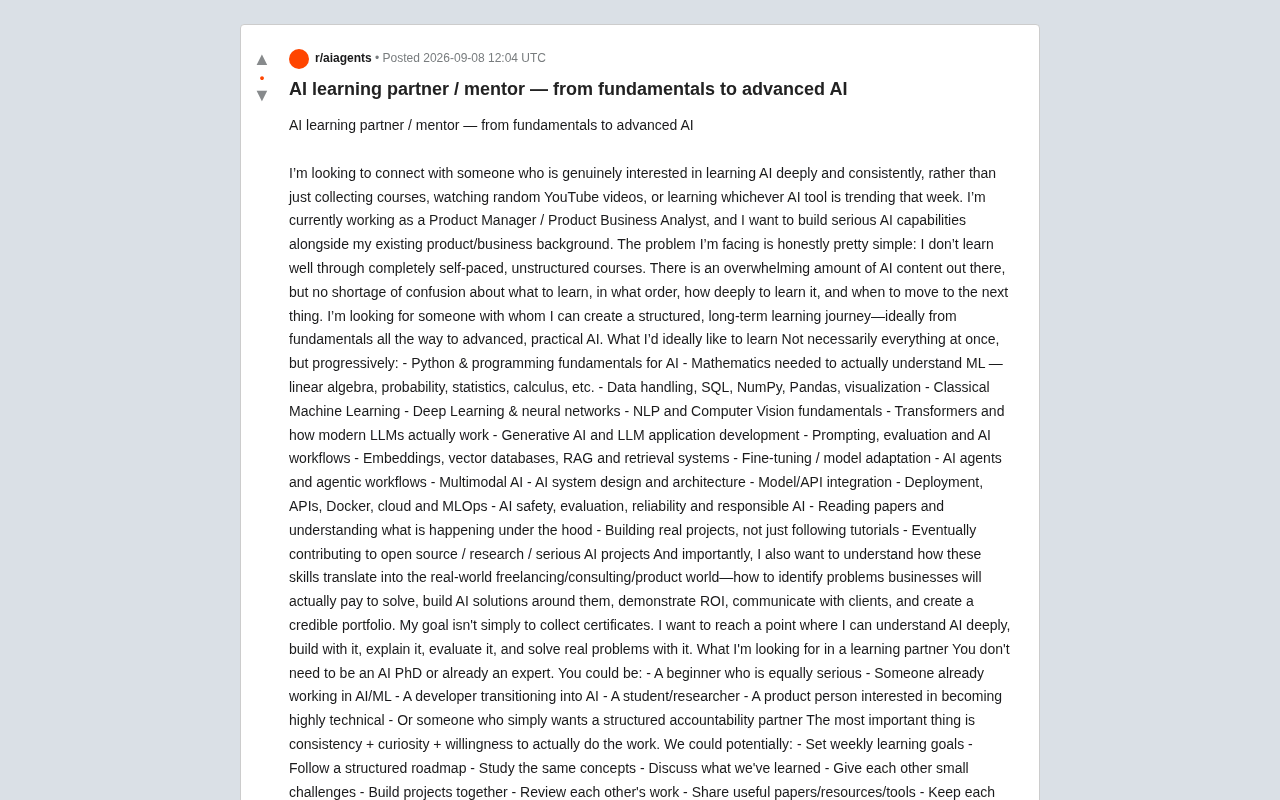
AI learning resources are never in short supply—online courses, YouTube videos, and technical blogs are everywhere. But the real challenge is: how do you build a systematic learning path amid information overload? A product manager's learning request post on Reddit resonated widely, articulating the dilemma many AI learners face: it's not content that's lacking, but structure, depth, and continuity.
This product manager admitted he couldn't learn effectively through completely self-directed, unstructured courses. Facing the vast ocean of AI content, he fell into a typical learning trap: not knowing what to learn, in what order, to what depth, and when to move to the next topic. This confusion isn't isolated—it reflects a pervasive problem in AI education: abundant resources but unclear pathways.
Complete AI Skill Blueprint: A Four-Layer Progressive Architecture
This learner proposed a comprehensive and progressive AI skill tree, covering full-stack AI development capabilities from basics to advanced levels.
Foundation Layer: Python Programming and Mathematical Foundations
- Python Programming Basics: The universal language of AI development, with nearly all mainstream frameworks built on the Python ecosystem
Python became the de facto standard for AI development thanks to its rich scientific computing ecosystem. Mainstream frameworks like TensorFlow, PyTorch, and scikit-learn all provide Python interfaces, NumPy offers efficient multidimensional array operations, and Jupyter Notebook has become data scientists' preferred interactive development environment. Python's syntactic simplicity reduces algorithmic implementation complexity, allowing developers to focus on model design rather than language details. This ecosystem advantage creates a positive feedback loop: more developers choose Python, spawning more tool libraries, which in turn attracts more newcomers.
-
Mathematical Foundations: Linear algebra, probability and statistics, calculus—these aren't optional, they're prerequisites for truly understanding machine learning algorithms. Linear algebra helps you understand matrix operations and tensor manipulations in neural networks, probability and statistics underpin Bayesian inference and model evaluation, and calculus is core to backpropagation algorithms and gradient descent optimization. Without these mathematical tools, you can only stay at the surface level of calling APIs, unable to deeply understand why models work, how to improve them, or effectively debug when problems arise.
-
Data Processing: SQL, NumPy, Pandas, data visualization—building the core toolkit for data analysis
Core Layer: Machine Learning and Deep Learning
-
Classical Machine Learning: Understanding algorithmic principles rather than just calling APIs, including fundamental models like regression, classification, and clustering. Classic algorithms like linear regression, logistic regression, decision trees, random forests, and support vector machines may not be as "cool" as deep learning models, but they remain optimal choices in many real-world scenarios. They train quickly, offer strong interpretability, and are friendly to small datasets. More importantly, understanding the mathematical principles of these algorithms (like maximum likelihood estimation, kernel tricks, ensemble learning) lays a solid foundation for subsequent deep learning studies.
-
Deep Learning and Neural Networks: From basic architectures to modern variants, mastering core network structures like CNNs and RNNs. Convolutional Neural Networks (CNNs) achieve image feature extraction through local receptive fields and weight sharing, while Recurrent Neural Networks (RNNs) and their variants LSTM and GRU specialize in processing sequential data. Understanding the design motivations behind these architectures—why CNNs suit images, why RNNs suit text, how residual connections solve vanishing gradients—is more important than simply calling PyTorch modules.
-
NLP and Computer Vision: Foundational theory and practical methods for these two major application domains
-
Transformer Architecture: Understanding how modern Large Language Models (LLMs) work
The Transformer architecture proposed by Google in 2017 completely transformed the NLP field. It solved traditional RNNs' long-range dependency problem through self-attention mechanisms, enabling models to process sequence data in parallel. Modern large language models like BERT, the GPT series, and Claude are all based on the Transformer architecture. Understanding Transformers isn't just a technical requirement—it's key to grasping AI's developmental direction. From encoder-decoder structures to multi-head attention mechanisms, these concepts form the core operational logic of contemporary AI systems. Mastering Transformer principles helps you understand why ChatGPT can generate coherent text and why model parameter scale shows regular correlation with performance.
Application Layer: Generative AI and RAG System Development
-
Generative AI Development: Prompt engineering, model evaluation, AI workflow design. Prompt Engineering has become an independent discipline, covering techniques like zero-shot learning, few-shot learning, and chain-of-thought prompting. Effective prompt design can boost model performance by tens of percentage points, while model evaluation requires understanding metrics like BLEU and ROUGE as well as the tradeoffs in human evaluation methods.
-
RAG Systems: Embedding techniques, vector databases, retrieval-augmented generation system construction
Retrieval-Augmented Generation (RAG) is the key technology for combining large language models with external knowledge bases. Its workflow includes: splitting documents and converting them into vector embeddings stored in vector databases (like Pinecone or Weaviate), retrieving relevant fragments when users query, and injecting retrieval results as context into LLMs to generate answers. RAG solves two major pain points of LLMs: knowledge cutoff limitations and hallucination issues. In enterprise applications, RAG enables AI to answer questions based on private document repositories without expensive retraining of base models. Understanding concepts like embedding spaces, similarity computation, and chunking strategies are essential skills for building practical AI systems.
-
Model Adaptation: Fine-tuning techniques and model customization methods. Full-parameter fine-tuning, LoRA (Low-Rank Adaptation), QLoRA (Quantized Low-Rank Adaptation) and other techniques allow developers to customize large models with limited resources. Understanding when to use prompt engineering, when fine-tuning is needed, and how to choose adaptation methods is key to transforming general models into specialized solutions.
-
AI Agent Development: Intelligent agent design and workflow orchestration
AI Agents represent a paradigm shift from passive tools to active collaborators. Unlike traditional single-turn Q&A, Agents can decompose complex tasks, invoke external tools, perform multi-step reasoning, and make autonomous decisions. For example, AutoGPT and LangChain's Agent frameworks allow models to plan task workflows, call search engines or APIs, validate results, and iteratively optimize. This capability stems from combining Chain-of-Thought prompting techniques with Tool Use abilities. Understanding Agent design requires mastering concepts like state management, task planning algorithms, and tool orchestration. As multi-agent collaborative systems develop, this skill will become core competitiveness in building next-generation AI applications.
- Multimodal AI: Cross-modal understanding and generation capabilities. Models like CLIP, DALL-E, and GPT-4V demonstrate the potential of vision-language joint understanding. Multimodal learning involves aligning representation spaces across modalities and designing cross-modal attention mechanisms—cutting-edge techniques.
Engineering Layer: MLOps Deployment and AI Safety
-
System Design: AI system architecture design and model integration solutions. How to design scalable inference services, handle streaming outputs, implement model version management and canary releases—these engineering questions directly impact AI product user experience and operational costs.
-
MLOps Practices: Deployment, API development, Docker containerization, cloud service management
MLOps (Machine Learning Operations) applies DevOps principles to machine learning systems. It covers full lifecycle management including model version control, continuous training, A/B testing, and monitoring alerts. A model that performs excellently in Jupyter Notebook may face data drift, inference latency, and resource consumption issues when deployed to production. MLOps toolchains (like MLflow, Kubeflow, Weights & Biases) help teams standardize model delivery processes. For AI learners, mastering Docker containerization, API design, and cloud service (AWS SageMaker, Google Vertex AI) deployment skills is the crucial leap from laboratory to real-world application.
- AI Safety: Model evaluation, reliability verification, responsible AI practices. Security issues like adversarial attacks, model bias, and privacy leakage are receiving increasing attention. Understanding red team testing, fairness metrics, and differential privacy concepts is fundamental to building trustworthy AI systems.
The core value of this AI skill tree lies in its progressiveness—not trying to master everything at once, but establishing clear learning ladders where each layer builds the foundation for the next.
From Technology to Business: The Scarce Value of AI Product Thinking
What makes this learner unique is that he wants not only to master AI technology but also to understand how AI translates into business value. He raised several key questions worth considering for every AI learner:
- How do you identify problems enterprises are truly willing to pay to solve?
- How do you build AI solutions around these pain points?
- How do you demonstrate ROI (Return on Investment)? Technical teams often focus on model accuracy, but business decision-makers care more about quantifiable business metrics like cost savings, efficiency improvements, and revenue growth. A model with 5% accuracy improvement, if it can reduce customer service costs by 30% or increase conversion rates by 10%, has powerful business persuasiveness.
- How do you communicate with clients and build a credible AI portfolio?
This mindset that combines technical capability with business insight is the most scarce composite skill in today's AI field. Many technical experts can train models but struggle to transform them into implementable products, while product managers often understand business needs but lack deep technical understanding. Composite talents who can bridge technical feasibility and business value have significant competitive advantages in the job market.
His proposed bidirectional learning model is quite insightful: willing to share experience in product management, business problem identification, and user journey design while learning AI implementation from technical partners. This complementary learning is more sustainable and efficient than one-way "mentor-apprentice" relationships.
AI Learning Partner System: A More Efficient Learning Approach Than Solo Course-Taking
Why seek learning partners rather than mentors? He listed potential backgrounds for ideal AI learning partners:
- Fellow AI beginners who are equally committed
- Professionals already working in AI/ML fields
- Software developers transitioning to AI
- Students or researchers in computer science-related fields
- Product people who want deep technical understanding
The three most critical traits are: consistency, curiosity, and execution. Consistency ensures both parties maintain long-term stable learning rhythm, curiosity drives deep exploration rather than superficial dabbling, and execution transforms discussion into actual projects and outcomes.
The learning partner system has clear advantages over solo learning:
- Structured Goals: Set clear weekly learning objectives, progressing along defined roadmaps
- Active Learning: Discuss learned content, challenge each other with questions, deepen understanding. The core of the Feynman learning technique is "teaching is the best learning"—explaining concepts to partners exposes your comprehension blind spots.
- Project-Oriented: Build real projects together rather than just following tutorials. The complete process from data collection and model training to deployment is far closer to actual work scenarios than isolated course assignments.
- Mutual Accountability: Maintain stable learning rhythm and sustained motivation. Human weakness is easy abandonment, but persistence becomes easier when someone walks alongside you.
- Knowledge Sharing: Share papers, learning resources, development tools, and industry updates
- Collaborative Practice: Ultimately collaborate deeply on real-world scenario projects
This model avoids the isolation of traditional self-study while being more focused and in-depth than large learning communities. Small-scale (1-2 person) learning partnerships are often more effective than large groups because they guarantee high-quality interaction and clear accountability.
Six Key Principles for Building a Long-Term AI Learning Journey
The lesson from this case for all AI learners is: AI learning shouldn't be a game of "collecting course certificates," but rather a long-term journey of building deep understanding and practical capabilities. The following six key principles are worth referencing:
- Systematic: Learn progressively along a clear skill tree rather than randomly jumping between courses
- Depth-First: Truly understand underlying principles rather than staying at the surface level of API calls. Being able to implement a simple neural network from scratch is more valuable than knowing how to call ten deep learning frameworks.
- Project-Driven: Consolidate knowledge at each stage by building real projects. One end-to-end AI application (like a personalized recommendation system or document Q&A bot) tests your comprehensive capabilities better than ten tutorial exercises.
- Sustained Investment: Maintain long-term learning rhythm, avoiding three-minute enthusiasms. Deep mastery of the AI field requires months or even years of continuous accumulation, not weeks of crash courses.
- Collaborative Learning: Find like-minded partners to mutually motivate and challenge each other
- Business Perspective: Always think about how technology transforms into actual value. For each new technology you learn, ask yourself: What real problems does this solve? Who would pay for it?
Whether you're a developer, product manager, researcher, or entrepreneur, establishing a structured AI learning path and finding suitable learning partners has more long-term value than simply accumulating course certificates.
The AI field changes rapidly, but fundamental principles remain relatively stable. Rather than chasing new tools and frameworks trending each week, settle down to build solid mathematical and algorithmic foundations, then gradually extend to cutting-edge areas like RAG and AI Agents. This may be a slower but more robust AI growth path. When GPT-5 and GPT-6 are released, understanding Transformer principles will help you quickly grasp their improvements; when new vector databases emerge, understanding embedding spaces will enable you to swiftly evaluate their merits. Foundational knowledge is the best moat against technological change.
Related articles

GPT-6 Astra Completes All 48 Levels of 'I'm Not A Robot' Game
GPT-6 Astra successfully completes all 48 levels of the 'I'm Not A Robot' game, demonstrating remarkable visual understanding, logical reasoning, and task adaptation. This article analyzes the technical capabilities behind this breakthrough and its implications for CAPTCHA verification and AI safety.
Stuxnet Source Code Reconstruction: Dissecting the Attack Chain of History's Most Complex Cyber Weapon
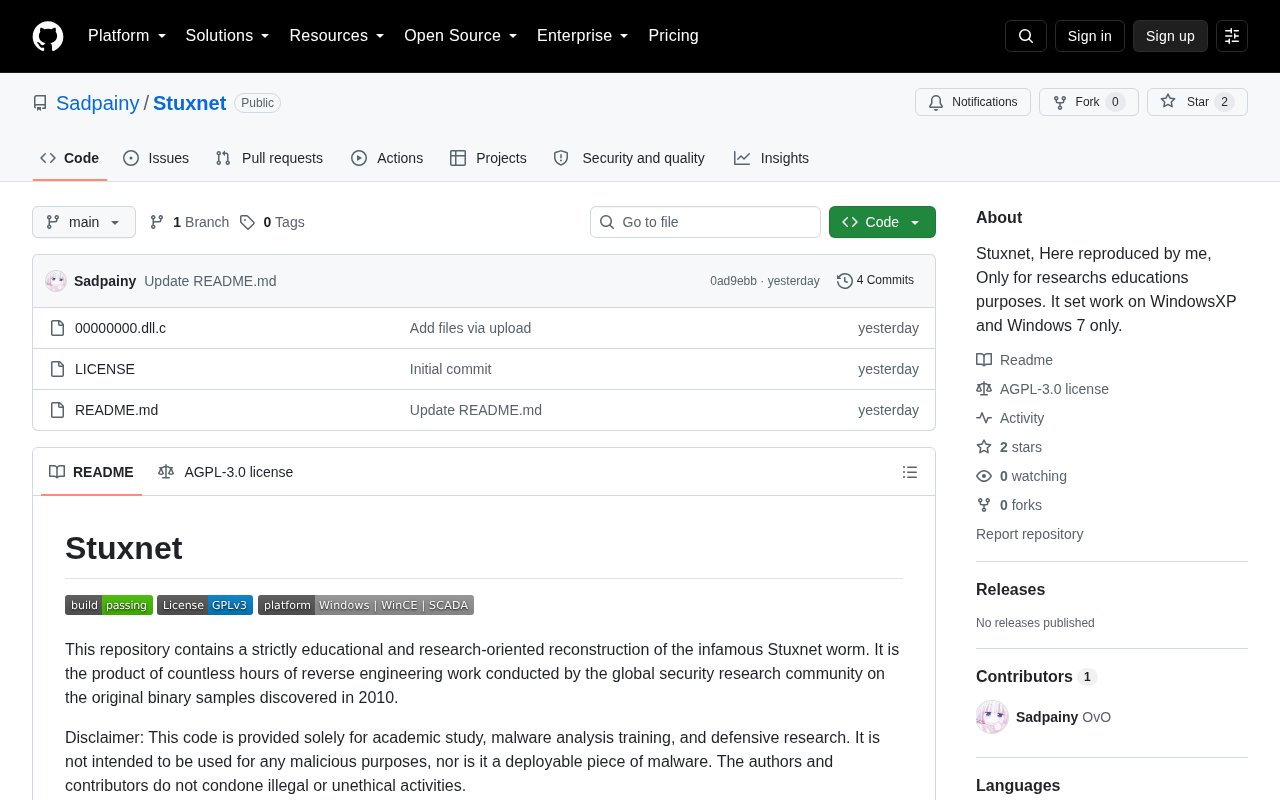
In-depth analysis of the Stuxnet source code reconstruction open-source project, examining how this cyber weapon targeting Iranian nuclear facilities exploited four zero-day vulnerabilities, stole digital certificates, covertly manipulated PLC centrifuges, and exploring industrial security lessons and ethical controversies of open-source reconstruction.

Minimalist Aesthetic Puzzle Game Development: Insights from Independent Creation
An in-depth analysis of an independent developer's aesthetic puzzle project shared on Hacker News, exploring minimalist design philosophy, Show HN community culture, and aesthetics-first product thinking in independent development.