Complete Guide to Building Autonomous AI Agents with Spring AI + Skills
From chatbots to Agentic AI: how Spring AI, ReAct, and Agent Skills power autonomous multi-agent systems.
This article traces AI's evolution from chat mode and Copilot, through single Agents, to multi-agent Agentic AI — where Agents now handle two-thirds of the production pipeline. It highlights ReAct reasoning, MCP tool protocols, and Agent Skills as core technical pillars, recommends the Spring AI Alibaba ecosystem (AgentScope, JManus) for implementation, and argues that "multi-agent collaboration" and "autonomous decision-making" are the stable, long-term skills developers should invest in.
The rapid pace of AI iteration has left many developers feeling anxious: what you learn today might be replaced by a new concept before long. Prompt engineering, personal knowledge bases (RAG), local LLM deployment and fine-tuning — topics that were all the rage just a year or two ago — are now discussed far less frequently. In the face of constantly evolving AI technology, what's truly worth investing in is the kind of expertise that sits at the core of the development trend and won't be easily displaced. This article maps out the complete trajectory of AI development and breaks down the technical path to building autonomous decision-making agents using Spring AI and Agent Skills.
From Chatbots to Agentic AI: A Clear Evolutionary Path
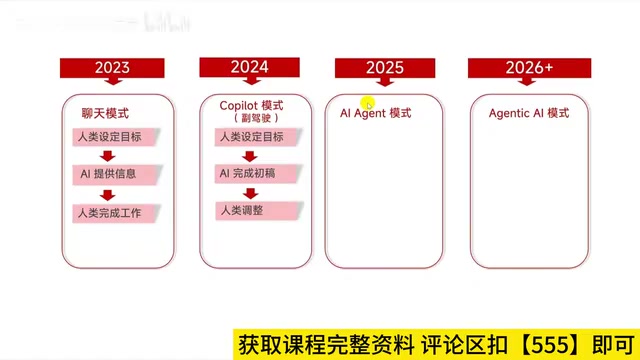
Understanding what to learn starts with understanding how AI has evolved to where it is today. This trajectory can be divided into several distinct phases, with the core difference at each stage being — how much of the actual work AI is doing in the production process.
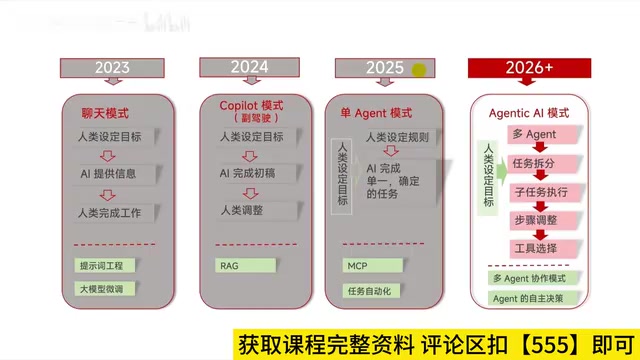
In the earliest phase, AI was essentially a chat mode tool. Users would type questions into a dialogue box, the large model would understand the intent and return accurate information. AI at this point was more like an upgraded search engine — the person still did the real work, manually opening Excel or PowerPoint and copying the AI's summaries by hand. Humans were the primary productive force; AI accounted for only a small fraction.
Next came Copilot mode. AI editors like GitHub Copilot began assisting with code writing, with users conversing with AI to get coding help. But at this stage, AI could only control localized code — the overall project structure, file creation, and debugging still required human intervention. AI accounted for roughly one-third of productivity, with humans still doing most of the work, while AI played the role of a supporting assistant.
The real turning point came with two landmark products. The first was software like Manus, capable of autonomously completing complex tasks from start to finish. For example, ask it to present a company's Q3 business information, and it will automatically scrape web data, filter for the target quarter, write to a local Excel file for analysis, and present the results in charts — all without human intervention. The second was AI editors like Claude Code, where users simply type a desired feature or project into the dialogue box, and the AI handles all the code writing, file generation, and project architecture.
The Agent Era and Agentic AI Mode
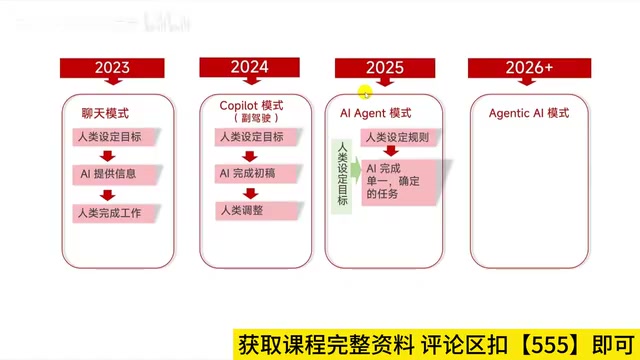
This phase is known as AI Agent mode. Here, AI occupies two-thirds of the production pipeline, with humans accounting for only one-third — humans are primarily responsible for setting goals, providing resources, issuing instructions, and establishing rules, while the Agent (the autonomous operator) does most of the actual work. Agents can call tools and leverage large models for logical reasoning. Although at this stage Agents could only handle simple tasks with well-defined workflows, it established the foundational trend in AI development: replacing humans with Agents as the primary operators in the production process. This is where the term "Year One of Agents" comes from.
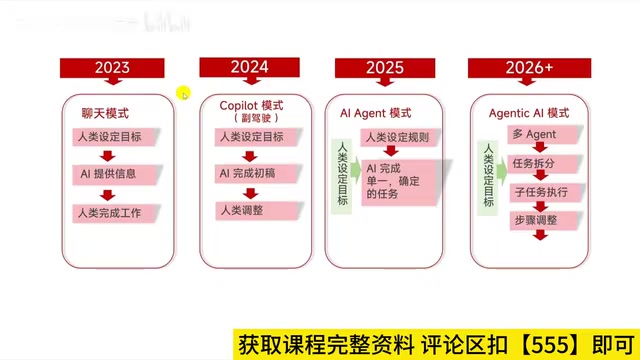
The Agent mode then evolved further — no longer a single Agent, but multiple Agents working in division of labor. When faced with complex tasks, the system can break them down and assign each subtask to an Agent with the relevant domain expertise. More critically, Agents have a reflection and adjustment thought process during execution: perform a step, check whether the expected goal was reached, adjust if the result deviates, and repeat until the actual result matches the preset goal. This is what is currently called Agentic AI mode.
From this trajectory, we can infer AI's future direction: Agent-centric, and not as isolated entities, but as multiple Agents working collaboratively — capable of using tools, leveraging large models, possessing autonomous decision-making processes and domain knowledge systems, and independently helping users solve complex tasks.
Market Trends and the Logic Behind Technology Choices
From a market perspective, the scale of AI Agents will grow in leaps over the coming years, with approximately 75% of enterprises already piloting or deploying AI Agents and integrating them into their production workflows. Some in the industry even argue that with AI Agents, a single person can have an entire company's worth of "digital employees."
This also explains the logic behind technology learning choices. Superficial new techniques are easily replaced in the rapid iteration of AI; what's truly worth learning are the capabilities at the core of the development trend — how to architect a multi-agent, autonomous decision-making AI application with professional skills, capable of completing complex tasks without user intervention. Agentic AI mode itself will continue to evolve as technology advances, but the two mental frameworks of multi-agent collaboration and agent autonomous decision-making are relatively stable, foundational concepts that won't be easily displaced.
The Technical Core: Two Essential Capability Areas
Around Agentic AI, we can identify two core capability directions. Using travel planning as a practical backdrop makes the explanation more intuitive.
Multi-Agent Collaboration
Multi-agent collaboration has two primary design philosophies. One is workflow orchestration frameworks centered on a Graph engine, which uses graph structures to orchestrate collaboration processes between Agents. The other — the more important direction — is the Agent autonomous proxy design philosophy.
In the autonomous proxy direction, there are two application frameworks worth paying attention to. One is JManus, which can be thought of as a Java version of Manus; the other is AgentScope, which belongs to the Spring AI Alibaba ecosystem and is the officially recommended framework. Since both frameworks involve Spring AI Alibaba, foundational knowledge of the related stack is also needed.
Graph engine workflow orchestration is exemplified by LangGraph (in the LangChain ecosystem) and similar components in Spring AI. The core idea is to model the collaborative workflow of a multi-agent system as a directed graph: nodes represent an Agent or processing step, edges represent data flow and trigger conditions, and conditional edges implement branching and looping. The advantage of this design is that the workflow is visual and easy to debug, making it suitable for business scenarios with relatively fixed process structures, such as a fixed pipeline of "data scraping → cleaning → analysis → report generation."
By contrast, the Agent autonomous proxy design philosophy (exemplified by Manus and JManus) does not pre-orchestrate a fixed workflow. Instead, a master-control Agent (Orchestrator) dynamically decides at runtime which sub-Agents to call and in what order, based on the task goal. Sub-Agent results are fed back to the Orchestrator for the next round of planning. This approach offers greater flexibility and is better suited for open-ended, loosely-bounded complex tasks — though it is correspondingly harder to debug. AgentScope, as the officially recommended framework within Spring AI Alibaba, integrates both philosophies to some degree, allowing developers to choose between "orchestration-first" and "autonomous-proxy-first" paradigms within the same system.
Agent Autonomous Thinking and Execution
The second core area is the Agent's autonomous thinking and execution, which can also be divided into two aspects.
The logic of autonomous thinking relies on a framework called ReAct. With this framework, an Agent can think autonomously — combining Reasoning and Acting, thinking, executing, and adjusting simultaneously.
Autonomous task execution encompasses two layers: first, the use of tools, involving protocols such as MCP (Model Context Protocol); and second, a more advanced capability — tools are not just called, but used to complete work according to a complete professional workflow. This is the currently trending professional skills system known as Agent Skills. It upgrades an Agent from "knowing how to use tools" to "working according to a professional process."
The ReAct framework (Reasoning + Acting) was proposed by Google researchers in 2022 as a prompting strategy whose core idea is to have language models alternately perform "thinking" and "acting" steps when executing tasks, rather than generating a final answer all at once. Specifically, the Agent first reasons about the current state (generating a chain of thought), then decides on the next action (calling a tool or producing output), observes the result of that action, and continues reasoning — forming a "think → act → observe" loop until the task is complete. This alternating mechanism allows the Agent to dynamically adjust its strategy based on intermediate results, significantly reducing the accumulation of hallucinations and errors. The difference between ReAct and pure Chain-of-Thought is that it introduces real interaction with the external environment, rather than purely internal reasoning. Most mainstream Agent frameworks (including LangChain, Spring AI, etc.) have built-in implementations of the ReAct pattern, allowing developers to directly build agents with autonomous decision-making capabilities without designing the reasoning loop from scratch.
MCP (Model Context Protocol) is an open standard protocol introduced by Anthropic in late 2024, designed to unify the interface specifications between large models and external tools and data sources. Before MCP, every AI application needed to write separate integration code for different tools, making maintenance extremely costly. MCP uses a standardized "server-client" architecture, allowing any large model to call capabilities such as file systems, databases, web search, and code execution in a unified manner. Agent Skills takes this a step further — rather than encapsulating individual tool calls, it packages an entire domain-specific professional workflow (such as the search → price comparison → scheduling → itinerary generation involved in "travel planning") into reusable skill modules. This enables Agents to complete complex tasks in an orderly fashion according to industry best practices, rather than cobbling together tool calls haphazardly.
A Checklist of Capabilities Worth Mastering
Overall, within the Agentic AI tech stack, learners can acquire several key capabilities: mastery of the ReAct autonomous decision-making pattern, familiarity with multi-agent collaborative architecture design, proficiency in the engineering standards of Agent Skills, familiarity with agent development in popular tech stacks, enhanced ability to decompose complex business workflows into collaborative components, and ultimately a complete AI application deployment solution.
For developers who want to remain competitive in the AI wave, rather than chasing every surface-level trend, it's better to focus deeply on the two main threads of "multi-agent collaboration" and "autonomous decision-making." They are not only the core of current Agentic AI, but also the foundational frameworks that will remain relevant for a considerable time to come.
Related articles
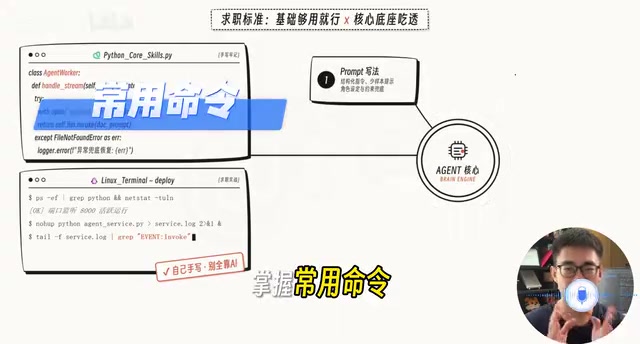
AI Agent Developer Job Hunt Guide: Four Hard Standards to Clear Before You Apply
A practical guide for landing AI Agent developer roles: four measurable standards — project runs, problems debuggable, solution explainable, interviews survivable.
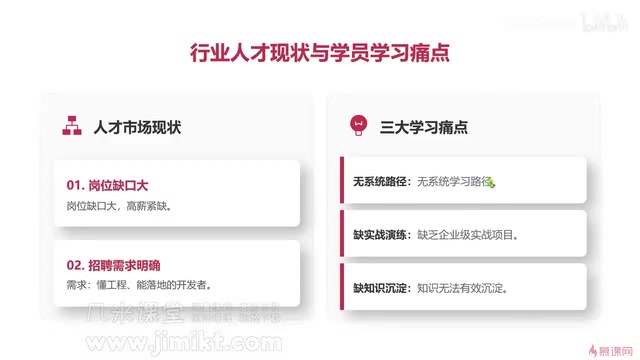
Multi-Agent Development Guide: From Monolithic AI to Team Collaboration in Practice
A beginner's guide to multi-agent development covering core advantages, common learning pain points, enterprise tech stacks, and engineering methodology for AI developers.
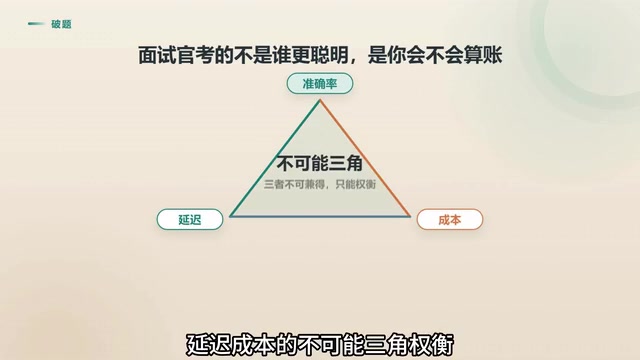
Agent Skill Routing: Retrieval vs. LLM vs. Two-Stage Architecture Compared
Retrieval or LLM for Agent skill routing? Compare coarse-filter vs. fine-select architectures on latency, accuracy, and cost — with 4 key production considerations.