Complete Guide to Claude Code: Installation, Configuration, and Practical Comparison with Cursor/TRAE

Claude Code is Anthropic's project-level AI coding assistant, leading rivals in code accuracy and full-project understanding.
Claude Code is an AI programming tool built by Anthropic on the Claude Sonnet model. Its core strength is reading entire project codebases (leveraging a 200K token context window), automatically generating and debugging code with best-in-class accuracy among similar tools. Unlike standalone IDEs such as Cursor and TRAE, Claude Code uses a plugin model that integrates into any mainstream IDE. Chinese users facing Anthropic's regional restrictions can configure third-party APIs like DeepSeek. The article argues that AI programming is entering the "Vibe Coding" era, where developers' competitive edge shifts from writing code to directing AI.
What is Claude Code?
Claude Code is an AI programming assistant developed by Anthropic. Anthropic was founded in 2021 by siblings Dario Amodei and Daniela Amodei, former OpenAI Research VP, and is currently one of the most closely watched companies in the global AI space. Their core philosophy is building safe, controllable AI systems. The Claude model series is Anthropic's flagship product—the Sonnet series is known for its cost-effectiveness and coding capabilities, while the Opus series targets more complex reasoning tasks. Claude Code is a developer tool built on the Sonnet series' coding prowess, embedding the model's code comprehension and generation capabilities directly into development workflows.
Unlike traditional conversational AI coding, Claude Code doesn't require opening any web pages. Once installed locally on your computer, it integrates directly into your existing development tools for project development.
Its core capability lies in: reading through all code files in an entire project, passing them as context to the large language model, automatically generating business code, debugging and fixing errors, and ultimately outputting accurate, usable code versions. This relies on the "Context Window" technology of large language models—the context window refers to the maximum text length a model can process in a single inference. The Claude Sonnet series supports context windows up to 200K tokens (roughly equivalent to 150,000 English words or a medium-length book), enabling it to load dozens of code files for analysis in one go. By comparison, the early GPT-3.5 only supported 4K tokens of context, making it impossible to perceive the full picture of a project. It's this ultra-long context capability that enables Claude Code to achieve the qualitative leap from "code snippet completion" to "project-level code understanding."
This is fundamentally different from conversational coding in DeepSeek or ChatGPT—those can only give you code snippets without perceiving the project's full scope.
The Evolution of AI Programming Tools: From Copilot to Claude Code
Looking back at the development history of AI programming tools, a clear evolutionary path of continuously advancing capabilities emerges.
The GitHub Copilot and Cursor Phase
The earliest was GitHub Copilot, which became popular around 2023 and implemented automatic code completion as an IDE plugin—already giving developers a sense of revolutionary efficiency improvement. GitHub Copilot was first released as a technical preview in 2021 and went commercial in 2022, becoming the industry's first widely adopted AI programming assistant. Based on OpenAI's Codex model (a code-fine-tuned version of GPT-3), it runs as a VS Code plugin, predicting and completing code by analyzing the current file's context. According to official GitHub data, developers using Copilot see an average 55% increase in coding speed. However, Copilot's limitation is that it primarily infers from the current file and a few adjacent files, lacking the ability to globally understand the entire project architecture.
Then Cursor burst onto the scene—not only able to complete code but also perform more intelligent coding operations, taking capabilities up a notch. Developed by Anysphere, Cursor is an AI-native IDE deeply rebuilt on VS Code's open-source codebase (Electron + Monaco Editor). Its core innovation elevates AI capabilities from "plugin-level" to "IDE-level"—going beyond code completion to enable cross-file editing, code refactoring, and natural language instruction execution. Cursor has built-in support for multiple large models (including GPT-4, Claude, etc.) and achieves partial project structure awareness through proprietary code indexing technology. By 2024, Cursor's valuation had exceeded several billion dollars, making it a star product in the AI programming space.
TRAE and the Domestic AI Programming Ecosystem
Later came TRAE (available in international and domestic versions). The domestic version excels at Chinese language understanding, with optimizations specifically for Chinese programmers, and the domestic version is free to use—a significant advantage. TRAE (Think, Run, Analyze, Evolve) is an AI programming IDE launched by ByteDance, also built on the VS Code architecture. The domestic version integrates ByteDance's proprietary Doubao model, with deep optimizations for Chinese programming scenarios including Chinese comment generation and Chinese technical documentation comprehension. Its free-to-use strategy has significantly lowered the barrier for Chinese developers to use AI programming tools. However, when dealing with niche tech stacks, TRAE's code generation accuracy may decrease due to the Doubao model's relatively limited training data on certain specialized frameworks (such as specific Rust libraries, Elixir, etc.).
Why Claude Code Stands Out
The market also includes OpenCode (relatively difficult to use), Codex (from OpenAI, reportedly comparable to Claude Code when paired with GPT-5), and other tools. OpenAI launched Codex CLI (a command-line programming assistant) in 2025, positioned very similarly to Claude Code, also running through terminal integration. OpenAI claims that Codex paired with the upcoming GPT-5 model will achieve new heights in code generation accuracy. This reflects how competition in the AI programming tools space is deepening from the "IDE experience" layer to the "underlying model capability" layer. The industry generally believes that Claude Sonnet 4 slightly outperforms GPT-4o on programming benchmarks (such as SWE-bench, HumanEval, etc.), though the release of GPT-5 may change this landscape.
After comprehensive comparison, Claude Code performs most strongly in code accuracy—the core reason for its rapid rise to popularity.
Ultimately, the capability ceiling of all programming assistants depends on the underlying large model's level. Claude Code excels precisely because Anthropic's Sonnet series models perform exceptionally well in the programming domain.
The Fundamental Difference Between Claude Code and Cursor/TRAE
There's a very important concept to clarify here:
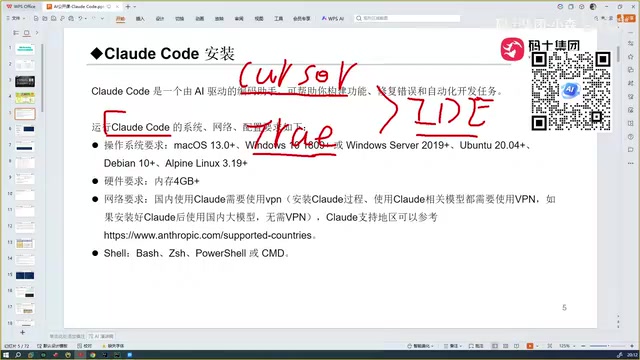
- Cursor and TRAE are IDEs (Integrated Development Environments)—essentially VS Code-based development tools that you can use immediately after downloading and double-clicking to install.
- Claude Code is not an IDE, but software that can be integrated into various development tools. It can be embedded into Cursor, TRAE, VS Code, IntelliJ IDEA, PyCharm, and virtually all mainstream IDEs as a plugin.
These two approaches represent two design philosophies for AI programming tools. The standalone IDE approach (like Cursor, TRAE) has the advantage of deeply modifying the editor's interaction experience for tighter AI-editor collaboration; the downside is that users must migrate to a new development environment with higher learning costs. The plugin approach (like Claude Code) is the opposite—it respects developers' existing toolchain habits, communicating with the host IDE through standard protocols like the Language Server Protocol (LSP) to inject AI capabilities. For teams that have deeply customized VS Code or JetBrains IDEs, Claude Code's plugin approach is clearly more attractive.
Put simply, you don't need to switch your existing development environment—just integrate Claude Code into it to gain powerful AI programming capabilities. This design gives it a far wider range of applicability than any single IDE.
Claude Code Installation Guide and Important Notes
System and Hardware Requirements
| Item | Requirement |
|---|---|
| Operating System | macOS, Windows, Linux |
| Memory | 4GB or more |
| Network | VPN required during installation; can use domestic models without VPN after installation |
Detailed Installation Steps
On macOS, execute installation commands through the Terminal; on Windows, execute corresponding commands through PowerShell or CMD. The entire installation process takes approximately 3-5 minutes.
Important Notes:
- Windows users must install Git first, as Claude Code relies on Git for automatic version updates. In fact, Git plays the role of a "safety net" in AI programming workflows: when AI makes large-scale code modifications, Git's version control capabilities allow developers to roll back to any historical state at any time. Claude Code automatically creates Git commit points before executing code modifications, ensuring every AI operation is traceable and reversible. This design reflects Anthropic's "safety-first" product philosophy—maintaining human ultimate control while granting AI powerful code modification capabilities.
- If red error messages appear during installation, the vast majority of cases are caused by an inactive VPN preventing access to external networks
- After successful installation, Claude Code will automatically update its version (e.g., from 2.1.97 to 2.1.116) without manual intervention

Basic Usage
Usage is straightforward: navigate to your project directory and type the claude command in the terminal to launch. On first entry, you'll be asked to trust the current directory (Trust this folder). After confirming, you can begin conversational programming.
Model Configuration Solutions for Chinese Users
By default, Claude Code will guide you to log into an Anthropic website account, but there's an unavoidable reality: Anthropic does not offer services to mainland China and Hong Kong regions. Even if you successfully register with a foreign phone number, there's a risk of being banned when using it within China.
Solution: Chinese users can use Claude Code by configuring third-party APIs. Essentially, this leverages Claude Code's "replaceable model backend" architecture—Claude Code supports connecting to any large model through the OpenAI-compatible API format. For example, configuring DeepSeek V3/V4 or other domestically available models allows full use of Claude Code's programming functions. Beyond DeepSeek, mainstream Chinese models like Alibaba's Qwen and Zhipu's GLM-4 can also be integrated. DeepSeek V4 (developed by DeepSeek) performs excellently on multiple programming benchmarks, and its API pricing is roughly one-tenth of Claude's official API—making it a cost-effective choice for Chinese developers. However, note that after switching the underlying model, code generation accuracy and style will differ from the original Claude version, so developers need to test and tune according to actual project requirements. This is the most critical configuration step for Chinese developers in practice.
Summary of Claude Code's Core Advantages and Future Outlook
Claude Code represents a new pinnacle in current AI programming tools. Its core advantages can be summarized in four points:
- Full-project context understanding — Not fragment-based conversation, but reading through the entire project codebase
- Extremely high code accuracy — The most outstanding performer in cross-tool AI programming evaluations
- Automatic debugging and error correction — Capable of independently discovering and fixing code issues
- Flexible integration methods — Can be embedded into Cursor, VS Code, TRAE, or any mainstream IDE
For developers, Claude Code does bring significant disruption, but from another perspective, those who leverage these tools well will gain multifold productivity improvements. The era of Vibe Coding is arriving, and the core competitive advantage is shifting from "being able to write code" to "being able to harness AI to write code."
The concept of Vibe Coding was proposed by Andrej Karpathy—former Tesla AI Director and OpenAI co-founder—in early 2025. He described an entirely new way of programming: developers no longer write code line by line, but describe requirements in natural language, let AI generate code, then iteratively optimize through cycles of running, testing, and feedback. The developer's role transforms from "code writer" to "requirement describer" and "quality reviewer." The deeper implication of this philosophy is that it may redefine talent standards in software engineering—understanding business logic, breaking down requirements, and AI collaboration skills will become more important than pure coding technique.
Whether you're a frontend, backend, or full-stack developer, it's worth investing time now to get hands-on with Claude Code and adapt early to the new AI-assisted programming workflow.
Related articles
 Tutorials
ChatGPT Plus Subscription Guide: Are GPT-5.5, image-2, and Codex Worth the Upgrade?
A detailed look at ChatGPT Plus features — GPT-5.5, image-2, and Codex — with a Plus vs Pro comparison and a complete step-by-step subscription guide for users outside the US.
 Tutorials
Harness AI Engineering in Practice: Using Claude Code to Master Enterprise-Level E-Commerce Development
Deep dive into Harness AI Engineering: master enterprise e-commerce development with Claude Code using the Rules, Skills, Wiki, and Changes framework.
 Tutorials
Cursor + Codex Dual-IDE Collaboration: A Practical Methodology for Open-Source Project Customization
A complete methodology for open-source project customization based on real-world experience, detailing the Cursor+Codex dual-IDE workflow, seven-stage process, MVP validation, and AI source code reading techniques.