Complete Guide to Harness Engineering: The Three-Layer Architecture for AI Engineering Development

Harness Engineering uses three layers—information, constraint, and automation—to make AI development reliable.
Harness Engineering is the latest AI engineering paradigm that goes beyond prompt and context engineering. It introduces a three-layer system: the Information Layer helps AI understand your project, the Constraint Layer prevents common failure modes like direction drift and over-engineering, and the Automation Layer enables self-correction through automated testing loops. Industry leaders like OpenAI and Anthropic already apply these principles in practice.
Why You Need to Know About Harness Engineering
When using AI Agents for code generation or project development, a common pain point is: AI gradually drifts off course during generation, producing output that deviates from expectations with serious directional errors. This isn't because AI lacks capability—it's because we lack a systematic engineering methodology to harness it.
Harness Engineering is an engineering paradigm born to solve this exact problem. It represents the latest stage in AI engineering evolution, helping developers systematically constrain, guide, and verify AI Agent behavior, making AI a truly reliable development partner.

Three Evolutionary Stages of AI Engineering Paradigms
To understand Harness Engineering, you first need to grasp the evolutionary trajectory of AI engineering paradigms. AI engineering has gone through three key stages:
Stage One: Prompt Engineering
This is the stage most people are familiar with. By carefully designing prompts, we guide large models to generate desired results. It solved the basic problem of "how to communicate with AI," but in complex projects, the limitations of relying solely on prompts become glaringly obvious.
Prompt Engineering emerged during the initial popularization of large language models in 2022-2023. Its core methods include Zero-shot prompting, Few-shot prompting, Chain-of-Thought, and other techniques. For simple tasks, well-crafted prompts can indeed significantly improve output quality. However, when facing engineering projects with thousands of lines of code, the limitations of prompts are fully exposed: the context window of a single conversation is limited and cannot carry the complete project context; prompt effectiveness is highly dependent on wording, lacking engineering-grade reproducibility; and they cannot handle complex development tasks involving multiple steps and multi-file coordination. These limitations directly catalyzed the evolution of subsequent paradigms.
Stage Two: Context Engineering
Context Engineering builds upon prompts by introducing richer background information management. Through technologies like RAG (Retrieval-Augmented Generation), Agents, and long context windows, AI can understand more complex business scenarios. This stage solved the problem of "how AI understands the project."
One of the core technical pillars of Context Engineering is RAG (Retrieval-Augmented Generation), an architectural pattern that combines external knowledge bases with large language models. Its working principle is: when a user asks a question, the system first retrieves the most relevant document fragments from a vector database, then injects these fragments as context into the prompt, and finally has the large model generate an answer. In code development scenarios, RAG allows AI to retrieve relevant code files, API documentation, design specifications, and other information from the project in real-time, maintaining consistency with the existing codebase when generating new code. Additionally, as models like Claude and GPT-4 have expanded context windows to 100K or even 200K tokens, developers can provide more project files to the model at once—but this also introduces the "needle in a haystack" problem, where models may overlook critical information in ultra-long contexts.
Stage Three: Harness Engineering
Harness Engineering is the most cutting-edge paradigm today. It focuses not only on how to make AI understand requirements, but more importantly on how to systematically constrain AI from making mistakes, how to automatically verify AI output, and how to auto-correct when errors occur. This represents a qualitative leap from "usable" to "good" to "reliable."
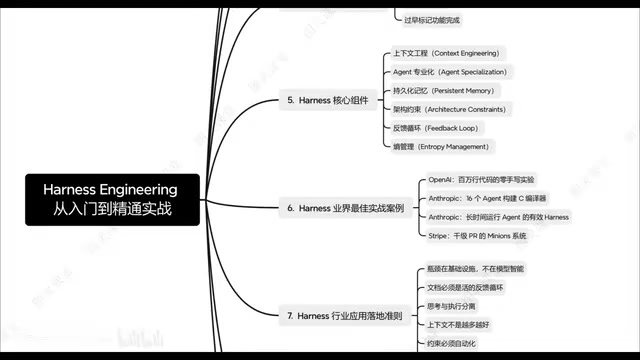
Core Architecture of Harness Engineering: The Three-Layer System
The implementation of Harness Engineering can be broken down into three key layers, each solving different problems:
Information Layer: Helping the Agent "Understand" Your Project
The Information Layer is the foundation of the entire system. Its core objective is to ensure the AI Agent fully understands the project's architecture, code standards, business logic, and tech stack. This isn't simply dumping code to the AI—it requires systematically organizing project information, including:
- Overall architectural design documentation
- Code standards and naming conventions
- Core business logic explanations
- Tech stack and dependency relationships
Only when the Agent truly "understands" the project can subsequent code generation be accurate.

Constraint Layer: Preventing the Agent from "Making Mistakes"
This is the most innovative core of Harness Engineering. The Constraint Layer ensures AI Agent output doesn't deviate from expected directions through a series of rules and restrictions.
In actual development, common Agent failure modes include:
- Direction drift: Generated code gradually deviates from requirements
- Style inconsistency: Conflicts with existing project code style
- Over-engineering: Introducing unnecessary complexity
- Dependency chaos: Importing third-party libraries the project doesn't need
The Constraint Layer performs real-time boundary checks during the Agent's code generation process through predefined rule sets, eliminating these failure modes at their inception.
The technical implementation of the Constraint Layer typically relies on a combination of mechanisms. First is the "system prompt + rules file" pattern—for example, Cursor's .cursorrules file and GitHub Copilot's instruction files, which define boundary conditions for code generation in a declarative manner. Second is AST (Abstract Syntax Tree) level static analysis, which immediately performs structural syntax checks on output after code generation to ensure compliance with predefined code patterns. More advanced implementations also include formal verification-based constraints, such as type system constraints and interface contract constraints. In industrial practice, the Constraint Layer often needs to balance "soft constraints" and "hard constraints"—hard constraints are rules that must never be violated (such as security specifications), while soft constraints are suggestions that should preferably be followed but allow reasonable deviation (such as code style preferences).
Automation Layer: Enabling Agent "Self-Correction"
The Automation Layer addresses verification and correction. After the Agent completes code generation, the Automation Layer will:
- Automatically verify code correctness (compilation checks, unit tests, integration tests)
- Automatically locate error causes when problems are discovered
- Auto-correct or provide correction suggestions
This forms a closed loop: generate → verify → correct → re-verify, dramatically reducing the need for manual intervention.
The Automation Layer's core relies on the capabilities of modern CI/CD (Continuous Integration/Continuous Deployment) pipelines. In traditional software engineering, CI/CD is already a mature practice, including automated compilation, unit testing (JUnit, pytest, etc.), integration testing, code coverage checking (JaCoCo, Istanbul, etc.), and static code analysis (SonarQube, ESLint, etc.). Harness Engineering front-loads these verification capabilities into the immediate feedback loop of AI code generation—every time AI generates a piece of code, relevant test suites are immediately triggered, and test results are fed back to the Agent, forming a tight "generate-test-correct" cycle. This pattern is academically known as "Test-Driven Code Generation," and research has shown it can improve the first-pass rate of AI-generated code from approximately 40% to over 80%.
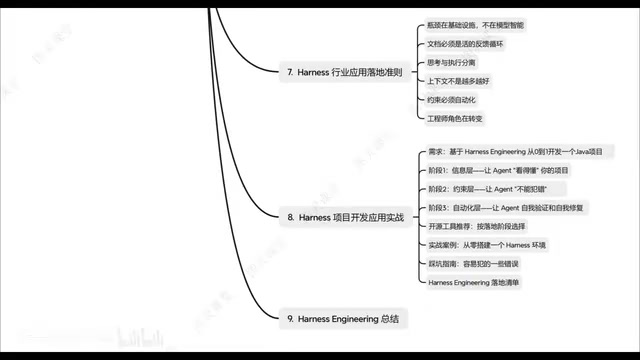
Industry Best Practices: From OpenAI to Anthropic
Notably, Harness Engineering is not a purely theoretical concept—leading AI companies like OpenAI and Anthropic have already extensively applied this approach in actual engineering.
OpenAI disclosed in their internal engineering blog that when using AI-assisted development, they employ a strict layered review mechanism: AI-generated code first passes through automated test suite verification, then undergoes AI security review systems checking for potential vulnerabilities and performance issues, and only then enters human code review. Anthropic, in their published "Claude Best Practices" documentation, emphasizes the engineering application of "Constitutional AI"—constraining AI behavioral boundaries through predefined principle sets (Constitution). Additionally, Anthropic's research team proposed the "Tool Use" paradigm, allowing AI Agents to proactively invoke compilers, testing frameworks, and other external tools to verify their own output during code generation—this is precisely the core concept of Harness Engineering's Automation Layer.
Several common core ideas emerge from these companies' engineering practices:
- Progressive Trust: Don't let AI complete all work at once; instead, advance step by step, module by module
- Continuous Verification: Each step has a corresponding verification mechanism
- Failure Rollback: When AI output doesn't meet expectations, there's a clear rollback strategy
- Knowledge Accumulation: Solidify successful patterns into reusable templates
Progressive Trust originates from the "principle of least privilege" and "defense in depth" concepts in security engineering. In AI engineering scenarios, it means AI Agents should not be granted full project modification permissions from the start. A typical practical approach is: in the first phase, only allow AI to generate independent utility functions; in the second phase, after verifying function quality, allow AI to modify module-level code; in the third phase, after establishing sufficient trust, allow AI to perform architecture-level refactoring. This progressive permission release strategy shares the same philosophy as "Canary Release" in DevOps—reducing the risk of large-scale failure through small-scope verification.
From these best practices, the core principle for Harness Engineering industry implementation can be distilled: first understand, then constrain, then automate—three progressive layers, none dispensable.
Practical Path: Building a Harness Development Environment from Scratch
In actual project implementation, using Java as an example, the complete process of developing a project from zero based on Harness Engineering follows a core philosophy: essentially no need to manually write a single line of code. But this doesn't mean developers have nothing to do—on the contrary, the developer's role transforms from "writing code" to "designing constraints, defining rules, and verifying output."
AI Programming Tool Selection Strategy
At different development stages, different AI programming tools should be chosen:
- Information Layer building phase: Tools that excel at project understanding and documentation generation
- Constraint Layer definition phase: Tools that support rule configuration and template management
- Automation verification phase: Tools that deeply integrate with CI/CD workflows
Choosing the right tool combination is key to efficient Harness Engineering implementation.
Common Pitfalls and How to Avoid Them
In practice, several common pitfalls deserve special attention:
- Rushing to generate code before the Information Layer is adequate — The result will inevitably be AI misunderstanding, with extremely high rework costs
- Constraint rules that are too broad or too strict — Too broad equals no constraints; too strict limits AI's creativity
- Neglecting automated verification — Manually checking large volumes of AI-generated code is extremely inefficient and prone to oversights
- Not establishing feedback loops — Lessons learned from each project should be accumulated as constraint rules for the next one
Summary: The Core Value of Harness Engineering
Harness Engineering represents an important directional shift in AI-assisted development: from focusing on AI's capability ceiling to focusing on AI's reliability floor. It doesn't pursue making AI do amazingly impressive things, but rather ensures AI produces high-quality results stably, reliably, and controllably in engineering scenarios.
For developers who want to systematically learn AI engineering development, mastering Harness Engineering's three-layer system (Information Layer → Constraint Layer → Automation Layer) and understanding the design philosophy behind it will be one of the most valuable technology investments for the future.
Key Takeaways
Related articles

WebMCP in Practice: How MakeMyTrip Is Reshaping the Travel Booking Experience
India's largest OTA platform MakeMyTrip uses WebMCP to standardize AI Agent interactions with web apps, replacing fragile DOM scraping with natural language-driven test automation and simplified complex booking scenarios.

Deep Dive into the EYG Programming Language: A New Portable Programming Paradigm Designed for Humans
Deep analysis of the EYG programming language's core design, including algebraic effects, program state persistence, and cross-platform portability, exploring how it addresses modern software fragmentation.

WebMCP in Practice: How MakeMyTrip Is Reshaping the Travel Booking Experience
India's largest OTA platform MakeMyTrip uses WebMCP to standardize AI Agent interaction with web apps, solving DOM scraping fragility, enabling natural language test automation, and simplifying complex international flight bookings.