Complete Guide to Pursuing a PhD in Computer Vision & Robotics: A Research Roadmap from Scratch

A comprehensive roadmap for aspiring PhD students in computer vision and robotics research.
This guide helps aspiring PhD students at the intersection of computer vision and robotics navigate common challenges: overcoming a low GPA through research output and strong recommendations, building essential math and programming foundations, finding a research niche through systematic exploration, and prioritizing activities that matter most for PhD admissions—with real research experience and publications at the top.
A Real Dilemma: Wanting to Pursue a PhD but Not Knowing Where to Start
Recently, a young person who just earned their Bachelor's degree in Computer Science posted on Reddit asking for help. Their goal was clear: apply for a fully-funded Master's or PhD program at the intersection of computer vision and robotics. But the problem was equally clear—they were a complete newcomer to research, feeling both excited and overwhelmed by the sheer number of hot topics: object detection, semantic segmentation, 3D vision, SLAM, Embodied AI, Vision-Language Models (VLMs), robot perception, and more.
The intersection of computer vision and robotics is one of the most active areas in current AI research. Object detection (e.g., YOLO series, DETR) enables robots to recognize objects in their environment; semantic segmentation (e.g., Mask2Former) helps robots understand which category every pixel in a scene belongs to; 3D vision reconstructs the three-dimensional world from 2D images, providing robots with spatial understanding. SLAM (Simultaneous Localization and Mapping) is a core technology for mobile robots, allowing them to simultaneously build maps of unknown environments while localizing themselves. Embodied AI is a recent research trend emphasizing that AI must learn through physical interaction with the world, rather than solely from static datasets. Vision-Language Models (VLMs) like GPT-4V and LLaVA can understand both images and text simultaneously, opening up possibilities for robots to execute complex tasks through natural language instructions.
What made this person even more anxious was their low GPA, fearing it would hurt their chances of getting into fully-funded programs.
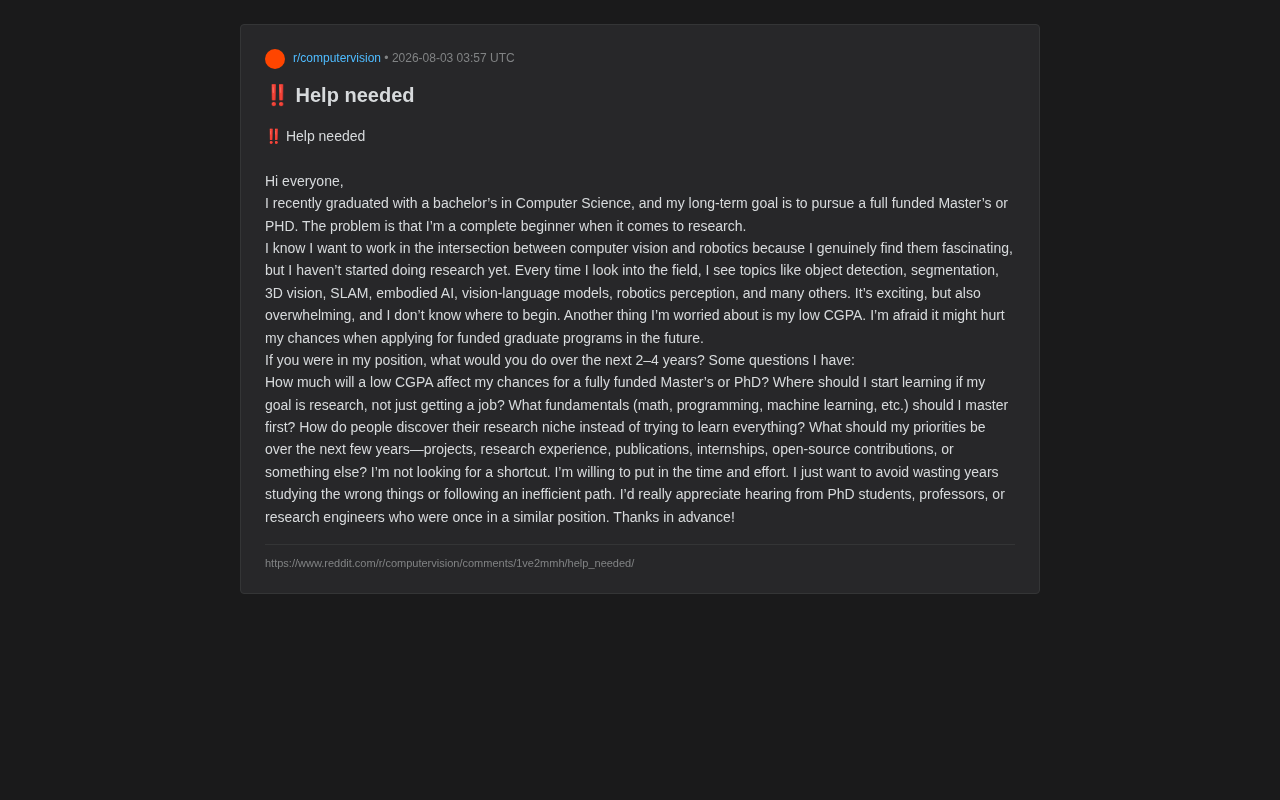
This question is highly representative. Almost everyone who embarks on a research career experiences similar confusion at the starting line. This article attempts to systematically answer the core questions raised, providing an actionable roadmap for beginners aspiring to pursue graduate studies in CV + robotics.
Will a Low GPA Really Ruin Your PhD Chances?
Let's face the most anxiety-inducing question head-on: How much does a low GPA actually matter?
The answer is—it matters, but it's far from decisive. In PhD admissions, what committees truly value is research potential, and GPA is just one signal among many. Here's a harsh but honest truth: a strong recommendation letter from a well-known professor, a co-authored paper, or substantial research experience often carries more weight than a 0.5 GPA difference.
Four Strategies to Compensate for a Low GPA
- Cover it with research output: Even a workshop paper, an arXiv preprint, or demonstrable results from lab work can powerfully prove your research ability.
- Secure strong recommendation letters: Find a mentor willing to guide you long-term who can describe your specific research performance in their letter, rather than speaking in generalities.
- Take advanced courses: If your undergraduate grades were poor, you can prove you've grown through graduate-level coursework (or even formally certified online courses).
- Address it honestly in your SOP: If there were objective reasons for your low GPA, briefly explain them in your personal statement and showcase your upward trajectory.
In short, GPA is a threshold, not a finish line. Research experience is the real currency in PhD applications.
Where Should You Start Learning for CV & Robotics Research?
A common mistake among beginners is conflating "preparing for a job" with "preparing for research." The required skills overlap, but the focus is entirely different. Research requires you to read and understand papers, reproduce methods, identify problems, and propose new ideas.
Essential Math and Programming Foundations
The CV + robotics direction demands relatively strong math and programming skills. Build your foundation in the following priority order:
-
Mathematics: Linear algebra (matrix operations, SVD, and eigenvalues are the lifeblood of CV and SLAM), probability and statistics, multivariate calculus, and optimization theory. The robotics direction also requires knowledge of rigid body transformations and Lie groups/Lie algebras.
Regarding SVD (Singular Value Decomposition): it's one of the most fundamental yet powerful mathematical tools in computer vision. In multi-view geometry, SVD is used to solve for the Fundamental Matrix and Essential Matrix, which describe the geometric relationships between two camera viewpoints. In point cloud registration, SVD efficiently solves for the optimal rigid body transformation between two sets of points. In dimensionality reduction and principal component analysis, SVD helps extract the most important feature directions from data. Additionally, when solving overdetermined systems of equations (such as computing camera projection matrices using the DLT algorithm), SVD provides the optimal solution in the least-squares sense.
Regarding Lie groups and Lie algebras: 3D rotations form the Special Orthogonal group SO(3), and rigid body motions form the Special Euclidean group SE(3)—both are Lie groups. A Lie algebra is the tangent space of a Lie group at the identity element, allowing us to approximate group multiplication using addition in vector space. This is crucial for pose graph optimization and Bundle Adjustment in SLAM. Classic visual SLAM systems like ORB-SLAM3 and LSD-SLAM, as well as recent deep learning-based SLAM methods, rely heavily on these mathematical tools.
-
Programming skills: Python is the best starting language, but high-performance code in the CV/robotics field often uses C++. Familiarity with PyTorch is standard for modern deep learning research.
-
Machine Learning and Deep Learning: Transition from classical ML to deep learning, with emphasis on CNN and Transformer architectures and their applications in visual tasks.
Transformers were originally proposed by the Google team in the 2017 paper "Attention Is All You Need" for natural language processing. Their core mechanism—Self-Attention—allows the model to dynamically attend to all other elements in a sequence when processing each element. In 2020, Vision Transformer (ViT) divided images into patch sequences and fed them into Transformers, proving that pure Transformer architectures could match or even surpass CNNs in image classification. Since then, DETR introduced Transformers to object detection, Swin Transformer improved efficiency through hierarchical design, and Segment Anything Model (SAM) demonstrated Transformers' powerful generalization in segmentation tasks. In robotics, Transformers are used to model action sequences (e.g., RT-2, Octo), enabling robots to perform complex manipulation tasks by learning from large-scale demonstration data.
-
Domain-specific knowledge: Multi-view geometry, camera models, point cloud processing, SLAM principles, etc.
Learning Path from Courses to Papers
Start by systematically going through open courses (such as Stanford CS231n, CMU's robotics courses), then transition to reading papers and hands-on reproduction as soon as possible. Research ability isn't built by passively watching lectures—it's forged in the cycle of "read → reproduce → improve."
How to Find Your Research Niche?
The poster listed a long string of sub-fields and then fell into the trap of "wanting to learn everything but mastering nothing." This is a classic beginner's pitfall.
The truth is: nobody finds their niche right away. Research directions "emerge" through hands-on work—they're not planned in advance.
Three Steps to Converge on a Research Direction
- Broad scanning: Spend 1-2 months casually reading survey papers across sub-fields to build a mental map and understand what problems each direction is solving.
- Deep diving: Pick 1-2 directions that excite you most, carefully read top-venue papers from the past 3 years (CVPR, ICCV, ECCV, CoRL, RSS, ICRA), and try to reproduce 1-2 representative works.
- Converge through practice: When you start reproducing work, discover flaws in existing methods, and develop thoughts like "what if we tried this instead?"—your niche naturally emerges.
Regarding the conference ecosystem: The three top computer vision venues are CVPR (every June), ICCV (odd years, October), and ECCV (even years, October), with acceptance rates typically around 25-30%. Top robotics conferences include ICRA (IEEE International Conference on Robotics and Automation), IROS, RSS (Robotics: Science and Systems), and CoRL (Conference on Robot Learning, focusing on robot learning). Understanding the positioning and style of these conferences helps you assess the maturity and future trends of a research direction.
For the CV + robotics intersection, Embodied AI and robot perception are currently very promising directions, and the combination of vision-language models with robot control is a particularly hot research topic. But when choosing a direction, besides interest, also consider the advisor resources and hardware conditions available to you.
How to Prioritize Your PhD Application Preparation?
The poster asked a key question: projects, research experience, papers, internships, open-source contributions—what should you prioritize?
For someone aiming for a PhD, the priority order should be:
First Priority: Genuine Research Experience
Find a way into a lab—whether as an undergraduate research assistant at your own university, through remote collaboration, or by cold-emailing professors. A productive research experience (even with a co-authored paper) far outweighs ten course projects. This is the most important asset in a PhD application.
Cold emailing professors is a crucial part of PhD applications, especially for applicants whose GPA isn't their strength. An effective cold email should include: deep understanding and valuable questions or ideas about 1-2 of the professor's recent specific papers, your own relevant background and existing technical preparation, and what you can contribute to their lab. Remote Research Assistantships (Remote RA) have become increasingly common since the pandemic, and many professors are willing to take on remote collaborators, especially when you can demonstrate specific technical capabilities (e.g., code reproduction, experimental design).
Second Priority: Paper Publications
If your research experience can be converted into a paper (even a workshop paper or second-authorship), the benefit to your application is exponential. It directly proves you can complete the full research cycle.
For beginners, workshop papers are an excellent starting goal—they typically have short review cycles (4-6 weeks), higher acceptance rates, and still carry meaningful weight since they're affiliated with top conferences. While arXiv preprints haven't undergone peer review, they've become an important channel for rapidly disseminating research results in the AI field, and many professors follow new arXiv work when evaluating applicants' research capabilities.
Third Priority: High-Quality Projects and Open-Source Contributions
When you don't have formal research opportunities, doing solid projects on your own, reproducing top-venue papers, and open-sourcing your code is an excellent way to demonstrate ability. These can also serve as conversation starters when contacting professors. Ways to join research communities include: contributing to open-source robotics/CV projects (such as the ROS community, MMDetection, Habitat platform), following and interacting with researchers on Twitter/X, and joining online reading groups. This social capital often translates into unexpected opportunities during applications.
Relatively Lower Priority: Industry Internships Unrelated to Research
Industry internships help with job hunting, but have limited value for pure research-track PhD applications—unless they're research internships (e.g., at corporate research labs, positions with paper output).
Practical Advice for Research Beginners
The poster was very candid: "I'm not looking for shortcuts. I'm willing to invest time and effort—I just don't want to waste years going down the wrong path." This mindset itself is incredibly valuable.
Based on the analysis above, here are a few core pieces of advice:
- Engage with real research as early as possible—don't wait until you feel "ready." You'll never feel fully prepared.
- Be proactive: email professors, contribute to open-source projects, join research communities. Opportunities often come to those who reach out.
- Maintain a long-term perspective: 2-4 years is enough to grow from a complete beginner into a competent researcher, but only if you continuously iterate in the right cycle.
- Don't let GPA trap you: Channel your energy into things that genuinely prove your research ability.
There's no single right answer on the research path, but when your direction is right, your effort won't be wasted.
Key Takeaways
Related articles

ilolink: A Registry That Lets Your Team's AI Agents Share a Single Knowledge Base
ilolink is a knowledge registry designed for AI Agents that supports MCP protocol, enabling all team AI assistants to read the same versioned, reviewed Skills, Specs, Runbooks, and other knowledge assets.

Cursor's $60 Billion Valuation: Bubble or Moat?
Why is Cursor worth $60B? Deep analysis of Cursor vs VSCode+Copilot, the business logic of AI-native editors, revenue growth data, and the bull/bear debate around its moat.

Google AI Student Deal: $5/Month Subscription Includes YouTube Premium
Google offers students a $5/month AI subscription including Gemini AI tools and YouTube Premium Lite for 12 months. Learn how to get this student-exclusive deal.