Computer Agent: An Open-Source Rust AI Desktop Agent That Automatically Controls Mouse, Keyboard, and Browser

Open-source Rust project Computer Agent lets AI directly control your terminal, browser, and peripherals.
Computer Agent is an open-source desktop AI agent built in Rust that enables AI to directly control a computer's terminal, browser, mouse, and keyboard through system APIs and visual understanding, with users issuing instructions in natural language. The project reflects the industry trend of AI Agents moving from text conversation to actual control, complementing commercial solutions like Anthropic's Computer Use and OpenAI's Operator, while also facing security challenges such as prompt injection and privilege escalation.
Project Overview: AI Directly Controlling Your Computer
As the AI Agent space continues to heat up, an open-source project called Computer Agent is rapidly gaining traction on GitHub. Built by developer suitedaces, this desktop application enables AI to directly control your computer—including the terminal, browser, mouse, and keyboard—achieving true "AI-operated computing."
AI Agents refer to artificial intelligence systems capable of perceiving their environment, making autonomous decisions, and taking actions to achieve goals. Unlike traditional chatbots, AI Agents possess planning, memory, and tool-calling capabilities, allowing them to decompose complex tasks into multiple steps and execute them sequentially. Since 2023, as large language model (LLM) reasoning capabilities have significantly improved, AI Agents have become one of the hottest technical directions in the industry. From AutoGPT igniting community interest to major companies releasing Agent frameworks one after another, this space is rapidly moving from proof-of-concept to practical deployment. Computer Agent is a representative project in this wave, focusing specifically on desktop control scenarios.
Since its launch, the project has earned 634 Stars and 77 Forks, written in Rust to achieve a solid balance between performance and security.
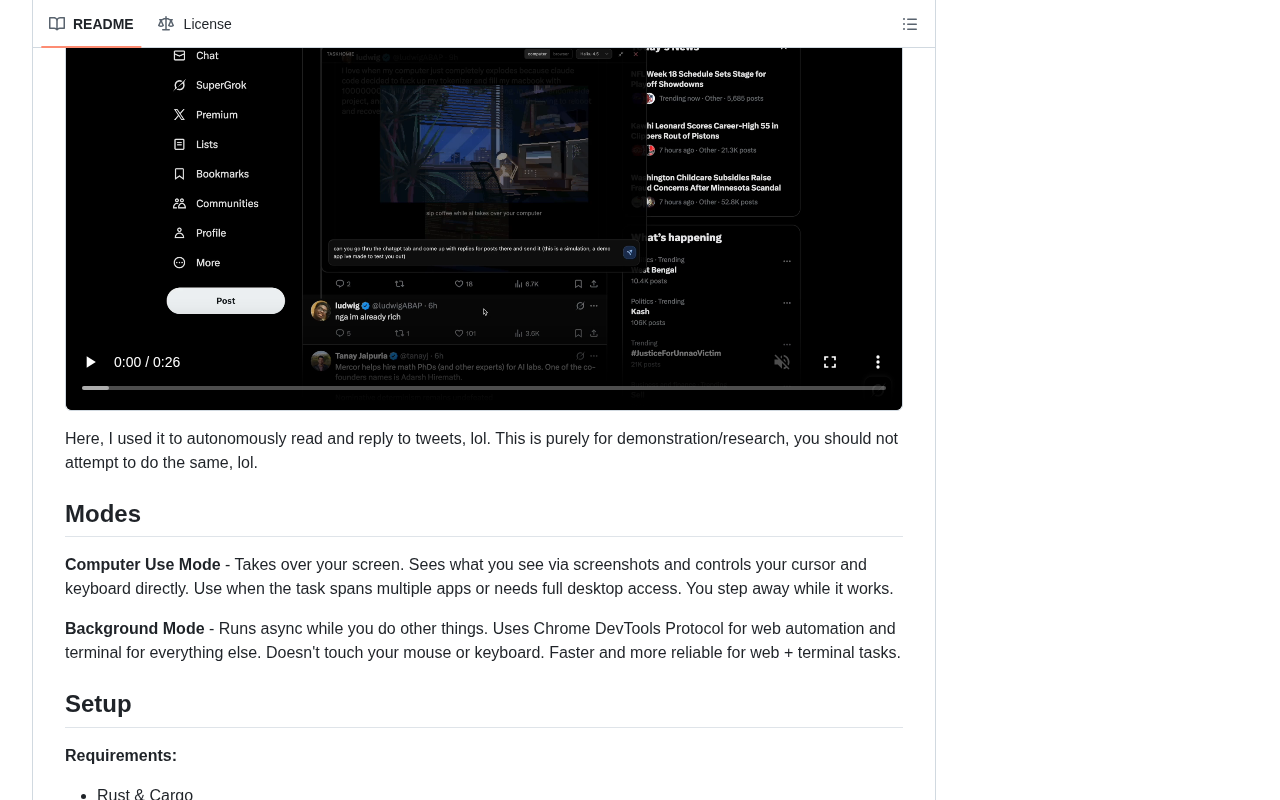
Core Features of Computer Agent
Computer Agent is a desktop AI agent application whose core philosophy is to free AI from being confined to dialog boxes answering questions, instead enabling it to operate computers directly like a human to complete tasks.
From a technical implementation perspective, AI computer control typically involves two core approaches. The first is API-level control, which simulates mouse movements, keyboard inputs, and window management through underlying interfaces provided by the operating system (such as Windows' Win32 API, macOS's Accessibility API, and Linux's X11/Wayland protocols). The second is vision-based control, which takes screenshots and uses multimodal large models to understand screen content before deciding on the next action. Computer Agent combines both approaches—it can precisely execute operations through system APIs while leveraging AI's semantic understanding to convert natural language instructions into specific operation sequences. This "perceive-plan-execute" loop is the core pattern of modern AI Agent architecture.
Specifically, it grants AI the following capabilities:
- Terminal Operations: Execute command-line instructions, handle file management, software installation, script execution, and more
- Browser Control: Automatically open web pages, fill out forms, extract information, and perform searches
- Mouse Control: Simulate precise mouse movements, clicks, drag-and-drop operations
- Keyboard Input: Automate text entry and keyboard shortcut operations
For example, you can issue instructions to the AI in natural language, such as "Help me open the browser and search for today's weather" or "Create a new project directory in the terminal," and the AI will autonomously plan the execution steps and complete them one by one. This interaction paradigm significantly lowers the barrier to computer operation.
Why Build a Desktop AI Agent in Rust?
The project chose Rust as its primary development language—a technical decision backed by solid reasoning. Rust is a systems-level programming language initiated by Mozilla Research and currently maintained by the Rust Foundation, with version 1.0 released in 2015. Its most fundamental innovation is the "Ownership System," which guarantees memory safety through a compile-time Borrow Checker without relying on garbage collection, fundamentally eliminating common security vulnerabilities such as null pointers, data races, and buffer overflows. In recent years, Rust's ecosystem for desktop applications has matured considerably, with the popularity of the Tauri framework (a Rust-based cross-platform desktop application framework) leading more developers to choose Rust for building high-performance desktop applications.
In the desktop AI agent scenario, Rust brings several key advantages:
Performance and Memory Safety Combined
AI agents need to respond to user instructions in real-time while manipulating system resources. Rust's zero-cost abstractions and memory safety guarantees make applications both efficient and stable. "Zero-cost abstractions" means that Rust's high-level language features produce no additional runtime overhead after compilation, achieving performance comparable to C/C++. Compared to similar tools implemented in Python, the Rust version has noticeably lower latency in system calls and event handling.
Cross-Platform Compilation
Rust's excellent cross-platform compilation capabilities mean Computer Agent has the potential to support Windows, macOS, and Linux, lowering the barrier to entry for users.
System-Level Low-Level Control
Controlling peripherals like mice and keyboards requires direct interaction with low-level OS APIs. Rust's systems programming capabilities make it an ideal choice for building such desktop automation applications.
Industry Trend: AI Agents Moving from Conversation to Control
Computer Agent's emergence is not an isolated case—it reflects an important development direction in the AI Agent field: moving from text-based conversation to actual control.
Since 2024, several leading companies have made attempts in this direction:
- Anthropic's Computer Use feature enables Claude to directly operate computer screens. Officially released in October 2024, it allows the Claude model to observe screen content through screenshots and then output specific mouse coordinates and keyboard operation instructions. Its technical implementation relies on Claude's multimodal visual understanding capabilities—the model can identify UI elements like buttons, text fields, and menus on screen, and plan operation paths based on task objectives. However, Anthropic acknowledges that the feature is still experimental, with relatively high error rates when precisely clicking small targets or handling complex multi-step tasks.
- OpenAI's Operator project focuses on browser automation, taking a similar approach but with more focus on web interaction scenarios.
- Microsoft's UFO project is an AI agent framework for Windows applications that leverages the Windows UI Automation framework to obtain structured UI information from applications, offering certain advantages in operation precision.
As an open-source community implementation, Computer Agent provides developers and power users with a freely customizable and extensible alternative. Compared to commercial solutions, open-source projects have inherent advantages in transparency and controllability.
Typical Use Cases for Computer Agent
The practical application scenarios for this type of AI desktop agent tool are extremely broad:
- Office Automation: Batch file processing, automatic form filling, scheduled execution of repetitive tasks
- Development Assistance: Code compilation, test execution, and development environment configuration through natural language instructions
- Information Gathering: Automated web browsing, structured data extraction, and analysis report generation
- Accessibility Support: Helping users with physical limitations control their computers through voice or text commands
For users who routinely handle large volumes of repetitive operations, Computer Agent has the potential to significantly boost productivity.
Security Risks and Mitigation Strategies
Allowing AI to directly control a computer introduces security risks that cannot be ignored. The security challenges posed by AI directly operating computers are far more complex than those of traditional software, and the industry categorizes them into several core risk dimensions.
First is "Prompt Injection"—malicious web pages or documents may contain hidden instructions that trick the AI agent into performing unintended operations, such as being injected with instructions while browsing a webpage to visit malicious links or leak local files. Second is "Privilege Escalation Risk"—AI agents typically require elevated system permissions to perform operations, and exploitation could lead to severe consequences. Third is "Irreversible Operation Risk"—operations like deleting files, sending emails, or executing financial transactions are difficult to undo once completed.
Users should keep the following points in mind when using such desktop automation tools:
- Permission Control: Limit the system resources and directory scope accessible to the AI agent, following the principle of least privilege—only granting the minimum permissions needed to complete a task
- Operation Review: Set up confirmation mechanisms for critical operations to avoid irreversible mistakes, adopting a human-AI collaborative confirmation model that requires explicit user authorization before executing sensitive operations
- Data Isolation: Ensure sensitive files and credentials are outside the AI's operational scope, running AI operations in a sandboxed environment when necessary
- Operation Logging: Maintain complete records of all AI-executed operations for traceability and auditing, enabling rapid root cause identification when issues arise
Rust's inherent memory safety features reduce low-level security risks to some extent—it eliminates exploitable vulnerabilities like buffer overflows at the compilation level—but application-level security strategies still require attention from both developers and users.
Conclusion: A Key Step from AI That "Can Talk" to AI That "Can Do"
Computer Agent represents an important evolution of AI from "can talk" to "can do." Although the project is still in its early stages, its open-source nature, Rust technology stack, and clear functional positioning make it particularly noteworthy among the many AI Agent projects.
For developers interested in AI automation and desktop agent technology, this is a project worth continuously tracking and contributing to.
Project URL: github.com/suitedaces/computer-agent
Related articles
Deep Dive into AI Agent Skill Design: …
Deep Dive into AI Agent Skill Design: Engineering Practices from Anthropic and Perplexity
A deep dive into Skill design philosophy from Anthropic's Claude Code team and Perplexity's Agent team, covering the Tax Test, Gotchas Flywheel, progressive disclosure, and Eval-First practices for building high-quality AI Agent skill systems.
Deep Dive into OpenAI's Official GPT-5…
Deep Dive into OpenAI's Official GPT-5.6 Prompting Guide: The Shift from Manual to Automatic
A deep dive into OpenAI's official GPT-5.6 Sol prompting guide: conciseness-first, outcome-oriented design, autonomy boundaries, tool routing, and reasoning intensity tuning.
 Deep Dives
Deep Dive into How OpenClaw (Open-Source Crayfish) AI Agent Works
Deep analysis of OpenClaw AI Agent internals: System Prompt, tool calling, SubAgents, Skill system, memory, and Context Engineering explained.