Condition-Anchored Generative Distillation (CAGD): Tackling Catastrophic Forgetting in Continual Learning for Language Models

CAGD decouples three replay roles to reduce catastrophic forgetting in continual LLM adaptation.
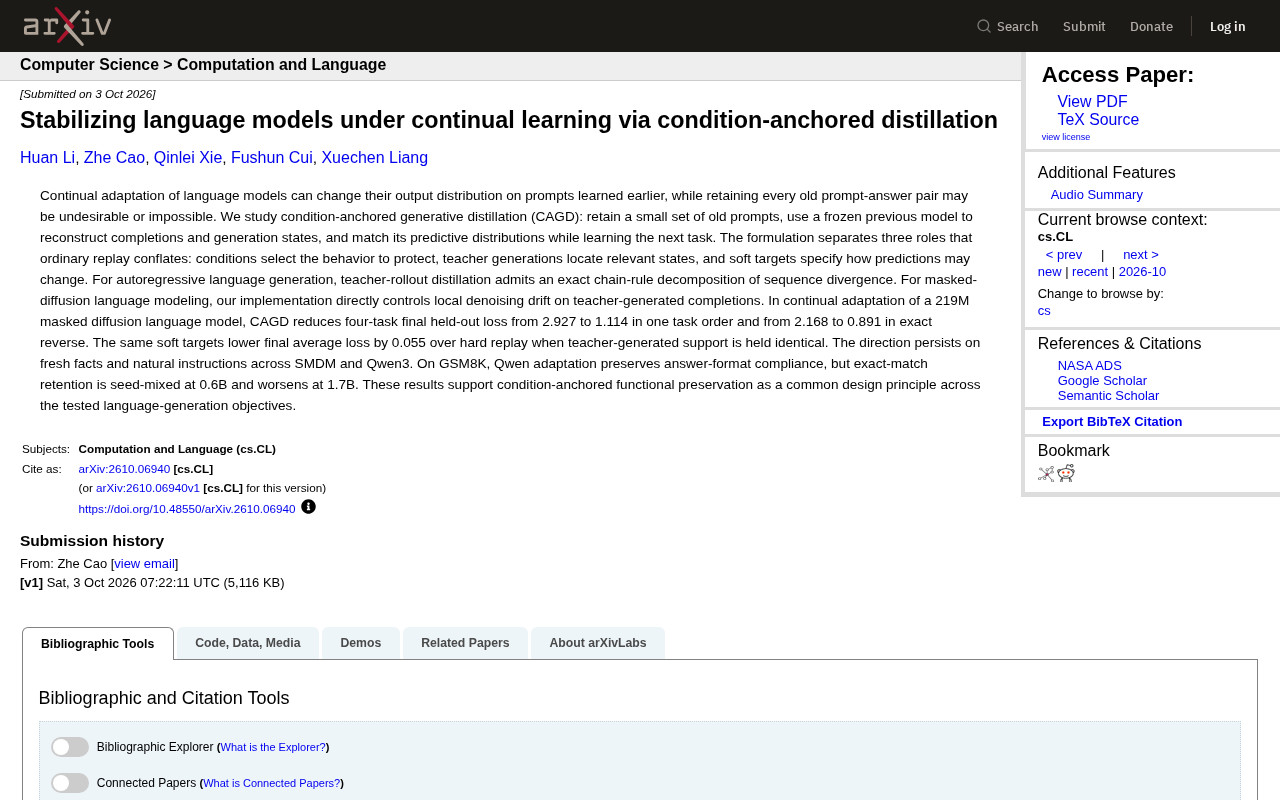
Large language models face catastrophic forgetting when continually adapting to new tasks — learning new skills overwrites weights encoding old ones. CAGD (Condition-Anchored Generative Distillation) addresses this by retaining a small set of old prompts and using a frozen teacher model to generate soft targets, training the updated model to match the teacher's predictive distribution while learning new tasks. Its key contribution is explicitly decoupling three roles conflated by standard replay: conditions (what to protect), teacher generations (where to protect), and soft targets (how much change is allowed). Compatible with both autoregressive and masked diffusion paradigms, CAGD reduces held-out loss from 2.927 to 1.114 in four-task experiments on a 219M masked diffusion model, with soft targets alone contributing an additional 0.055 reduction over hard replay.
The Core Tension in Continual Learning: Gaining New Skills, Losing Old Ones
After deployment, language models often need to continuously adapt to new tasks and absorb new knowledge. But this kind of continual adaptation introduces a thorny problem: as a model learns new tasks, it quietly shifts the output distribution for prompts it learned earlier — in other words, it gains new capabilities while forgetting old ones. This is what the field commonly calls "catastrophic forgetting."
An intuitive fix is to retain all historical prompt-answer pairs and have the model revisit them periodically. In practice, though, this is often neither feasible nor desirable: old data may no longer be accessible, storage costs can be prohibitive, and simply replaying old data doesn't precisely protect the model's critical behaviors. The Condition-Anchored Generative Distillation (CAGD) framework proposed in a recent arXiv paper offers a new approach to this tension.
Catastrophic forgetting was first described by McCloskey and Cohen in 1989. It refers to the phenomenon where a neural network, upon learning a new task, experiences a sharp decline in performance on old tasks because gradient updates overwrite the weights responsible for earlier knowledge. This problem is further amplified in the era of large language models: pretrained models typically have billions of parameters, and fine-tuning on a new task creates wide-ranging dependencies — even modifying a tiny fraction of weights can introduce subtle yet far-reaching shifts in the model's existing capability distributions.
Traditional mitigation strategies fall into three broad categories: regularization methods (e.g., EWC, which penalizes changes to important weights using the Fisher information matrix), parameter isolation methods (allocating separate parameter subsets to different tasks), and experience replay methods (retaining or generating old-task data and mixing it into training). CAGD is an evolution of the third category, but its innovation lies in treating the old model's predictive distribution — rather than raw historical samples — as the distillation target, protecting behavior at a functional level rather than a data level.
CAGD's Core Mechanism: Decoupling Three Distinct Roles
The basic CAGD pipeline works as follows: retain a small set of old prompts, use a "frozen" old model to reconstruct completions and generate states, then — while learning the new task — train the new model to match the old model's predictive distribution.
The most illuminating contribution of this paper is its observation that standard data replay conflates three roles that should be kept separate, which CAGD explicitly decouples:
- Conditions: select which model behaviors need to be protected — i.e., what to protect;
- Teacher generations: locate the relevant generation states — i.e., where to protect;
- Soft targets: specify how predictions are allowed to change — i.e., how much change is permitted.
The value of this decoupling is that it no longer mechanically forces the model to reproduce old answers word-for-word (hard replay). Instead, it preserves behavioral characteristics at a functional level. Soft targets give the model some room to vary, making knowledge retention smoother and more efficient.
The knowledge distillation framework that CAGD builds on was originally proposed by Hinton et al. in 2015. Its core idea is to have a "student model" fit the probability distribution output by a "teacher model" (i.e., soft targets), rather than just fitting one-hot hard labels. Soft targets carry the teacher's judgments about the relative relationships among candidate outputs, conveying far richer information than a single correct answer — enabling the student to achieve smoother generalization with less data.
In the continual learning setting, the "teacher" is the frozen old version of the model, and the "student" is the current model being trained on new tasks. CAGD's key design choice is that the teacher doesn't comment on new-task data — it only generates probability distributions over the retained old prompts. While learning new tasks, the student is required to maintain distributional alignment with the teacher on those old prompts. This eliminates the need to access original old data, while also being more flexible than hard replay — allowing the student to produce outputs on old prompts that differ in wording from the teacher's but are semantically equivalent.
Technical Implementation Across Different Generation Paradigms
One of CAGD's standout features is its adaptability to different language generation objectives.
Autoregressive Language Generation
For traditional autoregressive language generation, teacher-rollout distillation allows the sequence-level divergence to be exactly decomposed via the chain rule. This means that distributional differences at the full-sequence level can be rigorously broken down step by step, giving the distillation process a solid mathematical foundation.
Masked Diffusion Language Modeling
For the newer masked-diffusion language modeling paradigm, the paper's approach is to directly constrain the local denoising drift on teacher-generated completions. This demonstrates CAGD's adaptability as a general design principle — regardless of whether the underlying paradigm is autoregressive or diffusion-based, the idea of condition-anchored functional preservation can be applied.
Understanding why CAGD can span both paradigms requires appreciating their fundamental differences. Autoregressive language generation predicts tokens sequentially from left to right, with each step's probability depending only on the previously generated history. This naturally supports chain-rule decomposition, so sequence-level KL divergence can be precisely split across the token distributions at each time step.
Masked Diffusion Language Modeling (MDLM) draws on ideas from diffusion models: the forward process randomly replaces tokens in the text with [MASK], and the reverse process trains the model to progressively restore the masked tokens. Unlike image diffusion, MDLM operates in a discrete token space — its "denoising" is not a continuous score estimation but a categorical distribution prediction over each masked position. Local denoising drift describes the shift in predicted distributions between the old and new models at this denoising step; directly constraining it is equivalent to enforcing behavioral protection at every intermediate state of the diffusion process.
Experimental Results: A Dramatic Reduction in Forgetting Loss
The paper conducts four-task continual adaptation experiments on a 219M-parameter masked diffusion language model, with encouraging results:
- Under one task ordering, the four-task final held-out loss drops from 2.927 to 1.114;
- Under the completely reversed task ordering, the loss drops from 2.168 to 0.891.
These numbers clearly show that CAGD significantly mitigates forgetting across different task orderings. A critical ablation experiment further reveals that when the teacher-generation support set is held constant, simply replacing hard replay with soft targets alone reduces the final average loss by an additional 0.055. This confirms that soft targets themselves — not extra data — are responsible for the meaningful gain.
Generalization Across Models and Tasks
The researchers further validated CAGD on models including SMDM and Qwen3, targeting new facts and natural instructions. The directional finding — that CAGD improves forgetting — holds, suggesting the method has some degree of generality.
The paper also honestly reports limitations. On the GSM8K mathematical reasoning benchmark, Qwen model adaptation maintains answer format compliance, but exact-match retention results are mixed: at the 0.6B scale, results are confounded by random seed variance, and at the 1.7B scale, performance even degrades. This suggests that CAGD's effectiveness on complex reasoning tasks and larger models still requires further investigation — it is not a universal solution.
Significance and Outlook
Taken together, CAGD's proposal of "condition-anchored functional preservation" as a general design principle spanning multiple language generation objectives provides a more fine-grained framework for continual learning than traditional replay. By explicitly separating what to protect, where to protect it, and how much change is allowed, it enables models to absorb new knowledge while functionally preserving old capabilities.
For large language model deployment scenarios that require long-term iteration and continuous updates, this approach has real practical value. That said, the exact-match degradation exposed on GSM8K is a reminder that stability in continual learning for high-precision reasoning tasks and larger-scale models remains an open challenge.
Related articles

AI New Grad Resume Diagnosis: How to Stand Out for ML/CV Roles?
How can AI/ML new grads optimize their resumes to get interviews? Based on a real Reddit case, this article analyzes project selection, depth display, and structure for ML/CV roles, with actionable revision advice.

OpenAI Opens Up Decision Models as Competition with Jev Heats Up
OpenAI makes its decision model widely available, directly challenging first mover Jev. We analyze the impact on the decision model competitive landscape and key considerations for developers and enterprises.

Startup Growth Secrets: Early Sales Are Not the Key
At Disrupt, experts from Lovable, Polska, and Theory Ventures said early startup growth depends not on early sales but on a repeatable sales process, a clear ICP, team development, and data-driven iteration.