Continual-ARC: A New Lifelong Learning Benchmark Reveals the Real Bottleneck in AI Skill Acquisition

The Continual-ARC benchmark reveals: agent frameworks struggle to beat simple caching; only weight learning has a generalization advantage.
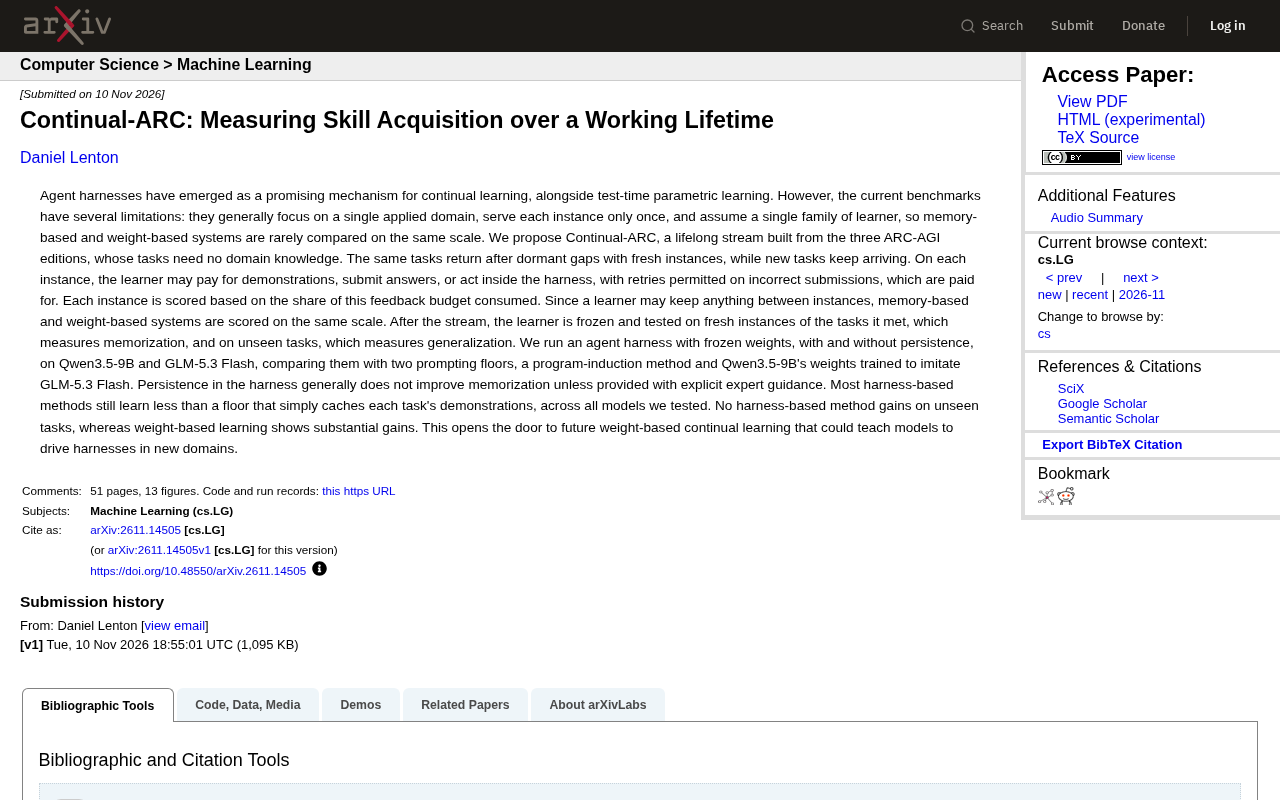
Researchers propose Continual-ARC, a lifelong learning stream built on tasks from three ARC-AGI competitions, addressing the issues of single-domain, non-repeating instances, and limited learner types in existing continual learning benchmarks. The benchmark lets the same tasks return as new instances after dormancy and scores by feedback budget proportion, enabling memory-based and weight-based systems to be compared on the same scale. Experiments cover caching, prompting, program induction, and parameter learning paradigms. Results show: harness persistence typically does not improve memory, most harness methods fall below a simple cache baseline, and no harness method gains generalization on unseen tasks; in contrast, weight-based learning shows significant generalization improvement. This points to a future direction—enabling models to truly learn to drive harnesses through weight-level continual learning.
Why Do We Need a New Continual Learning Benchmark?
Continual learning has long been one of the core challenges in AI. In recent years, agent harnesses and test-time parameter learning have been viewed as promising mechanisms, but existing benchmarks have clear limitations: they typically focus on a single application domain, each instance appears only once, and they assume a single type of learner, which means memory-based systems and weight-based systems can rarely be compared on the same scale.
To address these issues, researchers propose Continual-ARC—a lifelong learning stream built on tasks from three ARC-AGI competitions. ARC-AGI tasks require no domain knowledge, making them suitable for measuring general skill acquisition. In Continual-ARC, the same tasks return with entirely new instances after dormancy periods, while new tasks keep flowing in, simulating the scenario of skill reuse and expansion in a real working career.
How Does Continual-ARC Work?
Task Stream and Feedback Budget
In each instance, the learner can choose to pay for demonstrations, submit answers, or act within the harness. Incorrect submissions allow retries but require payment. The score for each instance is based on the proportion of the feedback budget consumed—the less consumed, the higher the score. This design forces learners to make trade-offs between exploration and exploitation.
Since learners can retain any information between instances, memory-based systems (such as caching) and weight-based systems (such as parameter fine-tuning) can compete on the same scoring scale. This solves the problem in previous benchmarks where the two types of systems were difficult to compare directly.
Agent harness refers to a set of outer execution scaffolding built around large models, typically including tool-calling interfaces, memory storage, prompt orchestration, result parsing, and retry logic. It does not change model weights itself, but provides a structured action space for the model during inference. In contrast, "weight-based learning" modifies model parameters through gradient updates, writing experience into the parameters themselves. The key difference between the two in continual learning is: harness "learning" is reflected in context or external caches, which may be lost when the session ends; weight learning solidifies skills and can transfer them to new tasks. Understanding this distinction is the prerequisite for understanding the experimental comparisons in this article.
Feedback budget is a mechanism for measuring the cost a learner must pay to obtain supervisory signals. In Continual-ARC, obtaining demonstrations and submitting incorrect answers both consume budget, and scores are calculated inversely based on the proportion consumed. This is similar to the cost of consulting experts and trial-and-error in real scenarios: a system that masters patterns with little feedback is more "efficient" than one that succeeds only after repeated trial and error. This design incorporates "learning efficiency" rather than just "final accuracy" into the evaluation, thereby distinguishing rote memorization from genuine acquisition.
Dual Testing After Freezing
After the data stream ends, the learner is frozen and tested on two types of new instances:
- Memory test: Measuring memory ability when facing new instances of previously seen tasks.
- Generalization test: Measuring generalization ability when facing entirely unseen tasks.
This design clearly distinguishes "remembering" from "learning," avoiding misjudging memory as skill acquisition.
The distinction between memory tests and generalization tests corresponds to the classic dichotomy of "memorization" and "generalization" in machine learning. Memory tests use entirely new instances of seen tasks to examine whether the system can reuse experience at the task level—this requires the system not only to remember specific answers but also to identify task types and invoke corresponding strategies. Generalization tests use entirely unseen tasks to examine whether the system can transfer abstract skills learned from old tasks to new situations. Combining both can avoid a common misjudgment: a system performing well on new instances of old tasks may simply have cached similar inputs rather than mastered transferable patterns. Only improvements on generalization tests truly demonstrate that skills have been internalized.
Experimental Design: Who Is Better at Continual Learning?
Researchers ran agent harnesses with frozen weights (with and without persistence settings), based on two models, Qwen3.5-9B and GLM-5.3 Flash, and compared them with two prompting floors, a program induction method, and a weight version obtained by training Qwen3.5-9B to imitate GLM-5.3 Flash.
Multi-source cross-validation shows that this experimental setup covers current mainstream continual learning paradigms: memory-based caching, prompt-based in-context learning, symbol-based program induction, and weight-based parameter learning.
Key Findings: The Limitations of Harnesses and the Potential of Weights
Persistence Is Not a Panacea
Experiments show that persistence in harnesses typically does not improve memory ability unless explicit expert guidance is provided. In other words, letting agents "remember" past experience does not automatically translate into better performance.
Cache Baselines Are Hard to Beat
Across all tested models, most harness-based methods still learn less effectively than a simple baseline that caches demonstrations for each task (floor). This means that complex agent frameworks are not necessarily more effective than naive memory strategies in continual learning scenarios.
Cache baseline refers to a minimalist strategy: storing demonstrations or answers that have appeared for each task as-is, and retrieving and reusing them when new instances are encountered. It requires no model reasoning or parameter updates and is the most naive "memory" implementation in continual learning. The significance of setting it as a floor is: if any more complex harness method cannot surpass it, then its additional framework complexity brings no actual benefit. In the experiments, most harness methods fall below this baseline, suggesting that the "learning" of current agent frameworks is often just disguised retrieval and concatenation, and no mechanism beyond simple memory has yet been formed.
Generalization Gap Is Significant
No harness-based method achieved improvement on unseen tasks, while weight-based learning showed significant gains. This contrast points to a core conclusion: current harness methods are good at leveraging context but struggle to internalize experience into generalizable skills.
Implications for the Future
The introduction of Continual-ARC provides a fairer and more comprehensive testing platform for continual learning research. Its results reveal an important direction: future weight-level continual learning is expected to teach models to drive harnesses in new domains. In other words, letting models truly "learn" how to learn through parameter updates, rather than relying on temporary memory in context.
For AI researchers and developers, this benchmark reminds us: before pursuing more complex agent frameworks, first ensure that evaluation methods can distinguish memory from generalization. Otherwise, we may overestimate the actual learning ability of systems.
For more details, please refer to the original paper.
One-line Summary
The Continual-ARC benchmark reveals: agent frameworks struggle to beat simple caching; only weight learning has a generalization advantage.
Paragraph Summary
Researchers propose Continual-ARC, a lifelong learning stream built on tasks from three ARC-AGI competitions, aimed at solving the problems of existing continual learning benchmarks being single-domain, non-repeating in instances, and limited in learner types. The benchmark lets the same tasks return as new instances after dormancy and scores by feedback budget proportion, enabling memory-based and weight-based systems to be compared on the same scale. Experiments cover paradigms including caching, prompting, program induction, and parameter learning. Results show: harness persistence typically does not improve memory, most harness methods fall below a simple cache baseline, and no harness method gains generalization on unseen tasks; in contrast, weight-based learning shows significant generalization improvement. This points to a future direction—enabling models to truly learn to drive harnesses through weight-level continual learning.
Related articles

Nothing CMF Buds 2A Drops to $17.89 on Black Friday: A New Low for ANC Earbuds
Nothing CMF Buds 2A wireless earbuds Black Friday deal: just $17.89 on Amazon, about $11 off retail and a record low. ANC earbuds at an entry-level price.

When AI Creation Gets Accused of "Spitting": Hacker News Heats Up Over the Glaude Controversy
A Hacker News post, "Spitting in the Face of Glaude," sparks debate on AI creation transparency and attribution ethics. This analysis examines the blurred creator identity behind the controversy and offers practical advice for AI content production.

Akai Embraces Custom Firmware: MPC Sample 1.4 Lets Users AI-Program Their Sampler
Akai embraces the modding community with MPC Sample 1.4 firmware, supporting vibe-coded custom firmware and effects. We analyze the impact of this open strategy on music hardware and AI-assisted programming.