Contrast Sets Over Single Hypotheses: Enabling AI Research Agents to Solve More Scientific Questions from the Same Evidence

Contrastive Discovery replaces single hypotheses with mutually exclusive, exhaustive explanation sets, enabling LLM research agents to point to specific alternative explanations after rejecting a hypothesis.
The article introduces the arXiv work Contrastive Discovery, noting that current LLM research agents generally use pointwise hypothesis evaluation, which can only reject a single hypothesis without indicating which alternative explanation the evidence supports—a structural blind spot. Contrastive Discovery changes the unit of inquiry to a mutually exclusive and exhaustive set of competing explanations and scores experiments by belief redistribution across the whole set rather than surprisal. Across six domains, most candidates pointwise methods deem most informative are rejection-type, while contrast sets attribute most of them to specific alternatives. The method works with existing agents without touching the underlying model and solves more problems under the same budget. Human expert blind evaluation shows high agreement, including on questions pointwise agents had abandoned. The article also notes that explanation-set completeness is a practical bottleneck.
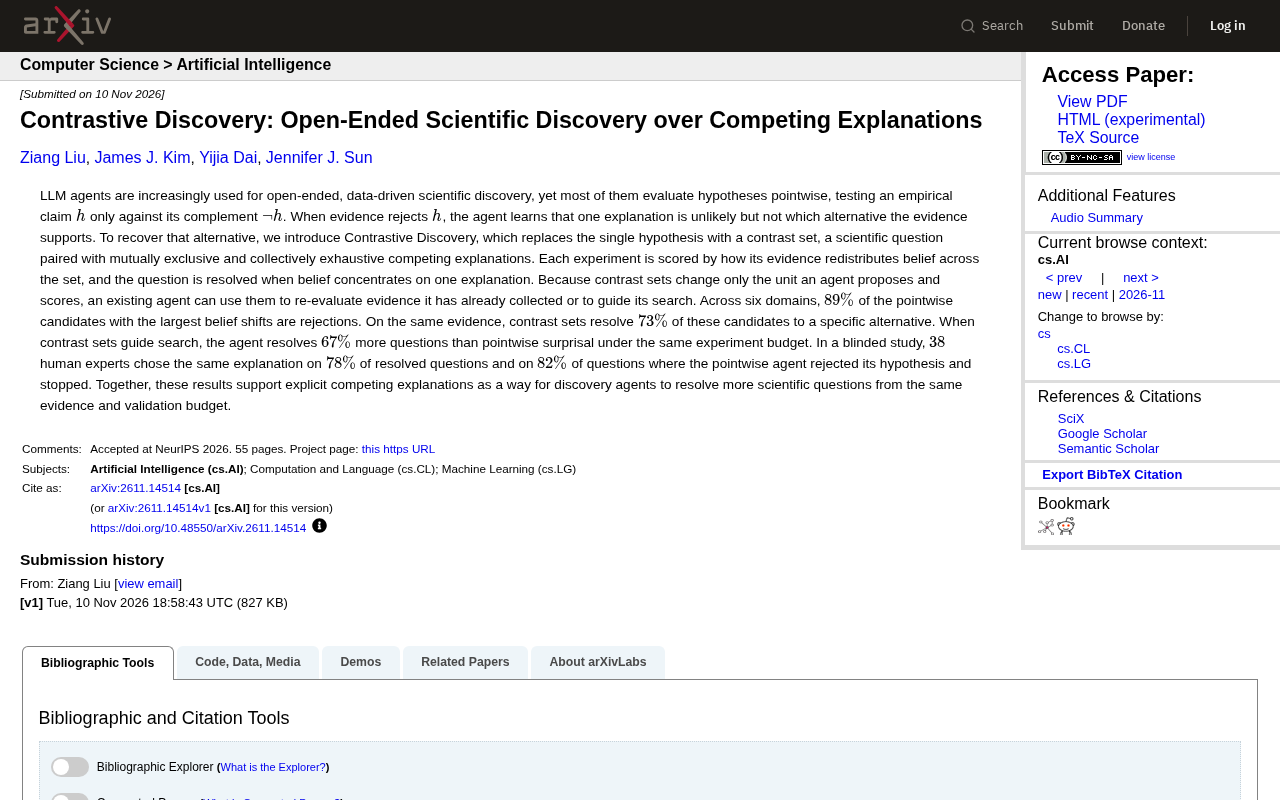
Large language model agents are being heavily deployed in open-ended, data-driven scientific discovery tasks. But an overlooked methodological flaw is limiting their output: the vast majority of agents use "pointwise" hypothesis evaluation—propose an empirical claim h, then run experiments to test h against its complement ¬h. Once the evidence rejects h, the agent only learns that "this explanation is unlikely," but has no idea which alternative explanation the evidence actually supports.
A new work from arXiv, Contrastive Discovery, directly targets this problem: replace the single hypothesis with a "contrast set"—a scientific question paired with a set of mutually exclusive and exhaustive competing explanations. Each experiment is scored by how much it redistributes belief across the entire set of explanations, and when belief concentrates on a single explanation, the question is considered resolved.
The Structural Blind Spot of Pointwise Hypotheses
The appeal of pointwise evaluation is its simplicity: one hypothesis, one negation, one statistical test. But it loses the information that is truly valuable in scientific reasoning—the discriminative power of evidence.
When the p-value is not significant or the evidence contradicts the prediction, the agent's reasoning chain terminates right there. It cannot answer the question a scientist actually cares about: "then which one is it?" The authors point out that agents under this setup often simply stop after rejecting a hypothesis, wasting an experiment that could have continued to converge.
The contrast-set design changes this unit: instead of "h or ¬h," it becomes "which of A, B, C." This requires researchers to enumerate a mutually exclusive and exhaustive set of explanations at the question-posing stage. It appears to add manual cost, but it anchors every experiment the agent runs to a convergent target.
Mutually exclusive and exhaustive are the two core constraints for constructing a contrast set. Mutually exclusive means no two explanations can be true at the same time—for example, "decreased enzyme activity arises from inhibitor binding" and "arises from transcriptional downregulation" cannot coexist mechanistically. Exhaustive requires that the candidate explanations cover all possible true causes, or at least do not omit major competing alternatives. Together these two conditions guarantee that belief redistribution can be measured: if the explanation set is not mutually exclusive, probability mass flows ambiguously between overlapping explanations; if it is not exhaustive, the true explanation may not be in the set at all, and the agent's convergence will point in the wrong direction. In the context of statistical hypothesis testing, the pointwise h and ¬h naturally form the simplest binary contrast set, but ¬h is a generic complement rather than a specific mechanism, so it cannot provide information about "which one replaces h."
Experiment Scoring Shifts from "Surprisal" to "Belief Redistribution"
The most critical methodological change is in the scoring function. Pointwise agents typically use surprisal to select the next experiment: do whichever experiment yields the most unexpected result. Contrast sets instead score by the magnitude of belief redistribution that the evidence produces across the entire set of explanations, prioritizing experiments that can significantly move probability mass between explanations.
According to the paper, in experiments across six domains, the pointwise candidates with the largest belief shifts overwhelmingly belonged to the "rejection" type—that is, the experiments the pointwise agent considered most informative often merely refuted the original hypothesis without pointing to any specific alternative.
When the same evidence is processed through a contrast set, most of these candidates can be attributed to a specific alternative explanation. This comparison shows that the evidence discarded by the pointwise framework is not lacking in discriminative power; rather, it lacks a representational structure capable of carrying that discriminative power.
Surprisal in information theory is defined as −log p(x)—the lower the probability of observing outcome x, the higher the surprisal. Pointwise agents use this to select the "most unexpected" experiment; intuitively this maximizes information gain, but the intuition implicitly assumes that high-surprisal results correspond to effective elimination within the hypothesis space. The problem is that under a binary hypothesis space, high surprisal is almost equivalent to "rejecting h," and rejection itself carries no directional information. Belief redistribution under a contrast set is different: it measures the magnitude of movement of the probability distribution across the entire set of explanations before and after the experiment, for example using KL divergence or entropy reduction. An experiment that only moves probability from h toward some generic complement of ¬h scores low under contrast-set scoring; only when the evidence clearly moves mass from explanation A to explanation B or C is it deemed highly informative. This is precisely the root of the divergence between the two scoring strategies.
Compatible with Existing Agents, No Retraining Required
A practical advantage of contrast sets is that they only change two components of the agent—"what to propose" and "how to score"—without touching the underlying model's capabilities. This means existing discovery agents can be reused directly:
- Retrospectively analyze collected evidence: Reinsert historical experimental results into the contrast-set framework to see whether they support a specific explanation
- Guide subsequent search: When the experiment budget is limited, prioritize experiments that can widen the gap between competing explanations
Under the same experiment budget, agents guided by contrast-set search solved significantly more scientific questions than the pointwise surprisal strategy. This gain does not come from more experiments or a stronger model, but purely from a change in how the problem is represented.
Signals from Human Expert Blind Evaluation
The paper conducted a blind test: human experts independently chose explanations for already-resolved questions. For questions that the contrast set judged as resolved, the proportion of cases where experts agreed with the agent was quite high; moreover—and you might not have noticed this—for the batch of questions where the pointwise agent had already rejected the hypothesis and stopped, experts could still provide clear explanations, and these aligned closely with the conclusions of the contrast-set framework.
This constitutes a two-way validation: on one hand, it shows that the convergence results of contrast sets are domain-acceptable; on the other hand, it reveals how much room for further progress the pointwise agent gave up when it rejected a hypothesis. However, it should be noted that the agreement rates here come from a single experimental setup in this paper; the difficulty of reaching expert consensus varies considerably across disciplines, and the generality of the conclusion still requires independent replication in more domains.
Blind evaluation here means that experts independently judge the most likely explanation for each question without knowing the agent's conclusion, thereby avoiding confirmation bias. This evaluation approach is gradually becoming standard in automated scientific research because it can distinguish between "the agent believes it has solved the problem" and "the conclusion is acceptable within the field." It should be noted that a high expert agreement rate does not equate to a correct explanation; it only indicates that the conclusion falls within the acceptable range of domain consensus. In addition, studies involving expert annotation usually have limited sample sizes, and the complexity of explanation spaces varies greatly across disciplines—for example, molecular mechanism questions often have relatively clear candidate mechanism sets, whereas the explanatory boundaries of ecological or social science questions are much more ambiguous. Therefore, the agreement rates reported in the paper should be understood as feasibility evidence for the method within its selected domains, not as a cross-domain universal guarantee.
Implications for the Design of AI Research Tools
The value of this work goes beyond a methodological improvement; it points to a more general design principle: an agent's reasoning capability is limited by the form of the question it is asked to answer.
Most current automated scientific research pipelines follow the scaffolding of statistical hypothesis testing, which has advantages in reproducibility and rigor, but structurally excludes "discovering alternative explanations." Contrast sets offer a low-cost path—no model change, no additional budget, just a change in how questions are posed.
The practical constraints of implementation are also obvious: constructing a mutually exclusive and exhaustive set of explanations requires domain knowledge, and for open questions where the explanation space itself is still unclear, this step may be the bottleneck. The six-domain experiments in the paper cannot yet answer this question; how to maintain the robustness of the framework when the explanation set is incomplete will be a key direction for future research.
Frequently Asked Questions
Does the contrast set conflict with traditional hypothesis testing? No. The contrast set is a layer of representation added on top of hypothesis testing; pointwise testing can still serve as a screening tool, while the contrast set is responsible for continuing the process after rejection.
Do all explanations need to be manually listed for each question? The paper emphasizes mutual exclusivity and exhaustiveness. In practice, an agent can first generate candidate explanations and researchers can then review them, but the completeness problem remains an open challenge.
Is this method sensitive to the experiment budget? The gains reported in the paper were measured under the same experiment budget, indicating that it improves the information efficiency per experiment rather than relying on more experiments.
One-line Summary
Contrastive Discovery replaces single hypotheses with mutually exclusive, exhaustive explanation sets, enabling LLM research agents to point to specific alternative explanations even after rejecting a hypothesis.
Paragraph Summary
The article introduces a new arXiv work, Contrastive Discovery, pointing out that current LLM research agents generally use pointwise hypothesis evaluation, which can only reject a single hypothesis but cannot indicate which alternative explanation the evidence supports—a structural blind spot. Contrastive Discovery changes the unit of inquiry to a mutually exclusive and exhaustive set of competing explanations and scores experiments by the magnitude of belief redistribution across the entire set, rather than relying on surprisal. Experiments across six domains show that most candidates the pointwise approach considers most informative are rejection-type, while the contrast set can attribute most of them to specific alternative explanations. The method does not touch the underlying model, and existing agents can reuse it directly to solve more problems under the same budget. Human expert blind evaluation shows that questions the contrast set judges as resolved align closely with expert explanations, including some that pointwise agents had already abandoned. The article also notes that the completeness of the explanation set is a practical bottleneck.
Related articles

Gemini 4 Neon Leak: A Potential Strong Contender Against Opus 5.5
A Hacker News thread suggests Gemini 4 Neon looks like an Opus 5.5 competitor. This article unpacks the product positioning behind this community signal, shifts in the top-model competitive landscape, and what it means for developers' model selection strategy.

Claude Fable 5.2's Self-Authored Short Film 'Fable' Sparks Discussion
A short film 'Fable,' credited to Claude Fable 5.2 for script, visuals, and directing, appears on Hacker News. This article analyzes the significance of full-pipeline AI creation, community reactions, and what it means for content creators.

Anthropic IPO Pricing: A Signal of AI Giants Going Public
Anthropic's IPO pricing draws attention. This article analyzes its potential impact on AI industry valuation, commercialization paths, and the competitive landscape, and highlights public-market expectations and challenges for AI companies.