Conversational AI May Spark an Education Revolution: How Gakku Is Reinventing K-12 Writing Training with Voice Tutors

Conversational AI could replicate one-on-one tutoring at extremely low cost; Gakku offers an early sample worth watching.
Starting from the core contradiction that one-on-one tutoring is education's gold standard yet can't scale, this article introduces Gakku, a K-12 AI voice tutor app. Gakku breaks writing training into 10-minute missions, using voice dialogue to proactively ask and probe, guiding students to think independently and build arguments rather than generating content for them—a fundamental divide from "AI writes your essay" tools. The article argues conversational AI makes scale and personalization simultaneously possible for the first time, with major implications for education equity, while soberly noting four questions to watch: learning outcome validation, AI guidance boundaries, children's data security, and school integration, and envisioning the "AI coach" framework extending to reading, speaking, science inquiry, and more.
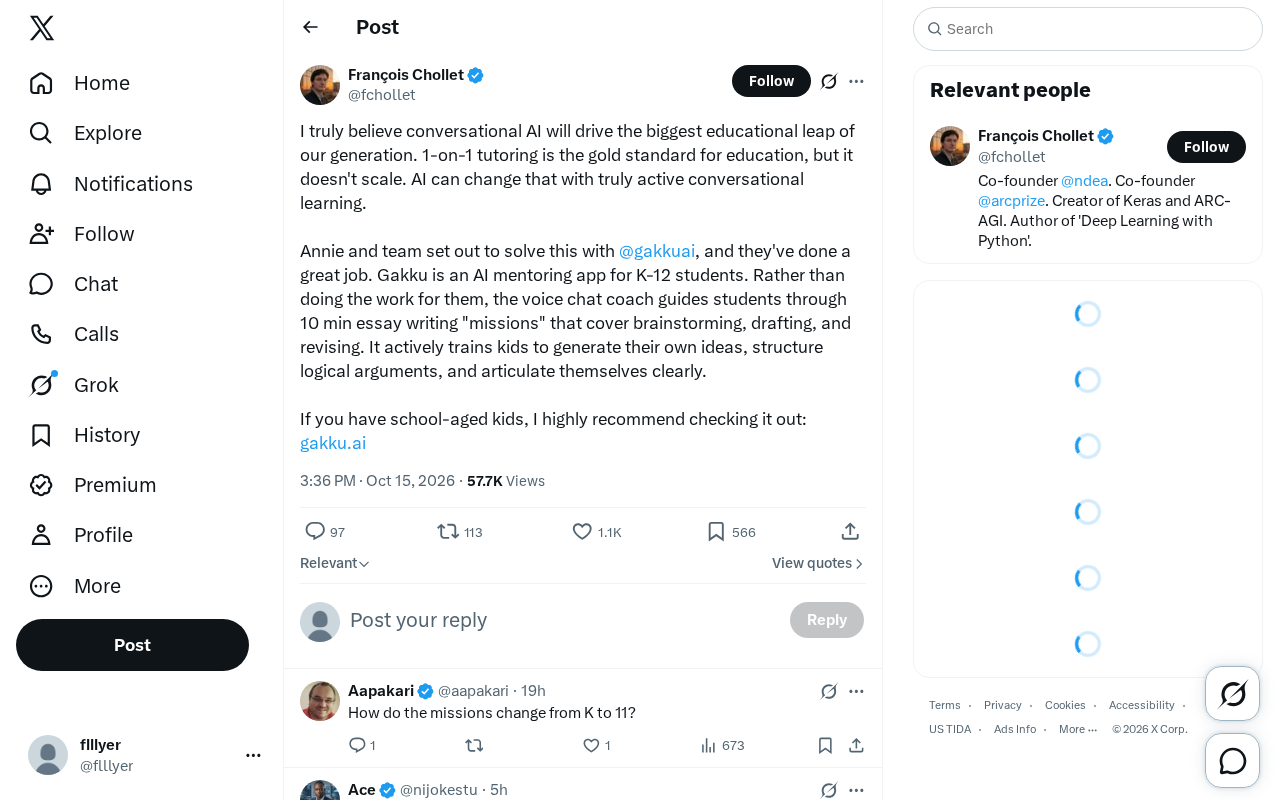
"One-on-one tutoring is the gold standard of education, but it doesn't scale." This statement precisely captures a long-standing core contradiction in the education industry—the most effective teaching method is precisely the hardest to make widely available. A tech observer expressed his firm belief on social media that conversational AI could drive the biggest educational leap of our generation. And the case he recommended is an AI tutor app called Gakku.
Why One-on-One Tutoring "Doesn't Scale"
Education research has repeatedly proven that personalized tutoring improves learning outcomes far more than traditional classrooms. But excellent tutors have always been a scarce resource—costly and unevenly distributed geographically. When one teacher faces thirty students, they can only advance at an average pace; in a one-on-one setting, the tutor can capture a student's confusion in real time, adjust the pace, and provide immediate feedback.
The value of conversational AI lies precisely in this: it has the potential to replicate this "real-time responsiveness" at extremely low marginal cost. The maturation of voice interaction means AI is no longer just text-based Q&A on a screen, but can "listen" and "speak" like a real tutor—this is the key leap from tool to coach.
Bloom's "2 Sigma Problem" provides a classic footnote for this discussion. Educational psychologist Benjamin Bloom found in a 1984 study that students who received one-on-one tutoring scored on average about two standard deviations higher than students in traditional classroom instruction—meaning an average student under one-on-one tutoring could outperform about 98% of their classmates in a classroom. This conclusion has been cited repeatedly and became one of the most famous findings in the field of individualized instruction research. However, Bloom himself also pointed out that the real challenge is not proving tutoring works, but finding an affordable, replicable alternative that allows every student to enjoy an interactive experience close to tutoring effects. In the decades since, from programmed instruction machines to intelligent tutoring systems, multiple explorations in educational technology have attempted to address this problem, but were always limited by insufficient natural language understanding, speech recognition, and dialogue management capabilities. It wasn't until large language models and real-time voice interaction technologies matured that "replicating tutor dialogue" became engineering-feasible for the first time.
"Marginal cost of scaling" is the key economic concept for understanding this contradiction. In traditional one-on-one tutoring, each additional student requires a nearly proportional increase in a teacher's labor input—the assumption of near-zero marginal cost simply doesn't hold, which is the fundamental reason it's hard to popularize. Software and AI systems, by contrast, have the typical characteristics of "high fixed cost, low marginal cost": once model training and product development are complete, the cost of adding one more user is mainly computational consumption, far lower than hiring a human tutor. This difference in cost structure is the core logic behind the judgment that "conversational AI may solve the education equity problem."
What Gakku Does Differently
According to the tweet, Annie and her team built Gakku, an AI tutor app for K-12 students. Its core design philosophy is noteworthy: it doesn't do homework for students, but guides them through the thinking process themselves.
Gakku takes the form of a voice chat coach, breaking writing training into 10-minute "missions" covering three stages: brainstorming, drafting, and revising/polishing. Throughout this process, the AI coach actively asks questions, probes further, and guides, training children to generate their own ideas, build logical arguments, and express them clearly.
This stands in sharp contrast to the many "AI writes your essay for you" tools on the market. The latter solves the "output" problem, while Gakku attempts to solve the "capability" problem—this is a fundamental fork in the road of educational product design.
The True Potential of Conversational Learning
From a broader perspective, the role of conversational AI in education can be understood at several levels:
From Q&A Tool to Proactive Coach
Traditional educational AI mostly appears in "Q&A" form—students ask, AI answers. But real learning happens at the moment when students are forced to think actively, organize their language, and respond to follow-up questions. The introduction of voice dialogue lowers the barrier for young students to use AI (no typing needed), while increasing the immersion and continuity of interaction.
Intelligent Tutoring Systems (ITS) can be seen as the predecessors of conversational AI tutors. Such systems have been developing in the educational technology field since the 1970s, typically containing three components: a domain knowledge model, a student model, and a pedagogical strategy model. They can track students' knowledge states and adjust question difficulty and hint intensity accordingly. A classic example is Cognitive Tutor developed by Carnegie Mellon University, which underwent relatively large-scale classroom validation in mathematics. But early ITS limitations were also obvious: they mostly relied on preset rules and structured question banks, with mechanical interaction formats, making it difficult to handle open-ended problems—especially tasks like writing and discussion that have no standard answers. What truly distinguishes conversational AI tutors is using large language models as the dialogue core, no longer limited by fixed scripts, capable of immediate, open-ended follow-up questions centered on students' current expressions. This expands the teachable scope while also bringing new challenges—how to ensure the AI's follow-up questions always point toward learning objectives rather than drifting into aimless chat is precisely the core engineering and pedagogical problem this generation of products needs to solve.
Why Writing Training Is an Ideal Entry Point
Writing is a capability highly dependent on feedback loops. Whether ideas are clear, arguments are rigorous, and expression is accurate—all of these require someone to point out problems in real time and guide improvement. But in reality, it's difficult for teachers to give detailed process feedback on every essay from every student. AI tutors can precisely fill this gap—and what they focus on is not the final product, but every thinking node in the writing process.
Personalized at Scale
"Scale" and "personalization" have historically been almost contradictory terms. The breakthrough of conversational AI is that it makes both possible simultaneously: every student can receive a one-on-one interactive experience, while the system itself can serve unlimited users. If this model is validated as effective, its significance for education equity will far exceed the product itself.
A Sober Look: Opportunities and Questions to Be Verified
The tweet author's attitude is optimistic and sincere—he even directly recommended this product to parents with school-age children. But as observers, there are several questions worth continued attention:
- Data validation of learning outcomes: A good voice interaction experience doesn't equal good learning outcomes. Controlled experiments or long-term tracking data are needed.
- Boundaries of AI guidance: To what extent can the AI coach identify students' cognitive misconceptions? When facing off-topic answers, does it pull them back or follow along?
- Privacy and children's data security: K-12 products involve minors' voice data, with compliance and ethical requirements far higher than adult products.
- Integration with school education: If the AI tutor's training approach is disconnected from classroom writing instruction, the effect could be diminished.
These questions are not meant to deny Gakku's direction, but rather represent the threshold that any educational technology product must cross to go from "interesting" to "effective."
The Educational Imagination of Conversational AI
Gakku represents a product approach worth watching: using conversational AI to replicate the core interaction model of one-on-one tutoring, rather than simply using AI to generate content. If this path succeeds, the beneficiaries won't just be writing education—reading discussion, speaking practice, scientific inquiry, and even social-emotional learning can all apply a similar "AI coach" framework.
The gold standard of one-on-one tutoring may finally have the possibility of being scaled. And Gakku is an early sample worth observing in this direction.
Background Supplement
The distinction between formative feedback and summative feedback is a key to understanding Gakku's design orientation. Summative feedback targets final outcomes, such as grading an essay or writing comments; formative feedback occurs during the learning process, providing immediate guidance on students' current thinking, choices, and expression. Education research generally holds that formative feedback has a stronger promoting effect on capability formation, because it can intervene before misconceptions solidify into habits. But in real classrooms, teachers' time is almost inevitably occupied by final products—grading essays is already a heavy burden, let alone tracking every step of each student's brainstorming stage. This is precisely where AI tutors can create differentiated value: they can push feedback granularity down to every thinking node in the writing process, which is exactly the scarcest resource in traditional teaching structures.
One-line Summary
Conversational AI could replicate one-on-one tutoring at extremely low cost, and Gakku provides an early sample worth observing.
Paragraph Summary
Starting from the core contradiction that "one-on-one tutoring is the gold standard of education but doesn't scale," this article introduces Gakku, an AI voice tutor app for K-12 students. Gakku breaks writing training into 10-minute missions, using voice dialogue to proactively ask questions and probe further, guiding students to think independently and build arguments, rather than generating content for them—forming a fundamental divide from "AI writes your essay" tools on the market. The article argues that conversational AI makes scale and personalization possible simultaneously for the first time, with significant implications for education equity. At the same time, the author soberly points out four questions to watch: learning outcome validation, boundaries of AI guidance, children's data security, and integration with school instruction, while envisioning that this "AI coach" framework can extend to reading, speaking, scientific inquiry, and more scenarios.
Related articles

OpenAI Partners with Shield: How the Astra Agent Revolutionizes IT Troubleshooting
OpenAI and Shield launch the Astra agent, which autonomously logs into computers and legacy systems to fix IT issues in real time, 35-40% faster than traditional models, with humans involved only when judgment is needed.

iPhone Duo Battery Life Tested: One Charge a Day Is Unavoidable, and the Large Screen Is the Culprit
iPhone Duo battery test: heavy use needs at least one charge a day, and about 30% remains after 6.5 hours of screen-on time. How often the large screen is unfolded is key; a MagSafe battery pack helps, and long-term degradation is also worth watching.

Kimi K3.1 Pro Open-Sourced: 2.8 Trillion Parameters Close In on Opus
Moonshot releases the open-source MoE model Kimi K3.1 Pro, with 2.8T total parameters and 104B activated, trailing Opus 5.5 by under 1 point on Terminal Bench 4.0.