Conversational App Builder: iwantmy.app Takes Your Idea to Mobile in One Minute

iwantmy.app generates a working mobile app with accounts, bookings, and group chat from a chat description in about a minute.
iwantmy.app showcased a more radical form of no-code on Product Hunt: describe your app's purpose and target users in a chat box, and in about a minute you get a complete app running in a mobile browser, with built-in account systems, employee roles, capacity-based bookings, photos, maps, and group chat. After generation, you can keep iterating via chat — changes only go live when complete, and failed modifications roll back automatically without breaking the existing app. Distribution uses links, QR codes, or official test apps to bypass app stores. The free plan includes 1 app and 30 AI modifications per month, no credit card required. The article argues it's well suited to highly standardized scenarios for rapid idea validation, but still has boundaries in complex business logic and long-term maintainability.
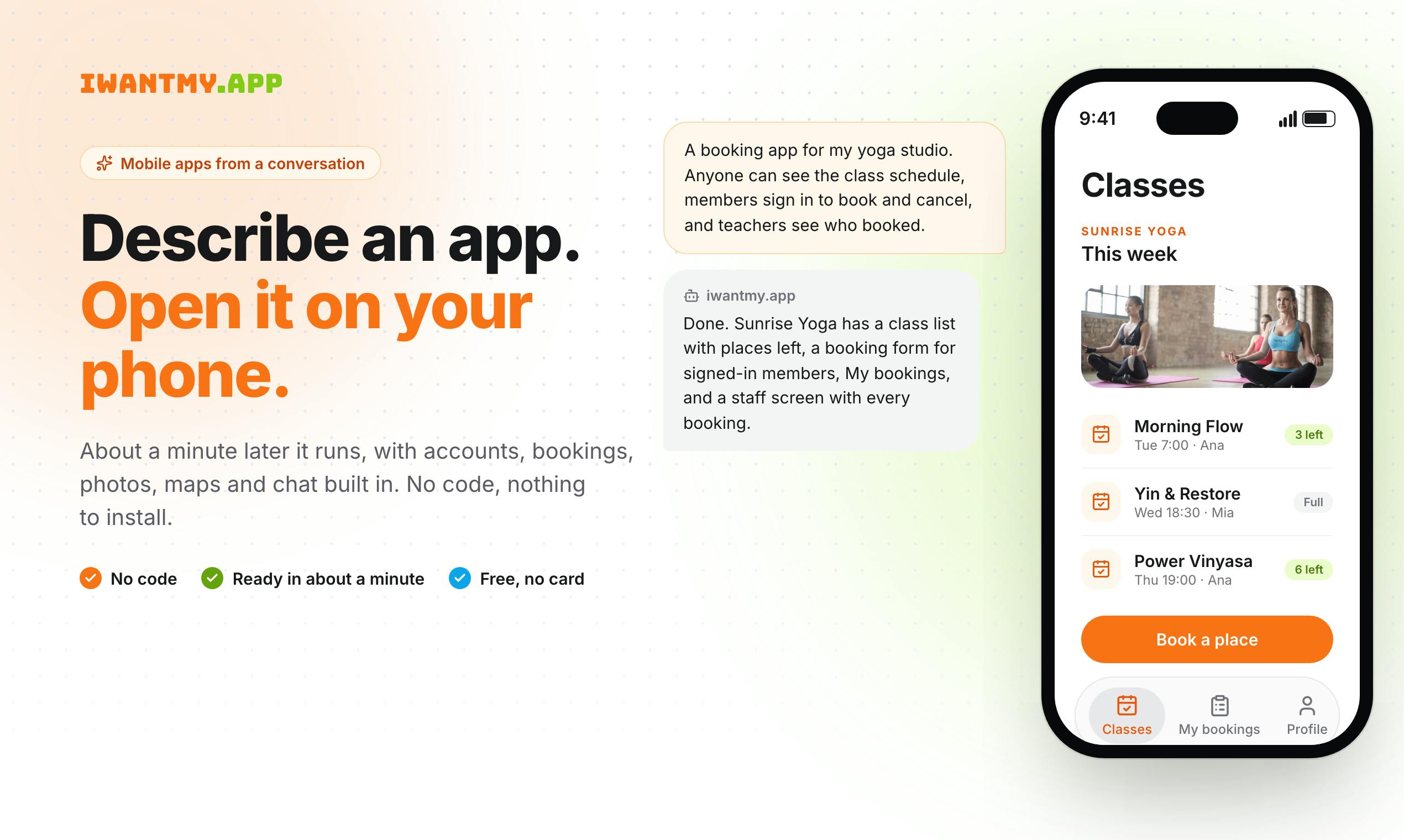
Describe your app idea in a chat box, and about a minute later you can open a complete application on your phone — complete with accounts, roles, bookings, and group chat. That's the core capability iwantmy.app showcased on Product Hunt. It pushes "no-code" to a more radical form: instead of dragging and dropping components, you generate a working product directly through natural language conversation.
From description to running app: the full conversational build experience
iwantmy.app is remarkably straightforward to use: tell it what your app does and who it's for, then wait about a minute. What you get isn't a prototype mockup but a real application that runs in a mobile browser, with built-in modules for account systems, employee roles, bookings with remaining capacity, photos, maps, and group chat.
These pre-built modules mean users don't need to build infrastructure from scratch. For small business scenarios — appointment-based services, community management, event registration — these capabilities cover exactly what's most commonly needed. The product page shows it received 72 upvotes and ranked high for the day, suggesting this "describe and get" approach has real appeal among developers and entrepreneurs.
Background
"No-code" refers to a class of tools that let you build software without writing traditional code, with representative products including Bubble, Webflow, and Airtable. They typically use visual drag-and-drop, form configuration, and preset templates so that business users can also build applications. iwantmy.app's difference lies in swapping the interaction layer from "dragging components" to "natural language conversation," while still relying on preset modular capabilities underneath. Understanding this helps gauge its boundaries: the quality of generated results depends on which modules the platform has pre-packaged, not on the model conjuring arbitrary functionality out of thin air.
"Bookings with remaining capacity" refers to a reservation mechanism where inventory or slots are limited and each booking deducts from the available amount — common in course registration, restaurant reservations, venue rentals, and similar scenarios. It requires the system to correctly deduct capacity under concurrent requests and prevent overselling, which is a classic stateful business logic. The platform pre-packages this kind of logic into modules, so users only need to describe their business rules to enable it, saving them from designing data tables and concurrency control themselves.
Chat-based iteration and the safety net of "rollback on failure"
Generation is just the starting point. iwantmy.app lets users continue to request changes in the chat, and each change only goes live after it's completed. More importantly, there's its fault-tolerance design: a failed modification won't break the existing app — the system keeps everything as it was.
This mechanism seems like a detail, but it actually determines whether conversational development is usable. Natural language instructions are inherently ambiguous. If every modification risked breaking the app, users wouldn't dare to keep iterating. Building "atomic changes" and "rollback on failure" into the product logic effectively adds a safety net for non-technical users, letting them adjust repeatedly with confidence.
Background
"Atomic changes" borrows from the database concept of transactions: a group of operations either all succeed and take effect, or have no effect at all. In conversational development, each natural language modification may trigger changes across multiple pieces of code or configuration. If it fails midway and only applies partially, the app ends up in an inconsistent intermediate state. Wrapping each modification in a transaction that only commits on success and rolls back to the pre-change snapshot on failure is precisely the key design that lets non-technical users experiment freely.
Distribution: links, QR codes, and test apps
Generated apps can be opened directly in a mobile browser via link or QR code, or accessed through the official iPhone and Android test apps. This distribution approach bypasses app store review and installation processes, making it suitable for rapid validation and internal use.
For teams wanting to validate demand before committing to development, this path lowers the cost of trial and error. The name itself reveals the product positioning — "iwantmy" emphasizes personalized, instant need fulfillment rather than a complex platform for large enterprises.
Background
App store review typically takes days or even weeks and has explicit requirements around feature completeness, privacy policy, and content compliance. For products still in the validation stage, this process significantly slows iteration. Opening directly in a mobile browser via link or QR code is essentially distribution as a web app (PWA form) — updates take effect immediately and users don't need to install anything. The official iPhone and Android test apps likely use TestFlight or enterprise internal distribution channels, giving users a near-native app experience without going through public store review.
Pricing and scope of applicability
The free plan offers 1 app and 30 AI modifications per month, with no credit card required. This quota is fairly generous for individuals validating ideas or small businesses trying things out, and 30 modifications are enough for a meaningful round of iteration.
It's important to recognize clearly that apps generated by tools like this still have boundaries in complex business logic, deep customization, and long-term maintainability. They're better suited to highly standardized scenarios rather than products requiring extensive custom backend logic. Treating iwantmy.app as "a tool for rapidly validating ideas" rather than "a platform that replaces the full development process" is the more reasonable expectation.
Where no-code meets AI programming
iwantmy.app sits at the intersection of no-code tools and AI coding assistants. Traditional no-code platforms require users to understand data models and interface logic, while AI coding assistants are more geared toward people with technical backgrounds. Producing a running app directly through conversation lowers the barrier to "being able to clearly explain what you need."
The challenges of this approach are also obvious: when generated results don't meet expectations, users need to keep debugging in natural language, and natural language has limits in expressive precision. Whether the product can find a balance between "simple description" and "precise control" will determine how far it can go. For now, iwantmy.app has chosen to serve standardized scenarios well first, trading in built-in modules and rollback mechanisms for reliability.
Background
AI coding assistants (like GitHub Copilot and Cursor) and LLM-powered app generators operate at different levels: the former complete and modify code within a developer's existing codebase, requiring users to read code and judge whether output is correct; the latter encapsulate the entire app-building process, with users facing only a natural language interface. iwantmy.app sits in the latter lineage, and its reliability depends more on constraining the generation scope — limiting it to combinations of pre-built modules — thereby reducing the uncertainty of "open-ended generation" to a manageable level.
Related articles

Nothing CMF Buds 2A Drops to $17.89 on Black Friday: A New Low for ANC Earbuds
Nothing CMF Buds 2A wireless earbuds Black Friday deal: just $17.89 on Amazon, about $11 off retail and a record low. ANC earbuds at an entry-level price.

When AI Creation Gets Accused of "Spitting": Hacker News Heats Up Over the Glaude Controversy
A Hacker News post, "Spitting in the Face of Glaude," sparks debate on AI creation transparency and attribution ethics. This analysis examines the blurred creator identity behind the controversy and offers practical advice for AI content production.

Akai Embraces Custom Firmware: MPC Sample 1.4 Lets Users AI-Program Their Sampler
Akai embraces the modding community with MPC Sample 1.4 firmware, supporting vibe-coded custom firmware and effects. We analyze the impact of this open strategy on music hardware and AI-assisted programming.