Convex Skill Allegedly Uploads User App Ideas to Remote Servers Without Consent

Convex skill accused of uploading app ideas without consent, sparking developer reflection on AI tool transparency.
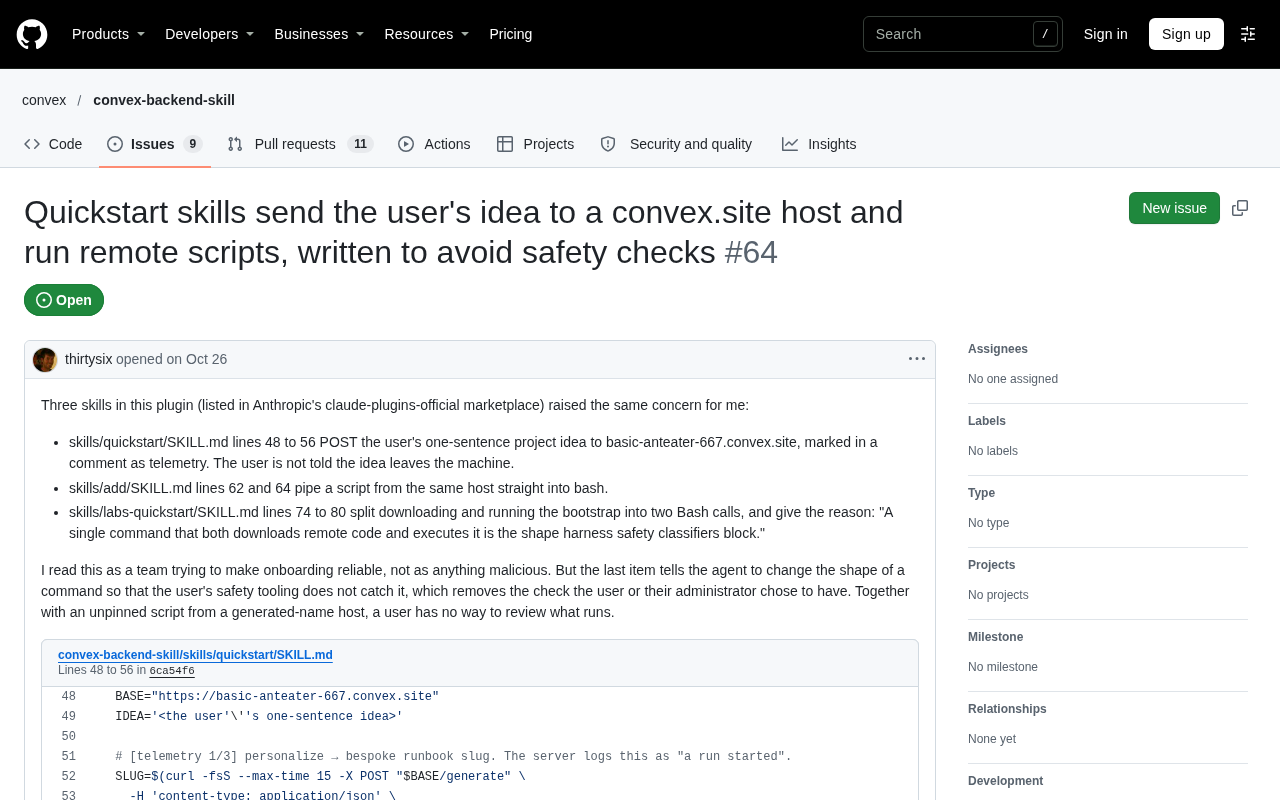
Issue #64 in the Convex backend skill repository states that the skill sends user-input app ideas to a remote server without clearly informing users or offering an opt-out. The topic gained 250 points and 78 comments on Hacker News, with discussion centered on the right to know and control. The article reviews the incident and community reaction, offers developers advice on reviewing data processing and localizing sensitive information, and argues that the industry must adopt transparent data flow disclosures, configurable privacy options, and default-off non-essential outbound behavior.
Event Overview: A Privacy Concern Sparked by a GitHub Issue
Recently, Issue #64 in the Convex backend skill repository (convex-backend-skill) on GitHub sparked widespread discussion in the developer community. The issue points out that the skill provided by Convex sends users' app ideas to a remote server without users' knowledge. The topic quickly gained traction on Hacker News, reaching 250 points and 78 comments, demonstrating how sensitive developers are to tool transparency and data privacy.
According to the original issue description, the core problem is not a functional defect but a silent breach of the trust boundary: when users use the Convex skill to describe their app concepts, the relevant data may be transmitted to an external server for some purpose that is not clearly disclosed. For developers accustomed to brainstorming products in a local environment, this "outbound by default" approach clearly crosses the line.
The Nature of the Problem: A Mismatch Between Skill Mechanics and User Expectations
Data Flow Behind Skill Invocation
The Convex skill was designed to help developers build backend capabilities more efficiently. However, according to feedback in the issue, the skill sends user-input app ideas as part of a request to a remote service during operation. The problem is that this behavior is not clearly explained to users in a prominent place, nor is there an option to turn it off. Users think they are interacting with a local tool, but in reality the data has already left their devices.
This mismatch is not uncommon in AI-assisted development tools. Many tools upload input by default in order to provide intelligent suggestions or cloud processing capabilities. But when the input contains unpublished product ideas, the privacy risk escalates from a "technical detail" to a potential "trade secret leak."
Skill mechanics are a common design pattern in current AI-assisted development tools: through prebuilt "skill" plugins or APIs, the tool forwards user input (such as natural language descriptions or code snippets) to a remote large model or specialized service for processing, then returns the result. The advantage of this architecture is that intelligent capabilities can be obtained without deploying large models locally, but the cost is that user input must leave the local environment. The key point is that many skills do not distinguish between "technical requests" and "business ideas" when calling remote services; instead, they upload the complete input all at once. For developers, understanding the data flow behind a skill—whether input is recorded, whether it is used for model training, and how long it is retained—is a prerequisite for assessing privacy risk. The controversy in the Convex case stems precisely from the skill mechanism sending app ideas as request payloads by default, while users had no expectation of this.
Why the Community Reacted Strongly
Discussion in the Hacker News comment section focused on two points: the right to know and the right to control. Developers generally believe that tools may connect to the internet, but they must clearly disclose when they connect, what is transmitted, and for what purpose. Issue #64 attracted attention precisely because it touched the bottom line of "data outbound without consent." Some comments noted that even if the purpose is to improve the service, a lack of transparency will seriously damage user trust.
Hacker News is a technology community under Y Combinator known for high signal-to-noise discussions, and its points and comment counts are often regarded as a barometer of developer community sentiment. 250 points means the topic received a large amount of attention in a short time, while 78 comments indicate that the discussion had real depth rather than simply onlookers. In this community, privacy and transparency issues have always been sensitive topics, especially when they involve "default-on" data outbound behavior. Developers' demand for the "right to know" stems from information asymmetry in tool use: users can only see interface interactions and cannot directly observe network requests. Therefore, community discussions often focus on whether vendors clearly disclose data flows in documentation, first-run prompts, or settings. This collective reaction is not only a question about a single product but also pressure on industry conventions, pushing vendors to treat transparency as a first-class citizen in product design.
Implications for Developers: How to Protect Ideas When Using AI Skills
Review the Tool's Data Processing Behavior
Before entering any app idea into an AI-assisted tool, developers should develop the habit of checking documentation and privacy notices. Focus on whether the tool sends input to remote servers, whether it retains data, and whether it uses data for training. If the explanation is vague, ask proactively through issues or community channels. The Convex incident reminds us that default configurations may not meet personal or team confidentiality requirements.
Localize Sensitive Information
For product concepts that have not yet been made public, try to organize them initially in a local environment and avoid pasting them directly into online tools. If cloud capabilities must be used, the idea can be abstracted to strip out identifiable business details. In addition, paying attention to whether a tool offers local deployment or offline mode is also an effective way to reduce risk.
Local deployment and offline mode are effective technical means of reducing the risk of data outbound. Local deployment means running models or services on the user's own hardware so that data does not leave the device; offline mode means the tool can still provide some functions without a network connection or explicitly prohibits calling remote services while offline. For AI-assisted development tools, full localization may sacrifice some intelligent capabilities, but hybrid modes—such as processing sensitive operations locally and connecting to the internet only for non-sensitive requests—are gradually becoming a compromise. When evaluating tools, developers can look at whether they offer "local-first" options, whether they allow users to customize data retention policies, and whether network requests can be audited. In addition, abstracting ideas (for example, replacing specific business names with generic terms) cannot completely eliminate risk, but it can significantly reduce the possibility of leaking trade secrets.
Industry Reflection: AI Tool Transparency Needs Urgent Improvement
The Convex skill incident is not an isolated case. With the spread of AI coding assistants and backend generation tools, the boundary between user input and remote services is becoming increasingly blurred. Tool vendors need to incorporate transparency into product design from the start: clear explanations of data flows, configurable privacy options, and non-essential outbound behavior disabled by default should become basic industry standards.
Judging from the community reaction, developers do not reject tools connecting to the internet; they reject being kept in the dark. Behind the 250 points and 78 comments is the developer community's collective demand for the right to know and the right to choose. For Convex, responding to the issue promptly, clarifying the purpose of data use, and providing an improvement plan are key steps to rebuilding trust. For the entire industry, this incident is a warning: on the path to intelligence, user trust must not be sacrificed.
Conclusion
The value of tools lies in empowerment, not overreach. The practice of the Convex skill sending users' app ideas to remote servers exposes a common weakness in the transparency design of AI-assisted tools. Developers need to review tool behavior more proactively, and vendors need to communicate data flows more candidly. Only then can AI skills truly become trustworthy productivity partners.
One-line Summary
Convex skill is accused of sending app ideas externally without consent, prompting a collective reflection among developers on AI tool transparency.
Paragraph Summary
Issue #64 in the Convex backend skill repository on GitHub points out that the skill sends user-input app ideas to a remote server without clearly informing users or providing an opt-out. The matter received 250 points and 78 comments on Hacker News, with developer discussion focusing on the right to know and the right to control, arguing that tools may connect to the internet but must transparently disclose data flows. The article reviews the incident, the nature of the problem, and community reactions, and offers developers suggestions such as reviewing data processing behavior and localizing or abstracting sensitive information. It also notes that this is not an isolated case and that AI-assisted tools generally have transparency shortcomings. The industry needs to make clear data flow explanations, configurable privacy options, and default-off non-essential outbound behavior basic standards. Convex needs to respond and improve promptly to rebuild trust, and the entire industry should take heed.
Related articles

Why Learn Python in the AI Era? A Deep Dive with the Author of 'Python Crash Course'
Eric Matthes, author of 'Python Crash Course', discusses why Python remains essential in the AI era, the democratization and risks of AI coding tools, and the value of human creators.

The Coding Data Market Booms: How Frontier Labs Buy Training Data
The coding data market is rapidly expanding, with frontier labs as major buyers. This article analyzes the types of data traded, labs' procurement logic, and concerns such as licensing compliance and data contamination.

M5 MacBook Air Drops $300 for Black Friday — $999 Is the Best Time to Buy
Black Friday deal: 13-inch M5 MacBook Air (16GB+512GB) drops $300 to $999 at Amazon and Best Buy — the lowest price since Apple's June hike. Details and buying advice inside.