Core Principles of RAG Retrieval: A Complete Guide to Top-K Rough Recall and Rerank Precision Sorting

Plain-language explanation of RAG retrieval logic: Top-K recall, Rerank sorting, and context compression
This article explains the underlying retrieval logic of RAG (Retrieval-Augmented Generation) systems in accessible language. RAG's core idea is to first retrieve relevant materials from a knowledge base, then have the LLM generate answers based on those materials. The article details the three-step production-grade RAG process: Top-K rough recall (using Bi-Encoders for fast candidate filtering), Rerank precision sorting (using Cross-Encoders for deep relevance scoring), and deduplication/compression (streamlining evidence before feeding it to the LLM). It also explains K-value trade-offs and the technical principles behind each stage.
Many people find that calling LLM APIs isn't difficult when learning AI application development, but they get confused when it comes to RAG-based knowledge base Q&A—vector retrieval, Top-K, recall, Rerank. These concepts sound advanced, yet it's hard to understand what role each plays in the system. This article uses the most accessible language to help you thoroughly understand the underlying logic of RAG retrieval.
The Essence of RAG: Find Evidence First, Then Answer Questions
RAG (Retrieval-Augmented Generation) can be summarized in one sentence: Instead of having the LLM answer from thin air, first help it find the relevant materials, then generate answers based on those materials.
Here's a simple example: A user asks, "What's the company's hotel allowance for business trips?" If the knowledge base contains thousands of policies, contracts, notices, and manuals, the system can't possibly feed all materials to the LLM. It's like asking a librarian a question—they won't carry every book in the building to you. A competent librarian will first determine which books, pages, and paragraphs likely contain the answer.
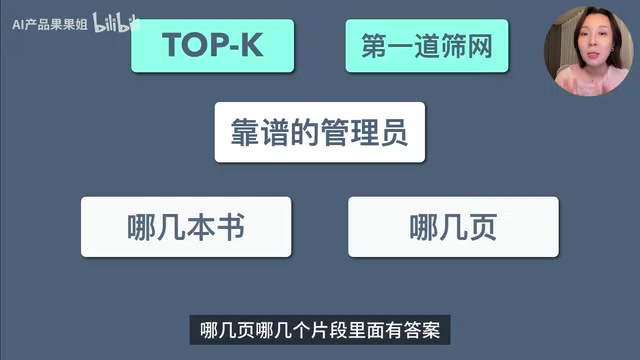
A RAG system works exactly the same way: after a user asks a question, the first step isn't generating an answer, but retrieving the most likely relevant material fragments from the knowledge base. This action is called "retrieval recall."
Knowledge Base Construction: The Hidden Foundation of RAG
The effectiveness of a RAG system depends not only on the retrieval algorithm but also heavily on the quality of knowledge base construction. Before being indexed, documents need to undergo chunking—splitting long documents into fragments suitable for retrieval. Chunking strategy directly impacts recall quality: chunks that are too small lose context, while chunks that are too large introduce noise. Common strategies include fixed-length chunking, sentence/paragraph-based chunking, recursive character chunking, etc. Some advanced implementations also use a "parent-child chunk" strategy—retrieving with small chunks but feeding larger chunks to the model. Additionally, metadata filtering (e.g., pre-filtering by document type or time range) is an important technique for improving retrieval precision, narrowing down the candidate document scope before vector retrieval.
Top-K: The First Filter in Retrieval Recall
What is Top-K?
The meaning of Top-K is very straightforward: From a large pile of materials, pick out the top K fragments that most likely contain the answer.
Here's the specific process:
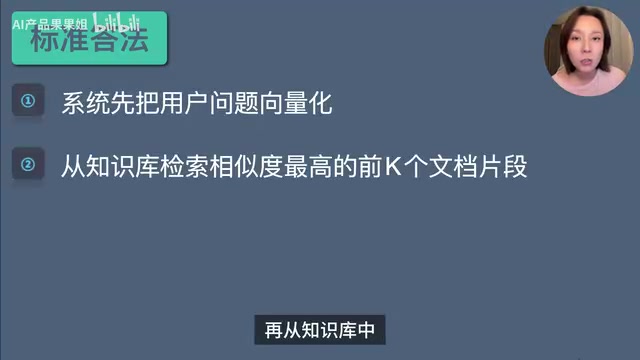
- The system first converts the user's question into a vector (Embedding)
- It performs similarity matching in the vector database
- It takes the top K fragments with the highest similarity scores as candidate content
Embedding and Vector Databases: The Technical Foundation of Top-K
Embedding is the technology of converting text into high-dimensional numerical vectors, forming the foundational layer of RAG systems. Its core principle is: semantically similar texts are closer together in vector space. Mainstream Embedding models include OpenAI's text-embedding-ada-002, the open-source BGE series (BAAI/bge-large-zh), etc. Vector dimensions typically range from 768 to 3072—higher dimensions offer stronger expressive power but also higher computational costs.
Vector databases (such as Faiss, Milvus, Qdrant, Weaviate) are specifically designed for efficient vector similarity retrieval, supporting multiple distance metrics like cosine similarity and Euclidean distance. They can complete Approximate Nearest Neighbor (ANN) searches across millions of vectors in milliseconds. It's this ability to "measure semantic similarity through spatial distance" that makes Top-K retrieval both fast and semantically aware, far surpassing traditional keyword matching.
For example, when a user asks about business trip hotel standards, the system might recall fragments related to "travel policies," "accommodation standards," "reimbursement procedures," and "invoice requirements," rather than stuffing in irrelevant content like "annual party notices," "cafeteria announcements," or "employee birthday benefits."
The Three-fold Value of Top-K
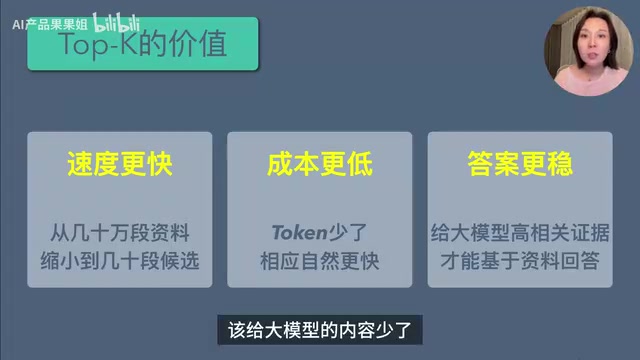
This step may seem simple, but it actually solves three key problems:
- Faster retrieval: Narrowing down from hundreds of thousands of fragments to dozens of candidates dramatically improves retrieval efficiency
- Lower token costs: Less content fed to the LLM means lower token consumption and faster response times
- More stable answer generation: Give the LLM highly relevant evidence and it can answer based on materials; give it a bunch of noise and the answer will drift off-topic
The Dilemma of Setting K Values
But Top-K doesn't mean bigger K is always better. There's a classic trade-off here:
- K too small misses key information: If the real answer ranks 6th but you only take the top 3, you directly miss it
- K too large introduces noise: If you take the top 50, a large amount of irrelevant material gets mixed in, and the LLM is like being surrounded by people all talking at once—the final answer drifts off-topic instead
This leads to the core challenge of RAG engineering—relying solely on Top-K rough recall isn't enough. You also need subsequent Rerank precision sorting and context compression steps.
Production-Grade RAG: Three-Step Process of Rough Recall → Precision Sorting → Compression
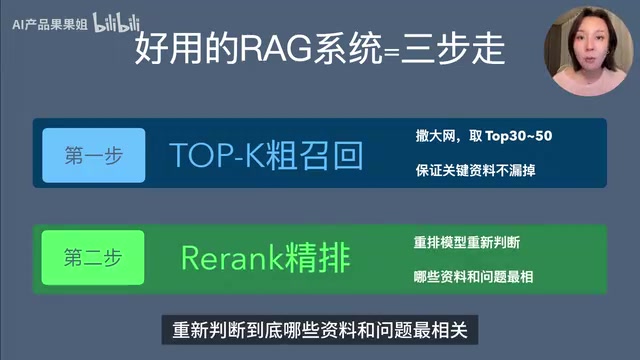
A truly effective RAG system doesn't just hand results to the LLM immediately after Top-K retrieval. A more robust engineering approach typically follows three steps:
Step 1: Top-K Rough Recall — Cast a Wide Net First
In this step, the system sets a relatively large K value (e.g., Top-30 or Top-50), with the goal of ensuring key materials aren't missed. It's better to retrieve more than to let the real answer get filtered out in the first round. This is a classic "cast wide" strategy.
Step 2: Rerank Precision Sorting — Pick Out the Good Fish
Rerank (re-ranking) is the critical step after rough recall. It uses specialized reranking models (such as Cross-Encoders) to re-score and re-order the candidate fragments from Top-K recall, determining each fragment's true relevance to the user's question.
Why is Rerank needed? Because while vector similarity matching is fast, its precision is limited—it judges based on "rough distances" in semantic space. A Rerank model takes the question and each candidate fragment together for deep semantic understanding, essentially having a more specialized reviewer re-examine everything and filter out truly highly relevant content.
Bi-Encoder vs Cross-Encoder: Why Rerank is More Precise
The Cross-Encoder used in the Rerank stage has a fundamental architectural difference from the Bi-Encoder used in the Embedding stage. A Bi-Encoder independently encodes the question and document into vectors separately before calculating similarity—it's extremely fast and suitable for rough filtering across millions of documents. A Cross-Encoder concatenates the question and candidate document together as input to the model, allowing the two to fully interact through attention mechanisms, outputting a precise relevance score.
This deep interaction makes Cross-Encoders far more accurate than Bi-Encoders, but at higher computational cost—each candidate fragment requires a separate inference pass. Therefore, in engineering practice, a Bi-Encoder is typically used first for fast rough recall, followed by a Cross-Encoder for precision sorting of a small number of candidates, forming a two-stage "rough ranking + precision ranking" architecture. Commonly used Rerank models include Cohere Rerank, BGE-Reranker, and bce-reranker-base, among which BGE-Reranker is particularly friendly for Chinese language support.
Step 3: Deduplication and Compression — Streamline the Evidence
After Rerank, a final cleanup of results is still needed:
- Deduplication: Multiple fragments may contain overlapping information; merge and remove redundancy
- Compression: Remove overly long or useless content, keeping only the core evidence that directly supports the answer
- Context assembly: Organize the curated fragments into structured context and pass it to the LLM for final answer generation
To summarize the relationship of these three steps in one sentence: Top-K casts the net, Rerank picks the good fish, compression removes impurities, and only then is it served to the LLM.
Interview Practice: How to Answer "Top-K Application in RAG"
If an interviewer asks: "How do you apply the Top-K algorithm to the RAG retrieval stage to improve recall efficiency?" You can answer like this:
In a RAG system, Top-K is primarily used in the retrieval recall stage. The system first vectorizes the user's question (converting it to a high-dimensional vector via an Embedding model), then retrieves the top K document fragments with the highest similarity from the vector database as candidate context. This quickly narrows the retrieval scope, reduces irrelevant content, lowers token costs, and improves response speed. However, K shouldn't be blindly set too large. In real projects, the typical approach is to first perform Top-K rough recall (using a Bi-Encoder for fast filtering), then combine it with Rerank precision sorting (using a Cross-Encoder for deep scoring) and context compression, delivering only the final high-quality fragments to the LLM for answer generation.
The key to answering this way: you're not just explaining what Top-K is, but also demonstrating your understanding of the entire RAG retrieval pipeline—from rough recall to precision sorting to final generation. This reflects systematic thinking rather than just stacking buzzwords.
Summary
When learning RAG, don't start by memorizing terminology. First internalize the underlying logic:
- The essence of RAG is "find evidence first, then answer based on evidence"
Related articles
Deep Dive into AI Agent Skill Design: …
Deep Dive into AI Agent Skill Design: Engineering Practices from Anthropic and Perplexity
A deep dive into Skill design philosophy from Anthropic's Claude Code team and Perplexity's Agent team, covering the Tax Test, Gotchas Flywheel, progressive disclosure, and Eval-First practices for building high-quality AI Agent skill systems.
Deep Dive into OpenAI's Official GPT-5…
Deep Dive into OpenAI's Official GPT-5.6 Prompting Guide: The Shift from Manual to Automatic
A deep dive into OpenAI's official GPT-5.6 Sol prompting guide: conciseness-first, outcome-oriented design, autonomy boundaries, tool routing, and reasoning intensity tuning.
 Deep Dives
Deep Dive into How OpenClaw (Open-Source Crayfish) AI Agent Works
Deep analysis of OpenClaw AI Agent internals: System Prompt, tool calling, SubAgents, Skill system, memory, and Context Engineering explained.