Corsair: Open-Source App Integration Framework for Seamlessly Connecting Users to Third-Party Apps
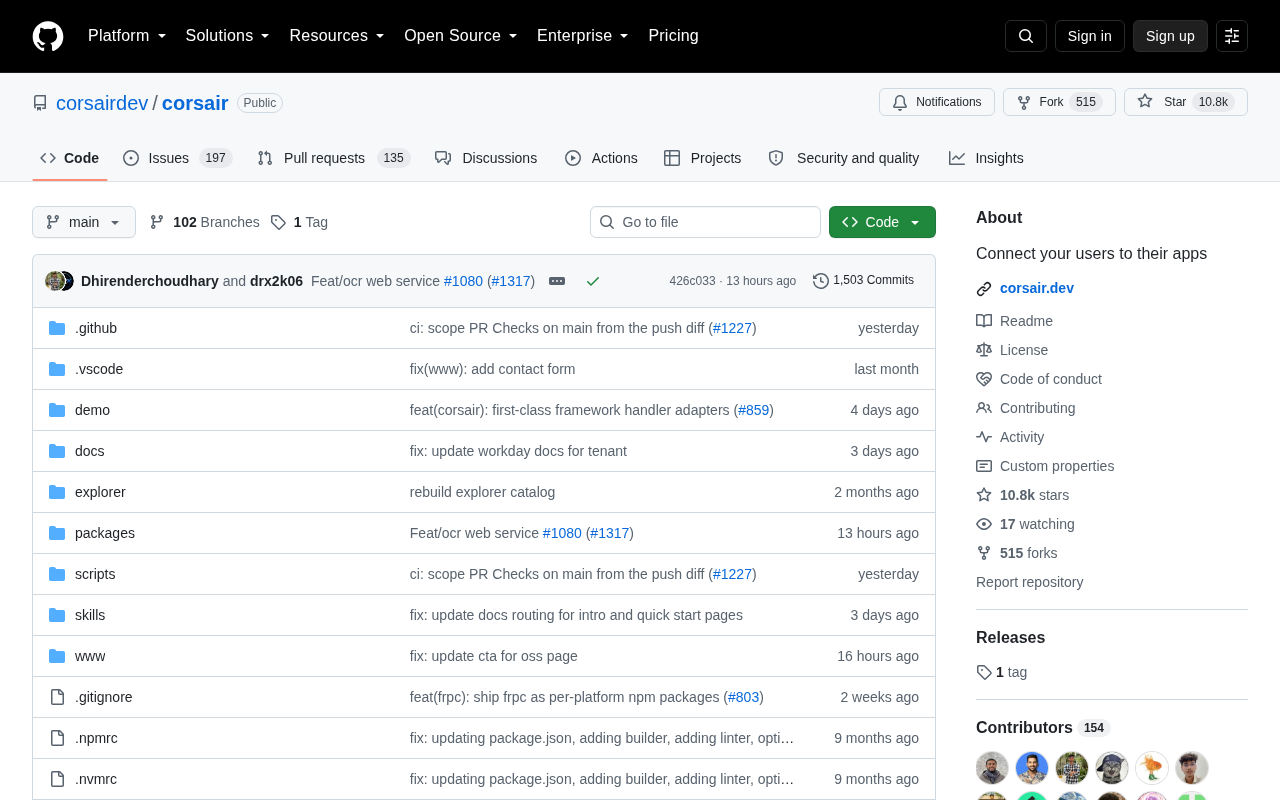
Corsair is an open-source TypeScript framework for unified third-party app integration.
Corsair is an open-source TypeScript framework that provides a unified abstraction layer for connecting users to their third-party applications. It simplifies OAuth authentication, token management, and data synchronization, eliminating repetitive integration code. With 10,000+ GitHub Stars, it supports use cases like SaaS integration hubs, automated workflows, and AI Agent data access, offering a self-hostable alternative to commercial solutions.
Corsair Project Overview
In modern SaaS and application development, there's an unavoidable pain point: how do you let users conveniently and securely connect their third-party apps to your product? Whether it's syncing calendars, fetching emails, integrating CRMs, or connecting payment systems, developers often have to write separate integration logic for each third-party service, dealing with varying authentication flows and data formats. The open-source project Corsair (corsairdev/corsair) was built to solve exactly this problem.
Its positioning can be summed up in one phrase: "Connect your users to their apps." Written in TypeScript, this project has rapidly gained traction on GitHub, amassing over 10,000 Stars and 500+ Forks with extremely high daily growth, reflecting the community's strong demand for a unified app integration solution.
Why App Integration Deserves Attention
App integration has always been time-consuming and labor-intensive work that developers can't avoid. Based on common industry experience, teams building external integrations often spend more than half their engineering effort on "glue code" — authentication (OAuth), token refresh, error retries, and data mapping — rather than core business logic.
It's worth explaining the complexity of OAuth authentication in particular. OAuth (Open Authorization) is the de facto standard protocol for authorization between internet applications. Its core idea is to allow users to authorize third-party applications to access their resources on a platform without exposing their passwords. The OAuth 2.0 flow involves multiple steps: client registration, authorization code acquisition, token exchange, access token usage, and refresh token rotation. Each third-party platform has variations in its OAuth implementation — some require PKCE (Proof Key for Code Exchange) for enhanced security, others use non-standard token refresh mechanisms, and still others differ in scope definitions. Developers must also handle automatic token refresh upon expiration, secure token storage (typically requiring encrypted persistence), and race conditions during concurrent refreshes. These seemingly edge-case engineering details can lead to broken user connections or security vulnerabilities if handled improperly, making them one of the most energy-draining aspects of integration development.
Corsair aims to abstract all this repetitive work into a unified framework, enabling developers to integrate more services with less code.
Core Value and Design Philosophy
Unified Connection Abstraction Layer
Corsair's core approach is to provide a unified abstraction layer that binds "users" to "the third-party apps they own." Developers no longer need to repeatedly implement authentication handshakes, token storage, and permission management for each service — instead, they can accomplish everything through Corsair's interfaces in one go.
This design aligns with the increasingly popular "Unified API" philosophy — using a single programming model to shield developers from the differences between underlying services, dramatically reducing the development cost of multi-service integration. Unified API is an architectural paradigm that has emerged in the B2B SaaS space in recent years. Its core idea is that while different vendors offering similar services (such as CRM, HRIS, or accounting software) each have different API designs, data models, and authentication methods, they often share significant commonalities at the business abstraction level. Unified API solutions define a standardized data model and interface specification, encapsulating the differences across multiple underlying services so that callers only need to interface with a single API to access multiple similar services. The advantage of this approach is a dramatic reduction in N×M integration complexity (N customers × M service providers), though it also faces challenges: over-abstraction may lose platform-specific features, and standardized data models may struggle to cover all edge cases. Notable practitioners in the industry include Merge (focused on HR/ATS unified APIs), Finch (payroll data unified API), and others.
Full-Stack TypeScript
The project is written entirely in TypeScript, enabling static type safety and improved developer experience from type definitions all the way to API calls. TypeScript is a superset of JavaScript introduced by Microsoft in 2012, addressing JavaScript's insufficient type safety in large-scale engineering through a static type system. Using TypeScript in full-stack development scenarios offers several notable advantages: First, sharing type definitions between frontend and backend eliminates runtime errors caused by API contract inconsistencies, catching type mismatches at compile time. Second, IDE features like auto-completion, type inference, and refactoring support perform far better in TypeScript projects than in pure JavaScript, significantly boosting development efficiency. Additionally, TypeScript's generics system and interface definition capabilities make SDK and framework API designs more self-documenting — developers can understand interface usage through type hints without constantly consulting documentation.
For modern web teams using Node.js / TypeScript as their tech stack, Corsair integrates almost seamlessly into existing engineering systems, reducing runtime errors and improving code maintainability. For a project like Corsair that exposes numerous integration interfaces, TypeScript's type safety is especially critical, since the correctness of data structures in integration scenarios directly impacts the reliability of downstream business logic.
Excellent Developer Experience
Judging by the project's rapid star growth, Corsair has invested heavily in developer experience (DX). A quick onboarding flow, clear documentation structure, and compatibility with mainstream frameworks are the decisive factors in whether an open-source integration tool gets widely adopted. Its sustained high growth indicates it's in a phase of rapidly building community word-of-mouth.
Typical Use Cases
Connection tools like Corsair are suitable for a variety of real-world business scenarios:
SaaS Product Integration Hub
Let end users connect their Google, Slack, Notion, CRM, and other accounts within your product with a single click, without needing to individually integrate each platform's API and authentication mechanism.
Automated Workflow Building
Serving as a central hub for data flow, it connects data across multiple applications to build cross-platform automation workflows, eliminating the tedious manual work of transferring data between different systems.
Data Access Layer for AI Agents
With the rise of AI Agents, enabling intelligent agents to securely access user-authorized application data has become a critical need. A unified connection layer can dramatically reduce the data access costs for AI applications.
In the context of rapidly evolving concepts like AI Agents and MCP (Model Context Protocol), "how to securely connect users' apps and data to AI" is becoming a new technology hotspot. MCP (Model Context Protocol) is an open protocol introduced by Anthropic in late 2024, designed to standardize interactions between large language models and external data sources and tools. Before MCP, the way AI Agents accessed external applications was highly fragmented — each tool call required a separate adapter layer, lacking unified security authorization and context-passing mechanisms. MCP defines a standard client-server architecture that enables AI models to discover available tools, request user authorization, execute operations, and retrieve results in a unified manner. In this architecture, "how to securely access third-party app data on behalf of users" becomes a critical link — AI Agents need explicit user authorization, use user credentials to access data on specific platforms, and adhere to the principle of least privilege. Connection layer tools like Corsair fill exactly this gap: they manage the authorization relationships and tokens between users and their applications, serving as a bridge between MCP servers and actual third-party APIs, allowing AI Agents to securely read and write data within the scope of user authorization.
Positioning and Competitive Advantages in the Open-Source Ecosystem
In the open-source integration tools space, commercial and open-source solutions like Nango, Paragon, and Merge already exist. Corsair enters the arena as a purely TypeScript-based, fully open-source and free solution, offering a new choice for teams that don't want vendor lock-in and seek self-hosting and deep customization.
It's worth understanding the competitive landscape in this space. Nango is an open-source platform focused on third-party API authentication and data synchronization, offering 300+ pre-built OAuth integrations and built-in token management, with a business model of open-source core plus paid cloud hosting. Paragon leans toward embedded integration platforms, providing SaaS products with visual integration builders, but is primarily commercial and closed-source. Merge focuses on the Unified API direction, mainly covering vertical categories like HR, ATS, and CRM, using a fully managed SaaS model. There are also players like Supaglue (which has been acquired) and Vessel. The key differences between these solutions include: whether they're open-source, whether they support self-hosting, the categories of integrations covered, whether they offer a Unified API or just authentication proxying, and their pricing models. For technical teams, the choice requires weighing vendor lock-in risk, security and compliance concerns around data passing through third parties, flexibility for custom extensions, and long-term maintenance costs.
For enterprises that prioritize data sovereignty and have private deployment requirements, the value of open-source solutions is particularly prominent — all data and tokens are managed on your own infrastructure without passing through third-party intermediaries. Data Sovereignty refers to an organization's complete control over its data, including where it's stored, who can access it, and how it's processed. With global privacy regulations like GDPR (EU General Data Protection Regulation) and CCPA (California Consumer Privacy Act) becoming increasingly strict, enterprises are growing more sensitive about data flow and storage locations. When using third-party hosted integration services, users' OAuth tokens and application data may pass through external service providers' infrastructure, which could cross compliance boundaries in heavily regulated industries like finance, healthcare, and government. Self-hosted open-source solutions allow enterprises to deploy all components on their own infrastructure — whether in private data centers or VPCs (Virtual Private Clouds) within their own cloud accounts — ensuring that tokens and sensitive data always flow within controlled boundaries. This is why many enterprise users treat "self-hosting support" as a hard requirement when selecting infrastructure tools.
Integration Assessment and Usage Recommendations
For teams considering adding Corsair to their tech stack, here are some suggestions:
- Small-Scale Validation: Start by integrating one or two frequently used third-party services in a test environment to verify the stability of authentication flows and data synchronization.
- Security Review: Focus on whether its token management mechanism, encrypted storage approach, and least-privilege practices meet your team's standards.
- Version Assessment: The project is still in a rapid iteration phase. Before using it in production, evaluate the stability of the current version and continuously monitor community activity and maintenance frequency.
Summary
Corsair targets a long-standing, frequently encountered development pain point — app integration — providing a unified user-to-app connection solution built on TypeScript. With over 10,000 GitHub Stars and continuously growing community attention, it reflects developers' genuine demand for lightweight, open-source, self-hostable integration solutions.
As AI applications' need for external data access continues to grow, the value of this kind of "connection layer" infrastructure is poised to become even more prominent. If your team is spending significant repetitive effort on third-party app integration, Corsair deserves a spot at the top of your technology evaluation list.
Related articles

Uber Deploys ChatGPT Work Company-Wide: AI in the Workplace Enters the Scaled Implementation Phase
Uber deploys ChatGPT Work to 30,000+ employees, extending it from engineering to all roles. We analyze its expert-engineer pairing, end-to-end automation, and questions of AI control and power concentration—insights for scaling AI in the workplace.

Shift at Midnight Hands-On: When "ID Verification" Becomes Alien Hunting
Shift at Midnight blends ID verification with horror survival in a four-player co-op game. We break down its inspection mechanics and chaotic humor.

Zelensky Recounts the Outbreak of War: I Need Ammunition, Not a Ride
Zelensky recalls the first day of war in a YouTube interview: farewell to family, rejecting Biden's evacuation offer with "I need ammunition, not a ride," and how Bucha shaped his stance on compromise and peace talks.