CosmoDex: In-Depth Experience with the AI-Powered Gamified Programming Learning Platform
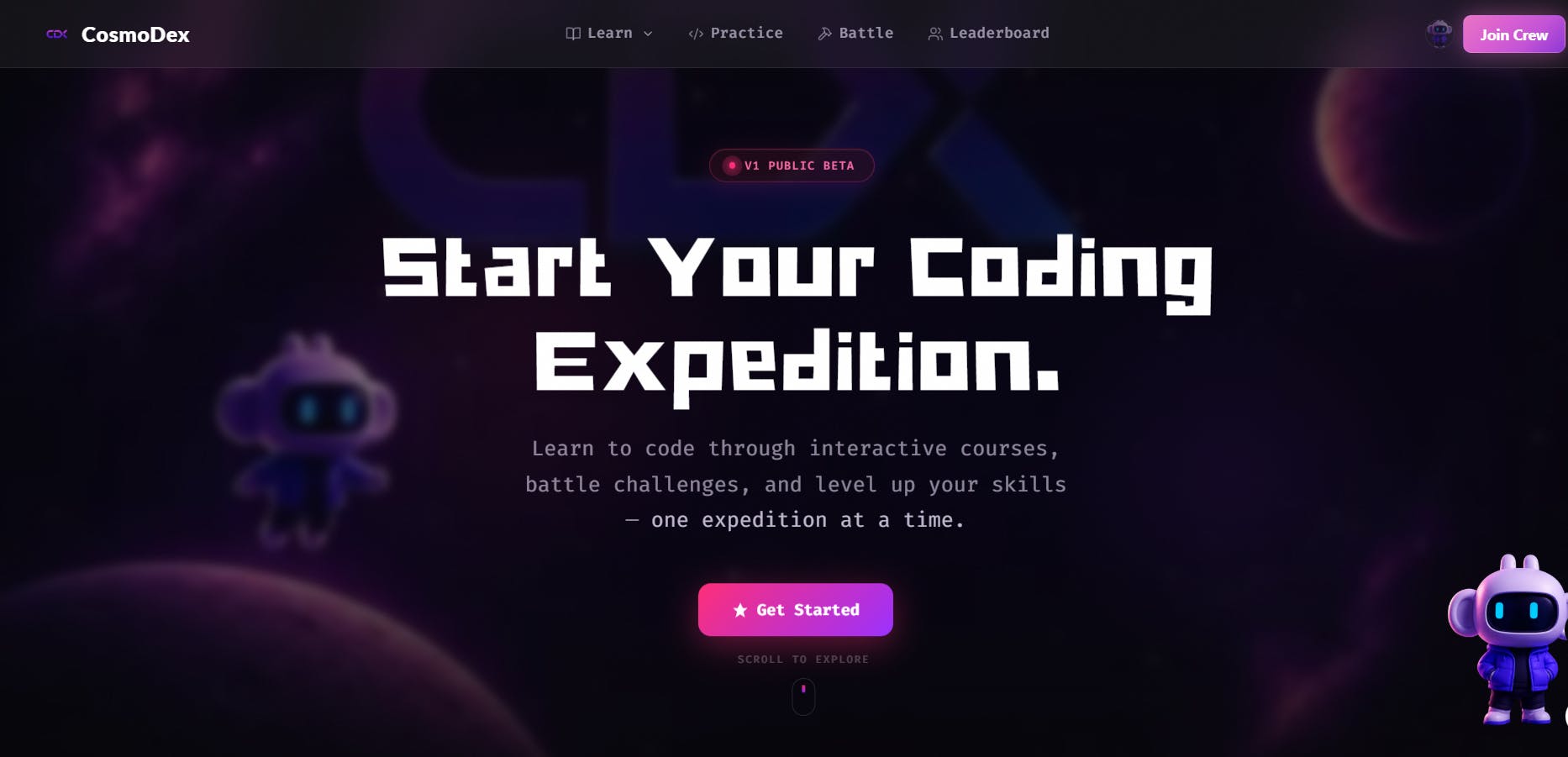
CosmoDex transforms programming education through AI-driven gamification with 1v1 battles and XP systems
CosmoDex is an AI-powered gamified programming platform that makes learning feel like competitive gameplay. It offers personalized Python and SQL courses with adaptive difficulty, real-time 1v1 coding battles, XP systems, streak rewards, and global leaderboards. Unlike LeetCode's interview focus, it targets beginners with lightweight entry barriers.
The Gamification Revolution in Programming Education
In the field of programming education, tedious practice problems and learning models lacking feedback have long been pain points for beginners. CosmoDex emerged to break through this dilemma—positioning itself as "the world's first AI-driven gamified competitive programming platform." By introducing mechanics like experience points (XP), daily streaks, leaderboards, and real-time 1v1 battles, it transforms programming learning into an adventure filled with competitive excitement.
Theoretical Foundation of Gamified Learning
Gamification is a methodology that applies game design elements and game mechanics to non-game contexts, first coined by Nick Pelling in 2002. In education, the core value of gamification lies in leveraging intrinsic human motivations—such as sense of achievement, competitive desire, and social needs—to drive learning behaviors. Psychological research shows that immediate feedback, clear progress visualization, and moderate challenges can significantly enhance learner engagement and knowledge retention rates. The experience point (XP) system originates from role-playing games (RPGs), concretizing abstract progress by quantifying learning outcomes; leaderboards leverage social comparison theory to stimulate competitive motivation. However, excessive gamification may lead to extrinsic incentives overshadowing intrinsic learning motivation, a risk that requires careful balance in educational product design.
This product received 8 upvotes on its Product Hunt launch day, ranking 16th, with its target audience locked on students and beginner developers. Its core philosophy is to make programming learning "no longer feel like homework, but more like a game."
CosmoDex Core Features: Complete Loop from Challenges to Battles
AI-Powered Personalized Programming Learning Paths
CosmoDex's AI functionality is not simply code completion, but deeply integrated throughout the entire learning process. The platform offers systematic courses in two core languages: Python and SQL. The AI dynamically adjusts problem difficulty based on user problem-solving performance, creating personalized learning curves.
Technical Implementation of Adaptive Learning Systems
Adaptive Learning systems dynamically adjust teaching content and difficulty through algorithms. Core technologies include knowledge tracing models and recommendation algorithms. Traditional Item Response Theory (IRT) estimates learner ability and problem difficulty through statistical models, while modern AI-driven systems employ machine learning methods such as Deep Knowledge Tracing (DKT) or Bayesian Knowledge Tracing (BKT). These algorithms continuously analyze multidimensional data including user answer accuracy, solution time, and error types to construct dynamic knowledge mastery profiles. For example, if the system detects repeated errors in loop structures, it automatically pushes more related foundational exercises rather than immediately advancing to advanced topics like recursion. This technology has been validated in mature products like Khan Academy and Duolingo, improving learning efficiency by 20%-40%.
This adaptive mechanism effectively avoids the "one-size-fits-all" problem of traditional programming textbooks, allowing learners of different backgrounds to find appropriate starting points.
Multi-Level Gamification Incentive System
The platform has designed a rich incentive system that fills programming practice with a sense of achievement:
- Experience Point System: Earn XP by completing each problem; accumulated experience points unlock new content
- Streak Rewards: Through the Streak mechanism, encourage daily learning and help develop continuous learning habits
- Cosmic League Leaderboard: Global players ranked by skill level, creating a strong competitive atmosphere
- Real-Time 1v1 Space Battles: The most innovative feature—two players simultaneously solve the same problem, with the first to complete winning
This design borrows from the ranking systems and instant feedback mechanisms of competitive games like League of Legends, quantifying and visualizing the sense of achievement in programming learning.
CosmoDex's Market Positioning and Differentiated Competition Analysis
Current programming education platforms can be roughly divided into three categories: traditional video course platforms (like Udemy), problem-solving websites (like LeetCode), and interactive learning platforms (like Codecademy). CosmoDex attempts to combine the advantages of the latter two while lowering the learning barrier through gamification.
Evolution History of Programming Competition Platforms
Programming competition platforms have evolved from academic competitions to mass-market learning tools. Early representatives like TopCoder, founded in 1997, primarily served algorithm competition participants. LeetCode, established in 2011, shifted focus to technical interview preparation with a problem bank emphasizing data structures and algorithms. HackerRank (2011) pioneered the model combining corporate recruitment with programming challenges, while Codewars (2012) introduced a martial arts ranking system, becoming the first to deeply integrate gamification into problem-solving experiences. CosmoDex's real-time 1v1 battle mode is innovative in this lineage—it mimics the instant confrontation mechanism of esports games, forming a sharp contrast with traditional platforms' asynchronous submissions and delayed ranking updates. This design can generate adrenaline stimulation and flow state, but also poses higher requirements for problem design: problems need to be completable within 3-10 minutes, and difficulty differences cannot be too large, otherwise competitive fairness will be compromised.
Its differentiation is mainly reflected in two aspects:
- Immediacy of Competitive Confrontation: The real-time 1v1 programming battle mode is relatively rare in programming education. This design stimulates urgency and focus, making the learning process less tedious
- Lightweight Entry Barrier: Compared to LeetCode's positioning toward job interview preparation, CosmoDex is more concerned with the needs of programming beginners. The language choices of Python and SQL also confirm this
Strategic Choice of Python and SQL for Education
CosmoDex's choice of Python and SQL as the first supported languages has clear strategic considerations. Python has surpassed Java to become the most popular introductory programming language in universities since 2018, with concise syntax, wide application scenarios (data analysis, machine learning, web development), and a large learning community. The TIOBE Programming Language Index shows Python consistently ranks in the top three. SQL (Structured Query Language) is a foundational skill for data processing; LinkedIn data shows SQL was one of the most sought-after technical skills by employers in 2023. This combination of languages covers the core competency model of "programming thinking + data processing," aligning with beginners' needs to quickly gain workplace competitiveness. In comparison, while JavaScript is essential for web development, the complexity of front-end frameworks is not beginner-friendly; C++ or Go are more suitable for developers with some foundation. This language selection reflects the product's priority judgment on "maximizing initial user value."
However, the platform currently only supports two languages, making it relatively less attractive to users who already have some foundation or wish to learn languages like JavaScript or Go.
Potential Challenges and Future Development Directions
User Retention is the Key Challenge
Gamification design is a double-edged sword: it can quickly attract user registration initially, but if core content quality doesn't keep up, users will quickly feel repetitive and fatigued. CosmoDex needs to continuously update its problem bank, enrich challenge difficulty gradients, and consider introducing user-generated content (UGC) to extend the product's lifecycle.
AI Functionality Still Has Deep Expansion Space
Currently, the specific application scenarios of AI in the product description are not rich enough. Future directions worth exploring include:
- Intelligent diagnosis of code errors with progressive hints
- Code review and optimization suggestions based on large language models
- Natural language interactive programming learning assistants
Application Prospects of Large Language Models in Programming Education
Large Language Models (LLMs) like GPT-4 and Claude have brought revolutionary possibilities to programming education. Traditional automated grading systems can only judge whether code output is correct, while LLMs can understand code logic, identify anti-patterns, and provide natural language explanations. Specific application scenarios include: 1) Socratic teaching—when students are stuck, AI doesn't directly give answers but guides thinking through questions; 2) Code review assistant—analyzes code time complexity, readability, and potential bugs; 3) Personalized error diagnosis—not only points out 'what's wrong,' but also explains 'why it's wrong' and 'how to improve'; 4) Natural language programming exercises—users describe requirements in plain language, AI generates corresponding code and explains implementation logic. GitHub Copilot has demonstrated the powerful capabilities of AI-assisted coding, but educational scenarios require special design to avoid students over-relying on AI while neglecting foundational skill development. The ideal model is 'progressive assistance': in the beginner stage, AI only provides hints, gradually opening more advanced features as abilities improve.
Choice of Commercialization Path
As an educational product, CosmoDex may adopt a Freemium model—basic functions are free and open, while advanced courses, private battle rooms, or ad-free features require paid unlocking.
Profitability Challenges of the Freemium Model
The Freemium business model combines 'Free' and 'Premium,' with the core logic of attracting a large number of users through free services, then converting 3%-5% of them into paying users to realize profitability. In the education technology field, Duolingo is a classic case: 95% of users use the free version, but 5% of paying users contribute about 80% of revenue. The key challenge of this model lies in 'value ladder design'—free functions need to be attractive enough to retain users, but paid functions must provide clear incremental value. Common strategies include limiting free users' usage frequency (such as daily practice problem quantity), advanced features (such as AI code review), or removing ads. For CosmoDex, potential paid features may include: unlimited battle attempts, private rooms, advanced problem banks, learning data analysis reports, etc. However, educational products need to be wary of excessive commercialization damaging user experience—if core learning functions are restricted by paywalls, it will cause user resentment and damage brand reputation.
How to find a balance between profitability needs and user experience will be an issue the founding team needs to continuously weigh.
Conclusion: Value and Limitations of Gamified Programming Education
CosmoDex represents an innovative attempt in programming education: wrapping the kernel of learning in the shell of a game. For those students who gave up programming due to tedious traditional textbooks, this "edutainment" approach may become a catalyst for getting started. But gamification is not a cure-all. What ultimately determines whether users stay is still the quality of course content, the practicality of AI functions, and whether the platform can truly help users build solid programming thinking.
One detail worth noting: CosmoDex is still in its early stages (only 8 votes on Product Hunt launch day), and its market acceptance and long-term development path remain to be observed. However, under the major trend of deep integration between AI and education, CosmoDex's exploration direction provides valuable reference for the entire programming education industry.
Related articles
Batch Generating Ad Creatives from a Single Product Image: Real Bottlenecks and Solutions for Scaled Workflows
From one product photo to multi-platform ad assets—brand consistency, text rendering, and cross-platform adaptation collapse first. Deep dive into AIGC marketing workflow bottlenecks with template-driven and layered composition solutions.

Scriptly: AI Voice-Following iOS Teleprompter That Eliminates Pace-Chasing
Scriptly is an iOS voice teleprompter using AI real-time voice-following technology to auto-match speaking pace. Supports local storage for privacy, integrates writing, script management & video recording workflow for content creators.
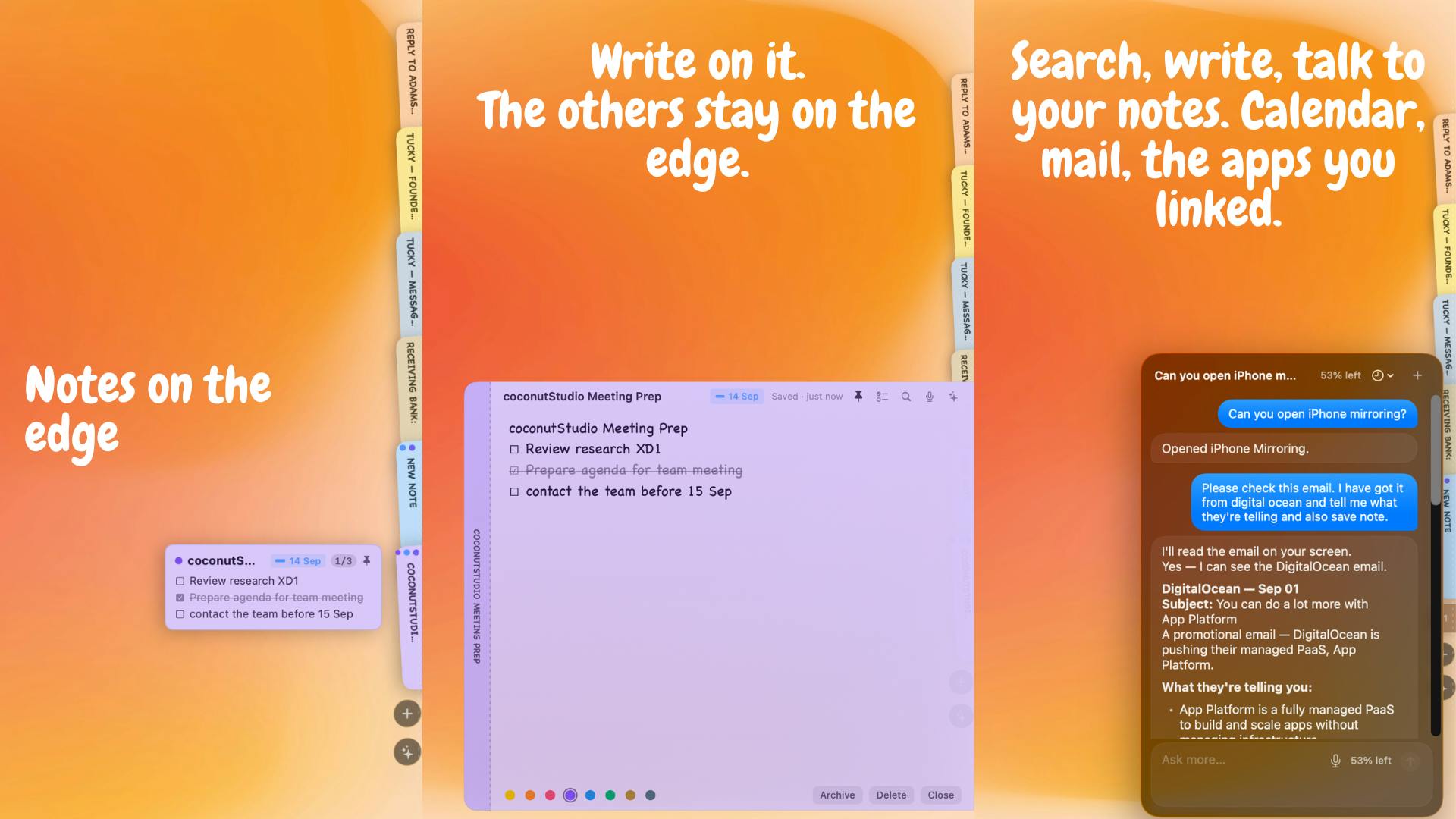
Tucky: An In-Depth Look at the macOS AI Note-Taking App Hidden at the Edge of Your Screen
Tucky is a native macOS AI note-taking app that hides at the screen edge for instant access, with a built-in AI Agent and local encrypted storage. A deep dive into its design, privacy, and pricing.