Coze from Scratch: A Complete Guide to Building Multi-Agent Collaboration

A hands-on guide to building multi-agent collaborative AI applications with ByteDance's Coze platform, no coding required.
This guide explains the core features of ByteDance's Coze agent platform: cross-platform interoperability, the Skills system, multi-agent collaboration modes, and workflow orchestration. It compares Coze with Dify's technical routes and covers key concepts like RAG, ReAct, Function Calling, and MCP to help zero-coding users quickly build practical AI applications.
What Is Coze? Understanding This Domestic Agent Platform
Coze is an intelligent agent (Agent) building platform under ByteDance, positioned around the idea that "you can master large model applications even with zero programming experience." For users who want to quickly build AI applications without getting bogged down in code details, Coze offers a remarkably friendly entry path.
Notably, there's a clear product strategy behind ByteDance's launch of Coze. Its Doubao large model is based on the self-developed "Yunque" (Skylark) foundation model, a large language model at the hundred-billion-parameter scale. The Yunque model adopts a Transformer Decoder-Only architecture similar to the GPT series, and by pretraining on the vast Chinese-language corpus accumulated across ByteDance's product ecosystem, it has established significant advantages in Chinese comprehension, Chinese generation, and localized knowledge. A hundred-billion-parameter scale means the model has extremely strong semantic understanding and long-text processing capabilities, but it also places extremely high demands on inference compute—ByteDance uses Volcano Engine's GPU clusters and a self-developed inference optimization framework (including technologies such as KV Cache compression and speculative sampling) to control inference latency and cost, providing a stable compute foundation for Coze.
Technical Background: KV Cache (Key-Value Cache) is a core mechanism for accelerating Transformer inference. During autoregressive generation, the model needs to recompute the attention over all historical tokens each time it generates a new token. KV Cache avoids redundant computation by caching the already-computed key-value matrices, boosting inference speed several times over. Speculative Decoding uses a small model to quickly generate candidate sequences, which a large model then verifies in parallel—significantly reducing end-to-end latency while ensuring output quality. The combined application of these two technologies is the key engineering means by which ByteDance supports Coze's massive concurrent invocations and compresses Doubao model inference costs to the industry's lowest range.
Product ecosystems such as Douyin, Toutiao, and Feishu form natural distribution channels and application scenarios.
Coze first launched overseas in late 2023 (coze.com), then entered the domestic market under the "Kouzi" brand (coze.cn). This timeline was almost synchronous with OpenAI's launch of the GPTs custom agent feature—OpenAI released GPTs in November 2023, allowing users to create customized AI assistants through natural-language descriptions, upload private documents as knowledge bases, integrate Actions (essentially external API calls defined by the OpenAPI specification), and finally publish them to the GPT Store for distribution and monetization. This product paradigm directly gave rise to the "AI application platformization" track, forming a competitive landscape both at home and abroad represented by OpenAI GPTs, ByteDance Coze, Baidu Wenxin Agents, and Tencent Yuanqi, extending the reach of Agent capabilities from the developer community to mainstream users. ByteDance quickly followed suit during the same period, reflecting its strategic pace at the AI application layer.
An AI Agent refers to an AI system capable of perceiving its environment, autonomously planning, invoking tools, and executing tasks—distinct from a purely conversational large model that simply engages in "question-and-answer." An agent's core architecture typically comprises four layers: the perception layer (receiving user input), the memory layer (storing context and history), the planning layer (decomposing goals and formulating steps), and the action layer (invoking tools or APIs for execution). The planning layer of modern agents is usually based on the ReAct (Reasoning + Acting) paradigm—formally proposed by Princeton University and Google in the 2022 paper "ReAct: Synergizing Reasoning and Acting in Language Models." Its core innovation lies in interweaving "Chain-of-Thought" reasoning with "tool-invocation actions" into a unified text sequence: the model first "thinks" (Thought) about what action to take next, records the "observation" (Observation) after execution, then continues reasoning, forming a "Thought → Action → Observation" loop until the task is completed.
Experiments show that ReAct significantly outperforms pure chain-of-thought or pure action modes on both knowledge-intensive and decision-making tasks, while also enhancing the interpretability of the reasoning process. It's worth mentioning that the effectiveness of the ReAct paradigm depends to some extent on the model's accurate judgment of "when to stop invoking tools and switch back to reasoning mode"—this is precisely one of the core reasons why large-parameter models such as GPT-4 and Claude 3 perform more stably than smaller models in Agent scenarios. When configuring system prompts, if users can follow this paradigm and provide clear task-decomposition guidance, they can often significantly improve an Agent's execution stability on complex tasks. Since 2023, Agent frameworks represented by AutoGPT and LangChain Agent have sparked a wave of enthusiasm, with major platforms productizing this capability one after another. Coze is precisely a typical landing form of this trend aimed at mainstream users.
From a product positioning perspective, Coze belongs to the "visual rapid agent building" track. In recent years, this track has seen the emergence of numerous products, among which the one most frequently compared to it is Dify. Both are dedicated to lowering the development barrier for AI applications, allowing non-technical users to assemble practical agents through visual means.
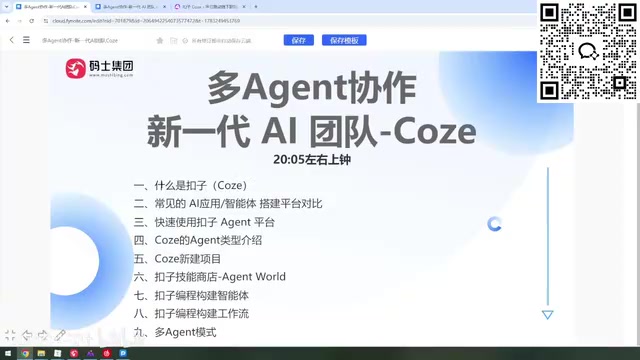
Compared to Dify, which developers are more familiar with, Coze leans more toward mainstream users in terms of usability and ecosystem integration, and it has natural advantages especially in Chinese-language scenarios and integration with ByteDance's product suite.
Coze vs Dify: Two Different Technical Routes
Before getting hands-on, it's worthwhile to understand the core differences between the two.
Differences in Target Audience
Dify leans more toward developers and enterprise-level applications, emphasizing open source, private deployment, and fine-grained control over RAG (Retrieval-Augmented Generation) and workflows. Dify supports one-click private deployment via Docker, giving it wide adoption in data-sensitive industries such as finance, healthcare, and government—private deployment means data doesn't pass through third-party clouds, satisfying compliance requirements like MLPS 2.0 and GDPR. Coze currently operates primarily on a SaaS model, with data stored in ByteDance's cloud. This difference is often a key dividing line in enterprise procurement decisions: for individual developers and small-to-medium businesses, Coze's low operations cost is more attractive; for large enterprises with strict data sovereignty requirements, Dify's private-deployment route is more prudent.
RAG (Retrieval-Augmented Generation) was proposed by Meta AI Research in 2020. Its core motivation is to address two inherent shortcomings of large language models: the lack of timeliness caused by knowledge cutoff dates, and the hallucination problem arising from the model's inability to precisely store large amounts of factual knowledge within its parameters. Its architecture combines external knowledge base retrieval with the generation capabilities of large language models—when a user asks a question, the system first retrieves the most relevant document fragments from a prebuilt vector database, then injects them into the prompt as context, allowing the model to generate answers based on real, up-to-date private data rather than relying solely on the parametric knowledge fixed during training. Modern RAG pipelines typically involve five stages: document preprocessing (cleaning, chunking), vectorization (Embedding), index building, online retrieval, and prompt augmentation.
The core infrastructure of the RAG architecture is the vector database. After text is encoded by an embedding model, it is converted into high-dimensional floating-point vectors stored in the database. During a query, the user's question is likewise vectorized, and the system finds the semantically closest document fragments by computing cosine similarity or Euclidean distance—a process called Approximate Nearest Neighbor (ANN) search. Mainstream vector databases include Pinecone, Weaviate, Milvus, and pgvector. Advanced variants such as HyDE (Hypothetical Document Embeddings), Self-RAG (self-reflective retrieval), and GraphRAG (structured retrieval based on knowledge graphs) continue to push the ceiling of retrieval precision, and are especially widely applied in scenarios such as enterprise knowledge base Q&A and legal document analysis.
Understanding this underlying mechanism also helps in correctly configuring knowledge base parameters in Coze. Chunk Size is a key variable that directly affects retrieval quality: chunks that are too large cause the retrieved text to contain too much irrelevant information, diluting the contextual focus; chunks that are too small may truncate complete semantic units and lose key context. The industry rule-of-thumb value is typically between 512 and 1024 tokens, supplemented by an overlap window of about 20% to maintain semantic coherence. Additionally, choosing a domain-fine-tuned Embedding model for specialized fields (such as law or medicine) can further improve retrieval precision.
Coze, on the other hand, emphasizes being "out of the box"—its various forms including a web version, an app version, and even a desktop client all reflect its product philosophy oriented toward ordinary users.
Cross-Platform Experience
A notable advantage of Coze is its multiple platform forms with data interoperability. Users can build on the web or invoke the same agent through the mobile app, and it even supports desktop client installation. The "build once, use everywhere" experience is very practical for users who want to invoke an AI assistant anytime, anywhere.
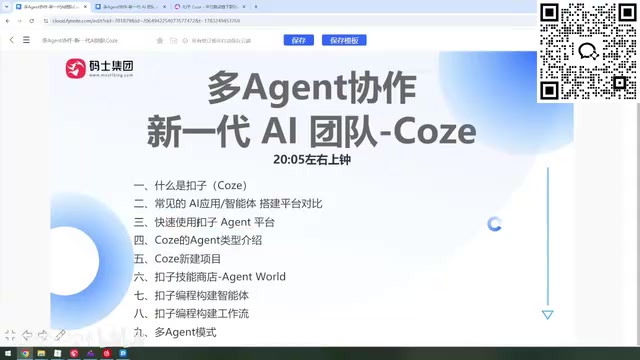
Beginner tip: Start with the web version. The visual editing interface offers a better operating experience on a large screen; once familiar, migrate to mobile use.
The Three Types of Built-in Agents in Coze
The Coze platform comes with several types of agents, broadly divided into three categories:
- Official Agents: Provided and maintained by Coze officially, with guaranteed quality and out-of-the-box usability, suitable for quickly experiencing the platform's capabilities.
- Local Agents: Run in a local environment, more suitable for users with requirements around data privacy or offline scenarios.
- Cloud Agents: Hosted in the cloud, requiring no local resources and available for invocation at any time.
This classification gives users considerable flexibility—they can enjoy the convenience of official templates while also choosing local or cloud deployment as needed, balancing usability and controllability.
Creating a Project from Scratch: Hands-On Practice
The most direct way to get truly hands-on with Coze is to create a project to solve a specific problem. Coze's creation flow is quite intuitive: select a template or a blank project, configure the model, orchestrate the logic, and you can complete the setup of a basic agent.
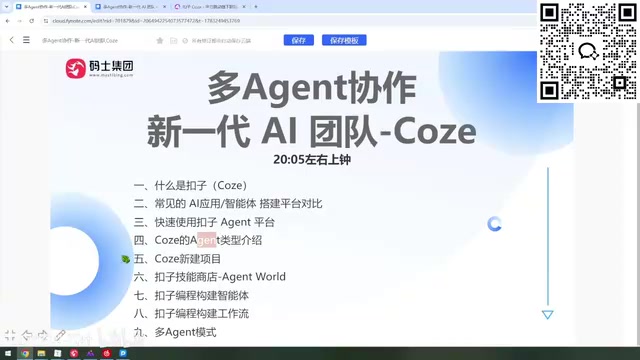
Practical advice: First clarify a specific application scenario, such as a "customer service Q&A assistant," a "document summarization tool," or an "information retrieval bot." With a clear goal, then configure the role settings, knowledge base, and interaction logic around it—the learning curve becomes much smoother.
The Skills System and the Agent World Section
Coze provides agents with a complete Skills system, enabling agents to invoke external capabilities and perform more complex tasks. These skills are like equipping the agent with a "toolbox" that can significantly expand its functional boundaries. Common skill types include web search, code execution, file read/write, and API calls—essentially wrapping external services into standardized interfaces that the Agent can directly invoke.
This design philosophy is highly aligned with mainstream industry standards. OpenAI's Function Calling mechanism was formally introduced in the GPT-4 API in June 2023, allowing developers to declare external functions in JSON Schema format. The model can automatically decide whether to invoke a specific function during a conversation and return structured parameters, establishing a standardized interface specification for interaction between large models and the external world. The underlying implementation principle of Function Calling is to teach the model, during the training phase through supervised fine-tuning (SFT), to recognize "when to stop generating text and instead output structured function-call instructions"—this essentially internalizes tool-calling capabilities into the model weights rather than relying on an external rule system, giving tool-selection decisions genuine semantic understanding rather than simple keyword matching.
In November 2024, Anthropic released the MCP (Model Context Protocol), further pushing this concept toward a cross-platform standard. MCP adopts a three-tier architecture of Host (host application), Client (protocol client), and Server (tool server), defining a complete specification for tool registration, invocation, and result return via the JSON-RPC protocol—analogous to a "USB interface" for the AI field, achieving "develop once, integrate everywhere." As of 2025, mainstream AI tools including Claude, Cursor, and Continue all support MCP, with thousands of MCP Servers covering mainstream scenarios such as file systems, databases, and browser automation, becoming a de facto industry standard in the AI tool integration field. As MCP becomes more widespread, the cost of integrating third-party services into Coze will drop significantly, and the Skills ecosystem is poised for explosive growth. Coze's Skills system is precisely built against this industry backdrop, opening the above capabilities to ordinary users in a productized manner.
Additionally, the platform originally planned a feature section called Agent World. However, according to actual testing, this feature has been under maintenance for nearly half a month without being opened, and the official reason remains unstated.
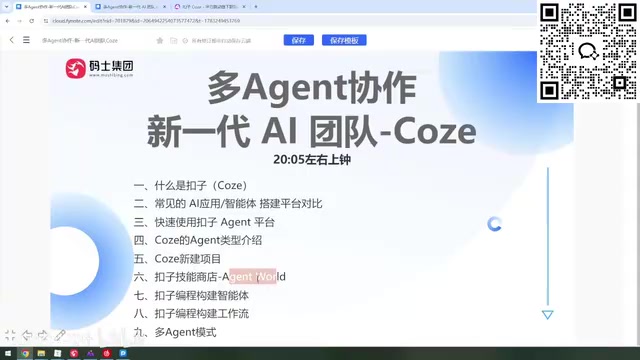
This is worth noting: as a product still iterating rapidly, some of Coze's features may be in a state of adjustment at any time. When using it, it's advisable to maintain reasonable expectations regarding feature availability, and avoid letting a temporarily offline module disrupt the overall workflow planning.
Building Agents and Workflows via a Programming Approach
Although Coze emphasizes zero programming, it also retains "code-level building" capabilities for advanced users. Through more flexible means, users can define two core concepts in a fine-grained manner:
- Agent: The core unit responsible for understanding intent, decision-making, and execution.
- Workflow: The orchestration logic that chains together multiple steps, conditional judgments, and skill invocations.
AI Workflow Orchestration draws on the process-automation concepts from software engineering, decomposing complex tasks into a node sequence structured as a Directed Acyclic Graph (DAG)—each node represents a processing unit, directed edges define execution dependencies, and the acyclic constraint ensures the process won't fall into infinite loops. Apache Airflow matured DAG scheduling in the data engineering field, while at the AI application layer, LangGraph introduced this paradigm into LLM orchestration in early 2024, supporting cyclic graphs for implementing an agent's iterative reasoning while retaining DAG mode for deterministic processes—its nodes can be LLM calls, tool executions, or conditional routing, and edges carry State that flows between nodes, presented as a node-and-edge drag-and-drop orchestration interface in a visual IDE, highly consistent with Coze's workflow design philosophy.
This concept has long had mature practice in the fields of RPA (Robotic Process Automation) and ETL data pipelines, and introducing it into the AI field has significantly improved system interpretability and maintainability. Compared to the Agent mode that purely relies on the model's autonomous planning, DAG-based workflow orchestration has clear engineering advantages in predictable execution paths, ease of debugging and tracing, and support for parallel branches, making it more reliable in business scenarios with high determinism requirements and fixed processes.
Selection reference: When the business process path is fixed and the steps are clear, prioritize the Workflow mode for higher predictability and lower token consumption; when the task boundaries are ambiguous and the model needs to dynamically decide the invocation order, the Agent mode is more appropriate. Combining the two modes—using the workflow as the skeleton and embedding Agents at key decision nodes—can often balance efficiency and flexibility.
Combining the two, you can build complex AI applications that can both make autonomous decisions and execute according to established processes. This "visual + programmable" dual-track design allows Coze to serve both beginners and users with a certain level of technical capability.
Multi-Agent Collaboration Mode: A Breakthrough for Complex Tasks
Multi-Agent Collaboration is a core highlight of the Coze platform. Simply put, multi-agent collaboration means having multiple agents, each with its own division of labor, jointly complete a complex task, rather than relying on a single agent to do everything.
The theoretical foundation of Multi-Agent Collaboration can be traced back to distributed artificial intelligence and multi-agent systems (MAS) research in the 1980s, reactivated and engineered into practice in the era of large models. Research such as Microsoft's AutoGen framework and Stanford's Generative Agents experiment has validated the potential of this route.
From an engineering implementation perspective, the communication and coordination mechanism of multi-agent systems is the core challenge. Currently, mainstream approaches fall into two categories: one is the "Blackboard Model" based on shared memory or message queues, where each agent reads from and writes to a common state space; the other is the "dialogue protocol model" based on peer-to-peer message passing, where agents interact through structured messages—Microsoft's AutoGen framework adopts this route. In addition, how to prevent the "echo chamber effect" in multi-agent systems—where agents mutually reinforce errors rather than mutually verify—is a key design challenge for ensuring system output quality. Introducing a dedicated "Critic Agent" to question and review the outputs of other agents is a common engineering means to address this issue. Coze's multi-agent collaboration uniformly manages state passing at the platform layer, shielding ordinary users from the above complexity.
It's worth noting that the multi-agent collaboration mode also brings a significant token consumption amplification effect. Since each API call needs to package and pass in the full information including the system prompt, conversation history, and tool definitions, token consumption in a multi-agent chain is often several times or even dozens of times that of a single agent. Take GPT-4o as an example: the input token price is about $2.5 per million tokens. For a collaboration chain containing three agents, if each agent carries 4,000 tokens of context, the theoretical consumption for a single task can reach 12,000+ tokens. Engineering optimization measures include: reusing system prompt computation results via KV Cache, using summary compression instead of passing full history, introducing a hierarchical memory architecture, and using smaller specialized models to handle simple subtasks. For Coze free-tier users, it's advisable to follow the "minimum agent principle"—introduce additional agents only when parallel processing or specialized division of labor is genuinely needed, avoid over-engineering, and reasonably control usage costs.
The value of this mode lies in the fact that a single large-model agent is often inadequate when handling complex, multi-step tasks, whereas through task decomposition and collaborative division of labor among differently specialized agents, overall reliability and processing capability can be significantly improved.
Here's a typical example:
- Agent A: Responsible for information retrieval and data scraping
- Agent B: Responsible for content generation and integration
- Agent C: Responsible for result review and quality control
The three cooperate with each other to form a complete intelligent workflow pipeline. Multi-agent collaboration represents an important trend in current AI application development, and Coze opens this capability to ordinary users, greatly lowering the barrier to building complex AI systems.
Summary
As an agent building platform launched by ByteDance, Coze provides users with zero programming experience a practical path to AI application development, thanks to its cross-platform interoperability, rich variety of built-in Agent types, Skills system, and multi-agent collaboration capabilities.
Although features like Agent World are still under maintenance, overall Coze strikes a good balance between usability and functional completeness. If you're interested in AI agent applications, Coze is a starting point worth exploring in depth.
Key Takeaways
Related articles

Kimi K3 Deep Dive: 2.8 Trillion Parameter Open-Source Model Closes the Gap with Closed-Source Frontier for the First Time
Moonshot AI releases Kimi K3 open-weight model with 2.8T parameters and 1M token context. Our deep dive covers coding, 3D dev, agent capabilities, and safety concerns.

How to Choose an AI Agent Platform for Your Team: 5 Evaluation Dimensions and a Decision Framework
Choose the right AI Agent platform by evaluating model flexibility, observability, tool integration, security compliance, and total cost. A complete decision framework to help technical leaders avoid vendor lock-in.

Legora's Legal AI Practice: How Vertical AI Empowers Law Firms and Corporate Legal Transformation
Explore Legora's legal vertical AI practice, covering AI model selection strategies, enterprise legal transformation challenges, and the path to deploying vertical AI in the legal industry.