Coze No-Code AI Agent Development: A Complete Guide from Getting Started to Deployment

A complete beginner's guide to building and deploying AI agents on ByteDance's Coze platform — no coding required.
This article provides a comprehensive introduction to Coze (扣子), ByteDance's no-code AI application development platform. It covers the platform's four core capabilities — visual workflow orchestration, an extensible plugin ecosystem, RAG-powered knowledge bases, and persistent memory — and offers practical guidance on choosing between the domestic and international versions, along with a clear three-step learning path from onboarding to deployment.
In the wave of generative AI, building your own AI application without writing a single line of code has become a topic of growing interest among creators and developers alike. Generative AI refers to AI systems capable of automatically generating text, images, code, and other content based on input prompts — with large language models (LLMs) like GPT, Claude, and Gemini as prime examples. These models, pretrained on massive datasets, possess general-purpose reasoning and generation capabilities across domains. As APIs have become more accessible, packaging these model capabilities into usable products has given rise to a new category: no-code/low-code AI development platforms. Coze, launched by ByteDance, is a next-generation AI application development tool built precisely for this need. This article provides a systematic overview of Coze's positioning, core capabilities, and platform selection logic to help beginners build a clear mental framework.
What Is Coze: A Next-Generation AI Application Development Platform
Coze is defined as a "next-generation AI application development platform," and its core value lies in dramatically lowering the development barrier: regardless of programming background, anyone can quickly build AI applications powered by large models. Once built, these applications can be published to social platforms and messaging apps, or integrated into existing business systems via API or SDK.
In short, Coze encapsulates "large model capabilities" into visual, orchestratable product components, shifting developers' focus from low-level API calls to business logic itself. This design philosophy mirrors tools like Zapier and Make — abstracting complex technical calls into graphical nodes, where each node might represent an LLM call, a plugin execution, or a conditional branch, while the platform handles concurrency control, error retries, and context passing under the hood. For teams looking to rapidly validate AI product ideas without getting bogged down in engineering details, this approach is highly compelling. Official documentation is also comprehensive, making it easy to learn as you go.
Domestic vs. International Version: How to Choose
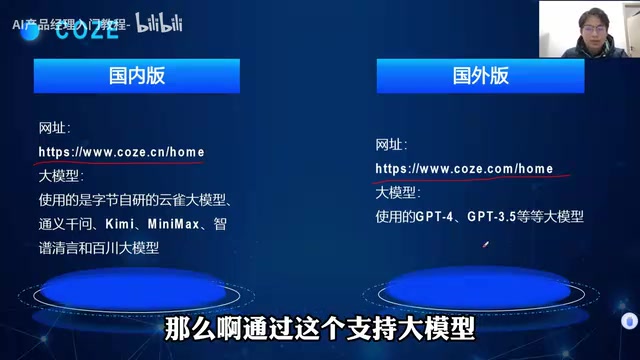
Coze is available in two versions: a domestic (China) version and an international version. The domestic version is accessible on regular networks, while the international version typically requires a VPN and may have less stable connectivity.
The most critical difference lies in the supported large models.
Models Supported by the Domestic Version
The domestic version integrates ByteDance's proprietary Doubao (Yunque) model, along with leading Chinese models including Tongyi Qianwen, Kimi, MiniMax, Zhipu AI, and Baichuan. Yunque is ByteDance's foundational LLM, powering products like Doubao; Tongyi Qianwen comes from Alibaba Cloud; Kimi is developed by Moonshot AI; while MiniMax, Zhipu AI (GLM series), and Baichuan are all products from top Chinese LLM startups. Since 2023, domestic models have continuously closed the gap with international counterparts on benchmarks covering Chinese language understanding, logical reasoning, and code generation — and they often have a distinct edge in Chinese semantic comprehension and regulatory compliance. From a practical standpoint, they are more than sufficient for the vast majority of use cases.
Models Supported by the International Version
The international version integrates globally leading models including the GPT series and Google's model lineup, offering a higher performance ceiling.
Recommendation: For learners and entrepreneurs in China, starting with the domestic version is strongly recommended — stable access, capable models, and no extra costs from network instability. This choice is especially friendly for beginners.
Why Choose Coze: Four Core Capabilities
Coze's appeal goes beyond being "usable" — it turns some of the most tedious aspects of AI application development into out-of-the-box features. These strengths manifest in four key areas.
1. Flexible Visual Workflow Orchestration
Traditional platforms typically require writing code to chain together workflow logic. Coze provides drag-and-drop visual orchestration: different workflow steps are connected via nodes to complete a full process. Under the hood, this system builds a Directed Acyclic Graph (DAG) — each node represents an operation unit, and the connections between nodes define data flow and execution order, while the platform handles scheduling and error management. This low-code or even zero-code approach dramatically reduces the complexity of implementing intricate business logic, making it one of Coze's most popular features among beginners.
2. Infinitely Extensible Plugin Ecosystem
Coze includes over 60 built-in plugins ready to use, while also supporting custom plugin development for specific business scenarios. Plugin functionality is powered by the large model's Function Calling feature — which allows the model to determine during response generation whether an external tool needs to be invoked, output a structured call instruction, and then incorporate the result into the final answer after the platform executes the call. Built-in plugins cover common scenarios like search, weather, calendar, and image generation, while custom plugins allow integration with internal enterprise systems. An agent's capability boundary is not fixed — it can be continuously expanded based on needs, which is precisely the key to building differentiated AI applications.
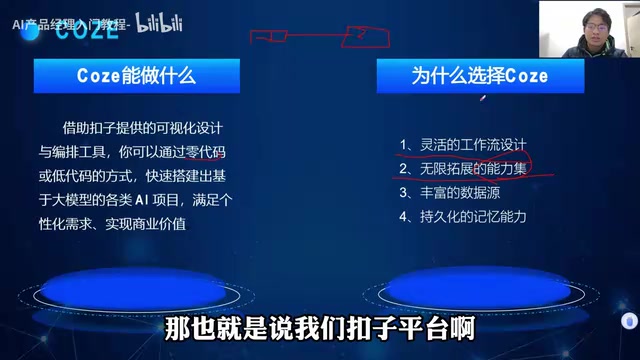
3. Diverse Knowledge Bases and Data Sources
The platform allows users to upload proprietary business data to build dedicated knowledge bases, and can also crawl web content directly into the agent via online links. The underlying technology powering the knowledge base is RAG (Retrieval-Augmented Generation): documents are chunked and converted into vector embeddings stored in a vector database; when a user asks a question, the system first retrieves the most relevant text segments, then injects them as context into the LLM prompt, enabling the model to answer based on private data. This mechanism effectively addresses the LLM "hallucination" problem and is the foundational approach for making general-purpose models truly "understand your business" — and the core technical path for building vertical-domain AI applications.
4. Persistent Memory Capability
Large language models are inherently stateless — each conversation is independent at the model level, with no native ability to remember user history. Yet in commercial scenarios, "remembering users" is critical — such as their preferences and historical query patterns. Coze's persistent memory capability addresses this by introducing external storage at the application layer: user preferences, behavioral history, and key information are extracted and saved, then dynamically injected into context during subsequent sessions, enabling the agent to retain this information across conversations. This "external long-term memory" mechanism delivers a more coherent and personalized interaction experience, significantly improving user retention and satisfaction.

Learning Path: Three Steps from Understanding to Deployment
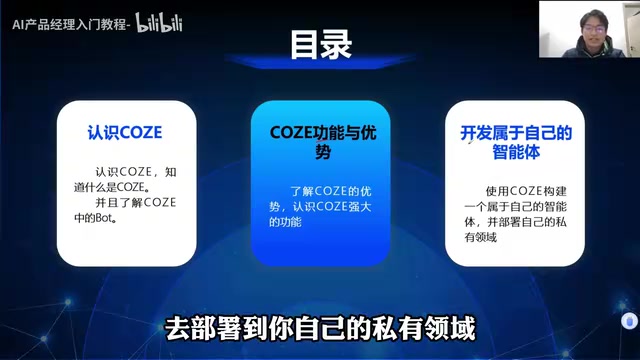
Learning Coze can be approached progressively through three stages:
- Understand Coze: Get familiar with the platform's positioning and foundational concepts, including the core definition of a Bot (agent);
- Master the Features and Advantages: Become proficient with workflow orchestration, plugin invocation, knowledge base construction, and memory management;
- Develop and Deploy an Agent: Build your own AI agent hands-on, publish it to social platforms or messaging apps, or integrate it into real business scenarios via API/SDK.
APIs (Application Programming Interfaces) provide services in the form of HTTP endpoints, suitable for lightweight, cross-language integration; SDKs (Software Development Kits) are packaged code libraries that offer a more convenient local calling experience. For enterprises, integrating agents into existing software such as CRM, ERP, and customer service systems via API/SDK is the critical "last mile" path to deploying real AI capability.
The value of this learning path lies in upgrading "learning a tool" into "delivering a deployable AI product." The real goal isn't to build a demo — it's to get the agent into real business workflows where it generates commercial value.
Summary
Coze represents the mainstream trend in AI application development today: visual workflow orchestration + plugin ecosystem + knowledge base (RAG) + persistent memory, transforming raw large model capabilities into deliverable business products. These four capabilities each address one of the four core challenges of deploying AI applications: business logic orchestration, capability expansion, private knowledge injection, and personalized user service.
For readers looking to get started with AI agent development, the recommended approach is to begin with the domestic version and follow the three-step path of "Understand → Master → Deploy." The next step — deeply understanding the Bot mechanism and workflow design logic within the platform — is where hands-on building truly begins.
Key Takeaways
Related articles

The Truth Behind Codex 'Build a Website in 5 Minutes': AI Isn't Creating Sites—It's Helping You Copy Them
Exposing the truth behind viral Codex 5-minute website videos: creators aren't building original sites with AI—they're copying shared prompts or scraping others' work. Learn AI coding tools' real limits.

Getting Started with AI Agent Development: A Complete Guide from Concept to Practice
A comprehensive guide to AI Agent architecture and development, covering automated marketing, intelligent customer service, and investment analysis scenarios with single and multi-agent collaboration.

The Truth Behind Codex 'Build a Website in 5 Minutes': AI Isn't Creating Sites — It's Helping You Copy Them
Exposing the truth behind viral Codex 5-minute website videos: creators aren't building original sites with AI — they're copying shared prompts or scraping others' work.