CrawlRaven MCP: Letting AI Agents Take Over Your SEO Workflow

CrawlRaven uses MCP to pipe multi-source SEO data into AI chat interfaces with impact-ranked action lists.
CrawlRaven MCP is an SEO tool that consolidates Search Console, GA4, keyword lists, and technical crawl data, then exposes it through an MCP server for Claude, ChatGPT, and Cursor. Its core promise is to end the constant platform-switching in SEO workflows, letting users query real site data from a chat window and receive impact-prioritized action recommendations. This is especially appealing for small teams without a dedicated SEO hire. As a new product, however, the reliability of its multi-source data fusion algorithm, the risk of AI hallucinations, and the maturity of the broader MCP ecosystem remain key variables that need real-world validation.
When SEO Meets MCP: One Attempt to Break Down Data Silos
The daily life of an SEO professional is a constant tool-switching marathon: monitoring click data in Search Console, checking conversions in GA4, maintaining keyword lists, and running technical crawls to audit site health. All this data lives on separate platforms, requiring manual aggregation and prioritization before you can form an actionable plan. CrawlRaven MCP aims to end that fragmentation with a single, unified interface.
The product earned 108 upvotes on Product Hunt and ranked 6th for the day. Its core idea is to consolidate data from Search Console, GA4, keyword lists, and site crawlers into one place — then rank everything by "impact," explicitly telling you what to fix first, what to update, and which content to write next.
Connecting to Major AI Assistants via MCP
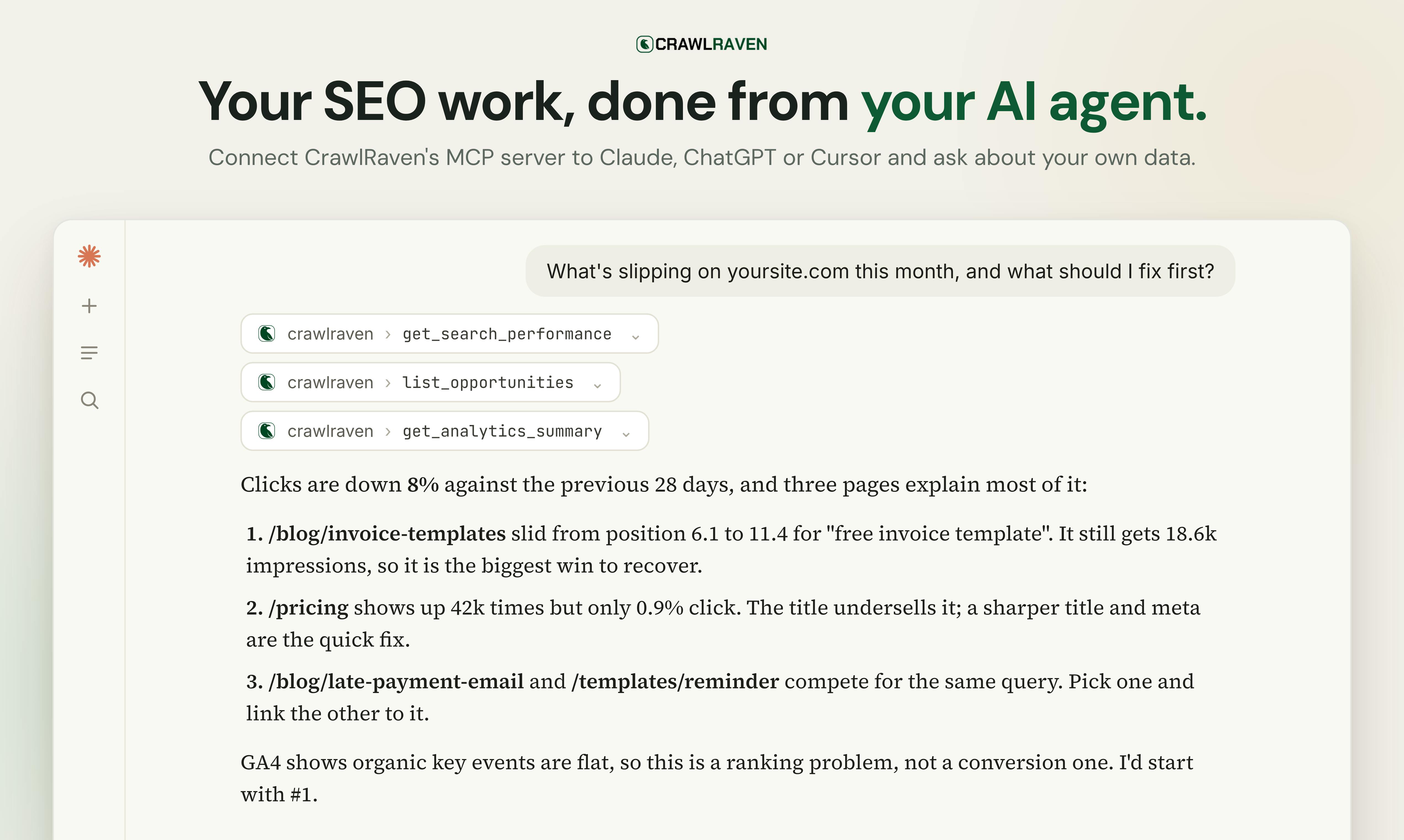
CrawlRaven's real differentiator is in how it delivers insights. Rather than building yet another standalone SEO dashboard, it provides an MCP (Model Context Protocol) server that lets users call their own SEO data directly from within Claude, ChatGPT, or Cursor.
MCP is a rapidly emerging standard that essentially gives AI models a universal interface for connecting to external data sources and tools. For SEO use cases, this means you never have to leave your chat window — you can ask your AI assistant questions like "Which pages dropped in rankings this month?" or "Based on ROI, what are the top three articles I should write next?" and get answers grounded in your own real data, not generic advice.
That combination of "data + reasoning" is the key. A raw data API can't make judgments on its own, and a standalone AI lacks the real context of your site. MCP bridges the two.
MCP (Model Context Protocol) was released and open-sourced by Anthropic in late 2024 to solve the "fragmentation" problem in AI-tool integrations — previously, every tool required a custom adapter, making maintenance costly. MCP defines a standardized client-server communication format: AI assistants act as "clients," while external data sources or tools expose themselves as "MCP servers," exchanging context and commands through a unified protocol. The analogy is USB: a universal standard means devices don't need separate adapters for every computer. Claude natively supports MCP, Cursor supports it via plugin, and OpenAI is working on compatibility. For developers, implementing an MCP server once theoretically gives you access to every AI client that supports the protocol — dramatically lowering the barrier for vertical tools to enter the AI ecosystem.
Prioritizing Actions from Data to Execution
The biggest pain point in traditional SEO tools isn't a lack of data — it's data overload with no clear starting point. CrawlRaven's emphasis on "ranked by impact" directly addresses this.
It cross-analyzes four data sources:
- Search Console: search performance, impressions, and clicks
- GA4: traffic and conversion behavior
- Keyword lists: target topics and opportunity gaps
- Technical crawler: site structure and technical issues
By fusing these dimensions into a prioritized action list, the tool theoretically lets practitioners skip the tedious manual analysis phase and focus immediately on the highest-value improvements. For small teams or founders without a dedicated SEO hire, this "tell me what to do first" capability is particularly valuable.
A Few Questions Worth Asking
As a newly launched product, publicly available information on CrawlRaven is still limited. A few things worth verifying in actual use:
How deep and accurate is the data integration? Fusing multi-source data and ranking by impact relies on an underlying algorithm — and that algorithm determines how trustworthy the output recommendations actually are. Additionally, while interacting through an AI assistant lowers the barrier to entry, it also introduces the risk of AI "hallucinations" — when the model misinterprets data, will users be able to catch it in time?
The MCP ecosystem itself is still in its early stages. Support and experience for MCP across Claude, ChatGPT, and Cursor varies, and real-world usability still needs time to prove out.
The risk of AI "hallucination" in data interpretation contexts deserves special attention. Large language models can misread numerical relationships when processing structured data — for example, confusing month-over-month changes with year-over-year, mixing up absolute values and percentage changes, or fabricating trends that don't exist when data is sparse. Unlike open-ended Q&A, SEO decisions directly affect resource allocation — one bad call can send a team chasing the wrong direction for weeks. A key indicator of an MCP tool's trustworthiness, then, is whether it surfaces raw data citations alongside its recommendations, giving users something to verify rather than just handing them a conclusion.
A Sign of Where Things Are Heading
Setting aside the maturity of any single product, CrawlRaven represents a clear direction: vertical professional tools are migrating from graphical dashboards toward conversational agent interfaces. SEO is just one entry point. In the future, more specialized workflows — data analysis, finance, operations — may connect to AI assistants via protocols like MCP, turning professional software from isolated islands into tools in an AI agent's toolkit.
For SEO practitioners, whether these tools actually improve efficiency depends on whether their recommendations prove more reliable than experienced human judgment. But the vision of "completing SEO work inside a conversation" is compelling enough on its own to be worth trying.
Related articles

Low-Cost Abstention Strategy: How LLM Ticket Classification Reduces Misrouting Costs
Cost-aware abstention framework cuts ticket routing costs by 38.1%, reduces misrouting from 15.3% to 3.5% on 47,837 IT tickets, outperforming LLMs.

METTA: Memory-Enhanced Meta-Reinforcement Learning for Test-Time Adaptation
METTA proposes dual-timescale memory decomposition for efficient test-time adaptation in meta-RL with linear complexity, exceeding 50% success on Meta-World ML10/45 and outperforming Transformer baselines on PointMaze.

Two Major Numerical Bugs in Softmax and Cross-Entropy and Their Fixes
Standard softmax and cross-entropy have two numerical bugs: Softmax Collapse causes non-zero-sum gradients, and Softmax Cancellation produces spurious gradients in distillation. This article presents fixes and their effects on grokking, accuracy stability, and knowledge distillation.