Credit Pre-check Mechanism for AI SaaS: The Right Way to Prevent Freeloading

AI SaaS products need credit pre-checks before task submission to prevent computing resource freeloading.
This article explains the necessity and implementation of credit pre-check mechanisms in AI SaaS products. Since AI tasks use asynchronous webhook callback architecture, charging only after task completion allows users with insufficient credits to consume computing resources for free. The solution is to verify credit balance before task submission, returning HTTP 402 status code to guide recharging when insufficient. Advanced strategies including concurrency locks, rate limiting, and credit pre-freezing are also needed to build a complete anti-abuse system.
When building AI SaaS products, many developers focus their energy on core features while overlooking a critical component—credit pre-check mechanism. Without verifying user credits before task submission, your AI computing resources could be freeloaded and your service abused. This article walks you through adding this "credit pre-check" security gate to your AI SaaS product step by step.
Why AI SaaS Must Implement Credit Pre-checks
In a typical AI SaaS architecture, after a user submits a task, the backend calls an AI model for processing, and upon completion, notifies the result via a webhook callback. A webhook is an "event-driven" asynchronous communication pattern—since model inference often takes considerable time (ranging from seconds to minutes), synchronous waiting would cause connection timeouts and resource waste. The mainstream approach is: the client submits a task and immediately receives a task ID, while the backend processes asynchronously; upon completion, the platform proactively sends an HTTP POST request to a pre-registered URL (the webhook callback) to notify of the task result. This pattern is widely adopted by major AI platforms like Replicate and Stability AI. It's precisely this asynchronous decoupled architecture that creates a time gap between "task submission" and "result return," which in turn necessitates credit pre-checks.
Many developers choose to deduct credits only during the webhook callback phase—that is, charging only after the task is completed.
This approach seems reasonable but has a serious vulnerability: If the user doesn't have enough credits, the task has already finished running, the AI computing resources have been consumed, but the credits can't be deducted. Essentially, your AI service is working for free.

Therefore, we need to add a "pre-check" step before task submission: first verify whether the user has sufficient credits—if yes, proceed; if not, block and guide them to recharge.
Complete Implementation of Credit Pre-checks
Backend: Verify Credit Balance Before Submission
The core logic is straightforward: in the API endpoint where users submit tasks, first query the user's current credit balance and compare it against the credits required for the task.
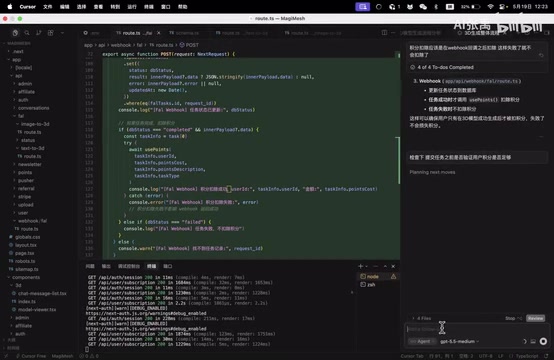
The specific flow is as follows:
- User initiates a task request → Backend receives the request
- Query user's credit balance → Retrieve current credits from the database
- Check if credits are sufficient → Compare against credits required for the task
- Credits sufficient → Proceed to the task processing flow
- Credits insufficient → Return HTTP 402 status code, prompting the user to recharge
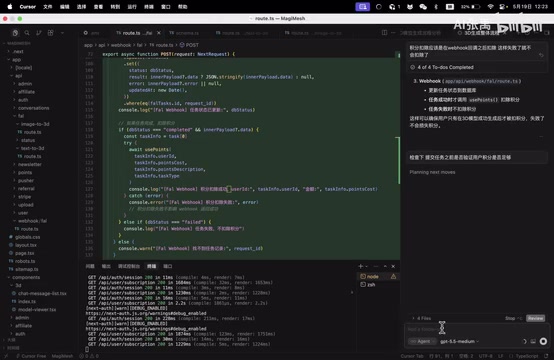
There's a key detail here: Use HTTP 402 status code. 402 (Payment Required) is one of the earliest defined status codes in the HTTP/1.1 specification. It remained in a "reserved" state for a long time, but as internet commercialization deepened, more and more API developers adopted it to express the semantics of "payment required to continue," gradually forming a de facto standard—Stripe, GitHub API, Google Cloud, and other major platforms all return 402 when quotas are exhausted or balances are insufficient. Compared to returning 400 (Bad Request) or custom error codes, the advantage of using 402 lies in semantic standardization: frontend frameworks and monitoring tools can uniformly identify it, and it facilitates API documentation comprehension during team collaboration without requiring additional conventions. The frontend can then respond with appropriate UI behavior based on this status code.
Frontend: Gracefully Handling Insufficient Credits
The frontend needs to specifically handle the 402 status code. When detecting a 402 response from the backend, it should:
- Display an "insufficient credits" notification
- Guide the user to the pricing page for recharging
- Prevent duplicate task submissions
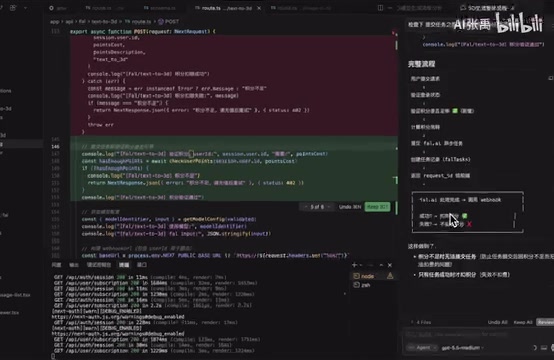
This approach both protects server-side resources and provides users with clear operational guidance, without feeling abrupt from a UX perspective.
Division of Responsibility: Pre-check vs. Deduction
It's important to emphasize that credit pre-check and credit deduction are two independent steps, each with its own responsibility:
| Step | Trigger Timing | Core Purpose |
|---|---|---|
| Credit Pre-check | Before task submission | Block requests with insufficient credits, prevent computing waste |
| Credit Deduction | During webhook callback | Actually deduct credits after task completion, ensuring accurate billing |
Placing credit deduction in the webhook callback is reasonable because charges should only apply when a task is truly completed. However, the pre-check step is indispensable—it's the first line of defense against freeloading.
Advanced: Anti-Concurrency and Anti-Abuse Strategies
Credit pre-checks alone aren't enough. In production environments, you also need to consider the following issues:
Race Conditions in Concurrent Requests
What if a user has only 1 credit remaining but simultaneously sends 2 requests, and both pass the pre-check? The solution is to use optimistic locking or distributed locks during pre-checks to ensure atomicity of credit checking and deduction.
The two approaches suit different scenarios: Optimistic locking is based on the assumption that "conflict probability is low" and is implemented by maintaining a version number field in the database record—during updates, it checks whether the version number matches what was read; if not, it rolls back and retries. It doesn't require additional lock resources and is suitable for moderate concurrency scenarios. Distributed locks use Redis's SETNX command or the Redlock algorithm to establish mutual exclusion across multiple service instances, suitable for high-concurrency or cross-service scenarios. For AI SaaS credit systems, optimistic locking is usually sufficient, but if the same user might initiate requests from multiple devices simultaneously, distributed locks provide stronger consistency guarantees.
Request Rate Limiting
Even with credit pre-checks, malicious users might consume server resources through high-frequency requests. It's recommended to pair with Rate Limiting strategies to restrict per-user request frequency. Common algorithms include Token Bucket (which allows a certain degree of burst traffic) and Leaky Bucket (which strictly outputs at a constant rate). Token Bucket is the most commonly used in AI SaaS scenarios because it can limit average rate while allowing users reasonable burst requests in short periods. Implementation can leverage Redis atomic operations or gateway middleware like Kong or Nginx. It's recommended to rate-limit by user ID rather than IP to avoid accidentally blocking legitimate users in NAT environments.
Credit Pre-freeze Mechanism
A more rigorous approach is to "freeze" the required credits after the pre-check passes.
Related articles
 Tutorials
ChatGPT Plus Subscription Guide: Are GPT-5.5, image-2, and Codex Worth the Upgrade?
A detailed look at ChatGPT Plus features — GPT-5.5, image-2, and Codex — with a Plus vs Pro comparison and a complete step-by-step subscription guide for users outside the US.
 Tutorials
Harness AI Engineering in Practice: Using Claude Code to Master Enterprise-Level E-Commerce Development
Deep dive into Harness AI Engineering: master enterprise e-commerce development with Claude Code using the Rules, Skills, Wiki, and Changes framework.
 Tutorials
Cursor + Codex Dual-IDE Collaboration: A Practical Methodology for Open-Source Project Customization
A complete methodology for open-source project customization based on real-world experience, detailing the Cursor+Codex dual-IDE workflow, seven-stage process, MVP validation, and AI source code reading techniques.