Criblist: Find San Francisco Apartments Like Swiping on Tinder

Criblist brings Tinder-style swiping to San Francisco apartment hunting with real-time aggregated listings.
Criblist is a new Product Hunt launch that aggregates real-time San Francisco rental listings from Craigslist and local property managers into a Tinder-style swipeable card interface. Users set budget, neighborhood, and must-have filters, then swipe through listings one by one. Powered by Context.dev for data extraction, it tackles SF's fragmented rental market where median rents exceed $3,000 and good listings disappear in hours.
When Apartment Hunting Meets Swipe Interaction
Renting in San Francisco is an exhausting battle—listings are scattered across Craigslist, various property management company websites, and a hodgepodge of brokerage platforms, forcing renters to constantly switch between multiple sources to filter and compare. A new product recently launched on Product Hunt, Criblist (SF Apartment Finder), aims to solve this pain point with an entirely new interaction model: turning apartment hunting into a swipeable deck of cards.
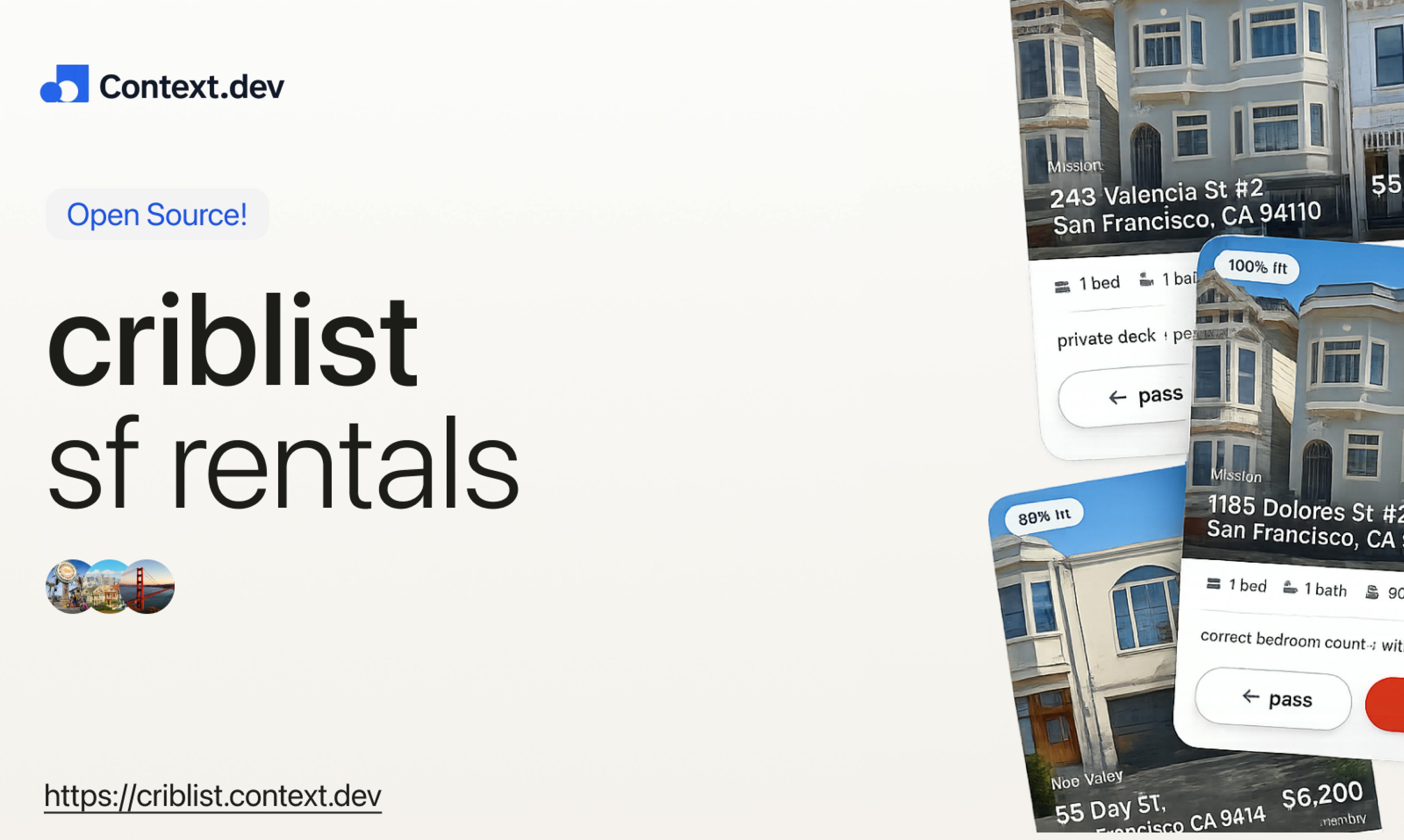
As its tagline states—"Tinder for live SF rentals from across the web"—the product brings the swipe mechanism that people already know from dating apps into the property search experience. You simply set your budget, preferred neighborhoods, and must-haves, then browse real-time listings one by one like swiping through a dating app—keep the ones you like, swipe away the rest. The product earned 231 upvotes and 11 comments on Product Hunt, ranking #4 for the day.
The left-right swipe mechanism that Tinder pioneered in 2012 went viral globally because it leverages several key cognitive psychology principles. First is "progressive commitment"—users face only one option at a time, breaking complex multiple-choice problems into a series of simple binary decisions (yes/no), drastically reducing cognitive load. Second is "instant feedback"—the swipe action triggers smooth animation responses that activate the brain's dopamine reward circuit, creating an addictive experience similar to slot machines. Third is "loss aversion"—cards that have been swiped away don't reappear, and this irreversibility keeps users focused. Migrating this mechanism from dating to apartment hunting essentially leverages the universality of human decision-making: when facing massive options, sequential binary decisions are more intuitive than repeatedly comparing items in a list, and far less likely to cause decision paralysis.
Core Mechanism: Web-Wide Listing Aggregation + Swipe Filtering
Real-Time San Francisco Listing Aggregation
Criblist's core value lies in data aggregation. It integrates real-time rental information from Craigslist and local property managers, automating the work that previously required renters to manually visit multiple platforms. For a market like San Francisco where listings move extremely fast, "live" (real-time) is the keyword—good apartments are often snatched up within hours, and an aggregated, promptly updated information source can significantly improve a renter's success rate.
Craigslist was founded in 1995 by Craig Newmark in San Francisco, originally as just a local email list. Despite its interface remaining virtually unchanged for decades, it remains one of the largest classified platforms in the US, holding a particularly important position in residential rentals. However, Craigslist's openness also brings serious problems: fake listings are rampant (reports suggest roughly 30% of rental posts involve scams), information formats are inconsistent, and standardized filtering features are lacking. San Francisco's rental market faces additional unique challenges: median rent has long remained above $3,000, vacancy rates are extremely low (typically under 5%), and numerous small property companies operate independently without joining unified platforms, forcing renters to monitor over a dozen information sources simultaneously. This fragmentation is precisely the core pain point Criblist aims to solve.
Personalized Condition Filtering
Before browsing, users can set three types of key conditions:
- Budget range: Filter out listings beyond affordability
- Target neighborhoods: Focus on areas within commuting or living radius
- Must-haves: Hard requirements such as pet-friendly, laundry facilities, parking, etc.
Once configured, the system presents qualifying listings as cards, and users quickly make decisions through swiping. This interaction reduces decision fatigue from information overload—you focus on evaluating one listing at a time, rather than scrolling back and forth through long lists.
Technical Foundation: Context.dev Powers Data Extraction
Notably, Criblist's listing data extraction is powered by Context.dev. Listing information is scattered across web pages with varying structures—from unstructured Craigslist posts to self-built websites of various property companies. Unifying this heterogeneous data into standardized, comparable cards requires powerful web data extraction capabilities.
Extracting structured data from unstructured web pages (Web Scraping/Data Extraction) is a technical field with over twenty years of history that continues to evolve rapidly. Early crawlers relied on regular expressions and XPath with manually written rules, incurring extremely high maintenance costs—once a target website was redesigned, extraction logic would break. In recent years, intelligent extraction solutions based on large language models (LLMs) are changing this landscape: systems can "understand" the semantic content of web pages rather than relying solely on DOM structure, dramatically improving adaptability to heterogeneous pages. Modern data extraction services like Context.dev typically combine browser automation (such as Playwright/Puppeteer), machine learning models, and structured output schemas, capable of handling JavaScript-rendered dynamic pages, countering anti-scraping mechanisms, and standardizing fields like price, address, area, and amenities into API-callable JSON format.
Context.dev handles the role of extracting structured information from source pages—this is also the key technical challenge for aggregation products of this kind. Data accuracy, timeliness, and breadth of coverage directly determine a product's practical value. From the product being categorized under tags like API, GitHub, Design Tools, we can see that Criblist's technical implementation relies on modern data extraction APIs and automated workflows.
Product Positioning & Market Considerations
Vertical and Focused Scenario Selection
Criblist currently focuses explicitly on San Francisco as a single city, built by independent developer Yahia Bakour. This "small but beautiful" positioning reflects the typical approach of today's indie developer products: go deep in a high-pain-point, high-demand vertical market first, validate product-market fit, then consider expansion.
The "start with one city" strategy has numerous successful precedents in tech startup history. Uber initially served only San Francisco, DoorDash started around the Stanford campus area, and Nextdoor expanded neighborhood by neighborhood. For independent developers, this strategy's advantages are even more pronounced: limited resources can be concentrated to ensure data quality and user experience, localized word-of-mouth spreads far more efficiently than generalized marketing, and rapid feedback loops can be established for product iteration. San Francisco as the initial market offers additional advantages—it concentrates a large number of tech professionals and early adopters who are highly receptive to new products, have strong willingness to pay, and are active on platforms like Product Hunt, providing initial visibility and viral momentum.
San Francisco's sky-high rents, fierce listing competition, and fragmented information channels make it the ideal testing ground for this type of aggregation tool. While swipe interaction isn't new—from Tinder to various content apps, swiping has long become a universal gesture of the mobile era—grafting it onto the high-frequency decision scenario of apartment hunting remains a clever product innovation.
Potential Challenges
Of course, aggregation products like this also face real-world challenges. First is data compliance and stability: relying on third-party data sources like Craigslist means that changes in scraping rules and anti-bot mechanisms could affect service continuity. Second is information depth: swipe interactions excel at quick filtering, but users ultimately still need detailed listing information, authentic photos, and contact details to complete their decisions. How to strike a balance between "lightweight swiping" and "deep information" is key to the product experience.
The legal and technical risks facing aggregation products shouldn't be underestimated. In 2022, the U.S. Ninth Circuit Court of Appeals ruled in hiQ Labs v. LinkedIn that scraping public data doesn't violate the Computer Fraud and Abuse Act (CFAA), but this doesn't mean all scraping activities are legal—a website's Terms of Service (ToS), robots.txt protocol, and copyright law can still impose constraints. Craigslist itself has filed lawsuits against aggregation sites multiple times. On the technical front, anti-scraping measures on major websites have evolved from simple IP blocking to behavioral fingerprinting, JavaScript challenges, CAPTCHAv3, and other multi-layered defense systems. Products that rely on third-party data sources must find a balance between "data freshness" and "scraping frequency" while developing degradation plans for when data sources go down.
Summary
Criblist represents a typical "familiar interaction + vertical pain point" product approach: using the swipe mechanism people are already accustomed to, solving the long-standing problems of scattered information and delayed updates in San Francisco's rental market. Leveraging Context.dev's data extraction capabilities, it consolidates real-time listings from across the web into a swipeable card deck, making the previously tedious apartment search process light and fast.
For renters currently searching in San Francisco, it's worth trying; for product developers, it offers a vivid case study of how "data aggregation + mobile interaction" can create value.
Related articles

Gemini 3.7 Flash Spotted in Google Cloud Console — Launch Countdown Begins
Developers spot Gemini 3.7 Flash in Google Cloud Console, sparking discussion about its relationship to Pro and Google's model distillation strategy.

AI-Memory: Building a Cross-Tool Long-Term Memory System for Coding AIs
AI-Memory is a Rust-based open-source project providing long-term memory for Claude Code, Cursor, Aider and other Agent coding CLIs, enabling seamless handoff between vendors.

Bullet Enters the Stage: YC Newcomer Bets on a Faster Coding Agent
YC S26 startup Bullet launches a speed-focused coding Agent targeting developer latency pain points. Analysis of its differentiation, acceleration techniques, and market opportunity against Cursor and Claude Code.