CRoS: Using Scrambled Chain-of-Thought as a Reward to Improve Reasoning Accuracy and Faithfulness

CRoS perturbs CoT by scrambling rather than changing content, measuring causality more purely and improving reasoning quality.
The article notes that RLVR relies only on outcome correctness and cannot guarantee causal CoT contribution, potentially reinforcing false-correctness reasoning. Existing causality measures perturb CoT by deleting steps or injecting errors, changing per-step information and creating confounding effects that induce less informative CoTs and reduced exploration/self-correction as rewards. The authors propose CRoS, which perturbs CoT by scrambling step order without changing content. On Reasoning Gym with Gemma-3-4B, CRoS outperforms baselines in out-of-domain accuracy (46.8% vs. 43.8%), CoT-Pass@K (avg 43.4% vs. 41.4%), and hint acknowledgment (34.0% vs. 20.2%).
Reinforcement Learning with Verifiable Rewards (RLVR) has become the standard approach for training language models' reasoning abilities, but it typically relies only on outcome correctness and cannot guarantee that the chain of thought (CoT) genuinely contributes causally to the final answer. Without this causal link, outcome rewards may fail to reinforce high-quality reasoning. Existing causality measures perturb the CoT (e.g., deleting reasoning steps or injecting errors) to assess causality and measure changes in the final answer. However, these perturbations inevitably alter the information at each step, so high causality scores may reflect sensitivity to the information changes introduced by the perturbation rather than true causality. When used as training rewards, this confounding effect induces undesirable reasoning behaviors, including generating less informative CoTs and reducing exploration and self-correction.
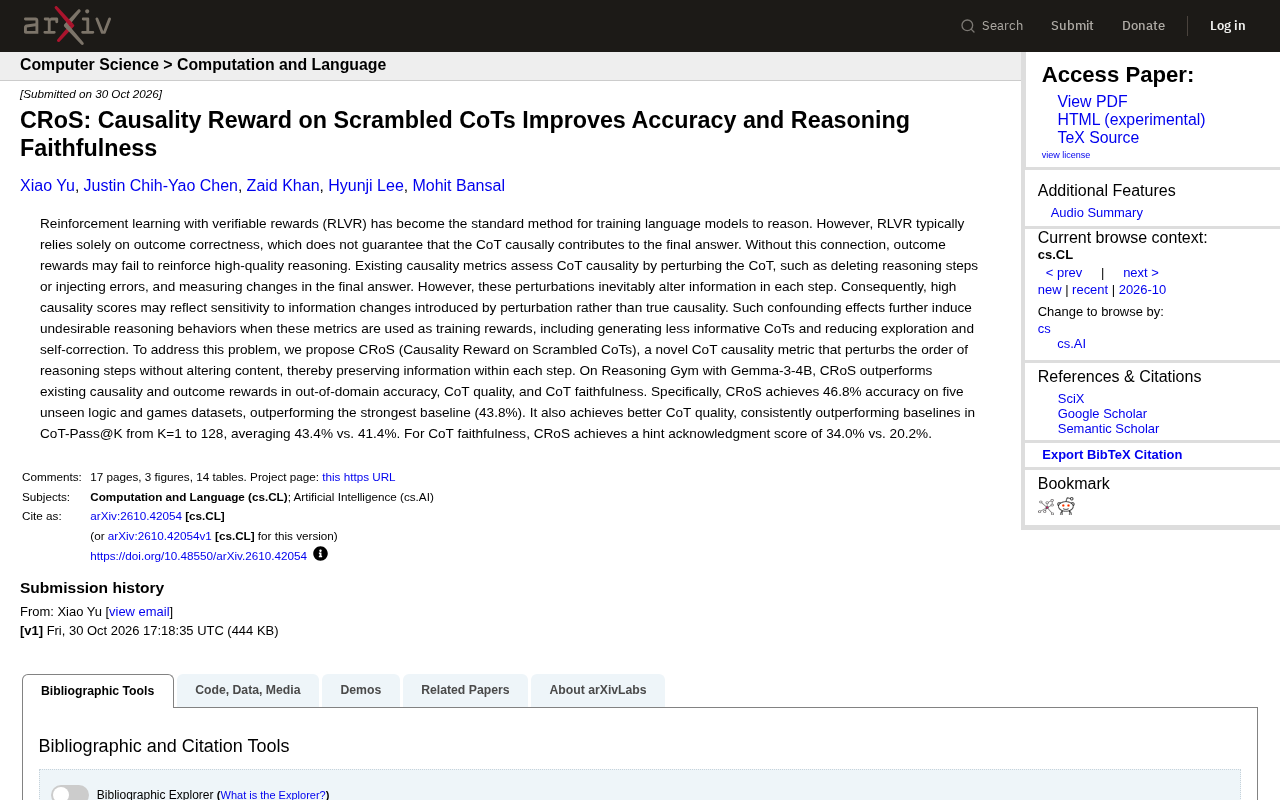
To address this issue, researchers propose CRoS (Causality Reward on Scrambled CoTs), a novel measure of CoT causality. It perturbs the CoT by scrambling the order of reasoning steps without changing their content, thereby preserving the information within each step. On the Reasoning Gym benchmark with the Gemma-3-4B model, CRoS outperforms existing causality and outcome rewards in out-of-domain accuracy, CoT quality, and CoT faithfulness. Specifically, CRoS achieves 46.8% accuracy on five unseen logic and game datasets, surpassing the strongest baseline (43.8%). In terms of CoT quality, CRoS consistently outperforms baselines on CoT-Pass@K (K=1 to 128), averaging 43.4% versus 41.4%. For CoT faithfulness, CRoS achieves a hint acknowledgment score of 34.0%, compared to 20.2% for the baseline.
Why Are Outcome Rewards Not Enough?
The core idea of RLVR is to use verifiable outcomes (such as the final answer to a math problem) as reward signals to train models. This approach has succeeded on multiple reasoning tasks, but it has a fundamental flaw: the model may arrive at the correct answer through flawed reasoning (i.e., "false correctness"). For example, the model may guess the answer, rely on shallow patterns, or use irrelevant reasoning steps. In such cases, outcome rewards reinforce these low-quality reasoning paths rather than genuinely promoting logical reasoning.
Therefore, researchers attempt to introduce causality measures as auxiliary rewards to assess the causal contribution of the CoT to the final answer. Intuitively, if the CoT is causally necessary, then corrupting the CoT should change the answer. Existing methods corrupt the CoT by deleting steps or injecting errors, then observe the degree of change in the answer. The problem is that these perturbations simultaneously alter the information content of each step, so the measurement results conflate the effect of information changes.
RLVR (Reinforcement Learning with Verifiable Rewards) is a class of reinforcement learning paradigms in which the reward signal comes from automatically verifiable outcomes (such as the numerical answer to a math problem or whether a code unit test passes), rather than from human annotations or a learned reward model. Typical examples include methods such as GRPO that use final-answer correctness as the sole reward. The advantage of RLVR lies in its objective and scalable rewards, but its drawback stems from the same source: the reward only cares about whether the result is correct, not whether the reasoning process is sound. When a model happens to obtain the correct answer through guessing, pattern matching, or irrelevant steps, the outcome reward still provides positive feedback, thereby reinforcing "false correctness" reasoning paths. Therefore, RLVR needs auxiliary signals to constrain the quality of the reasoning process, which is precisely the problem that causality rewards attempt to solve.
The Core Idea of CRoS: Scramble the Order Without Changing the Content
The ingenuity of CRoS lies in perturbing the CoT by scrambling the order of reasoning steps without modifying the content of any step. In this way, the information in each step is fully preserved, but the logical order among steps is disrupted. If the causal structure of the CoT matters, then scrambling the order should significantly affect the final answer; conversely, if the model merely concatenates steps mechanically, the order may be irrelevant.
This approach avoids the confounding effect of information changes because it only changes the arrangement order of steps without adding, removing, or modifying information. Therefore, causality scores based on scrambling better reflect the CoT's true causal contribution to the answer.
Confounding effect in causal inference refers to a third variable that affects both the treatment variable and the outcome variable, making the observed association not a true causal relationship. In CoT causality measurement, perturbation (deleting steps or injecting errors) simultaneously changes two factors: "step order/structure" and "the information content of each step"; the change in the final answer may come from the change in information content rather than the disruption of causal structure. The resulting causality score is a mixture of two effects and cannot be attributed solely to causality. CRoS changes only the structure while preserving information content through scrambling, thereby cutting off the confounding path of "information change" and making the score closer to a pure measurement of causal structure.
Experimental Results: Outperforming Baselines Across the Board
Researchers conducted experiments on the Reasoning Gym benchmark using the Gemma-3-4B model, comparing CRoS with existing causality rewards and outcome rewards. Evaluation metrics included out-of-domain accuracy, CoT quality, and CoT faithfulness.
In terms of out-of-domain accuracy, CRoS achieved 46.8% accuracy on five unseen logic and game datasets, compared to 43.8% for the strongest baseline. This indicates that models trained with CRoS have better generalization ability.
In terms of CoT quality, CRoS consistently outperforms baselines on the CoT-Pass@K metric (K from 1 to 128), averaging 43.4% versus 41.4%. CoT-Pass@K measures the probability that at least one high-quality CoT is generated among K samples, reflecting the model's ability to generate reliable reasoning chains.
In terms of CoT faithfulness, CRoS achieves a hint acknowledgment score of 34.0%, compared to 20.2% for the baseline. The hint acknowledgment score measures whether the model acknowledges in its CoT that its answer was influenced by a hint. A higher score indicates that the CoT more faithfully reflects the model's true reasoning process rather than post-hoc rationalization.
CoT-Pass@K is a sampling metric for evaluating chain-of-thought quality: for the same question, K CoTs are independently sampled, and if at least one of them satisfies high-quality criteria (such as complete reasoning steps, logical consistency, and a correct final answer), it is counted as a pass. The larger K is, the more chances the model has to "encounter" a good chain, so this metric increases with K. When comparing different methods, one typically observes the entire Pass@K curve rather than a single point to determine whether the model stably generates high-quality CoTs or merely gets lucky through extensive sampling. CRoS consistently leads for K=1 to 128, indicating that its improvement does not come from sampling diversity but from a higher probability that the model itself generates reliable reasoning chains.
Hint acknowledgment score is used to measure CoT faithfulness: under the condition that the answer is influenced by an external hint, it checks whether the model explicitly acknowledges in its CoT that it used the hint. If the model benefits from the hint but does not mention it at all in the reasoning chain, the CoT is post-hoc rationalization and has low faithfulness. The higher the score, the more honestly the model's reasoning chain reflects its true basis for decision-making, rather than fabricating plausible-looking steps to conceal shortcuts.
Implications for AI Reasoning Research
The significance of CRoS lies not only in proposing a new reward signal but also in revealing a key pitfall in the design of causality measures: the perturbation method itself may introduce confounding factors. By carefully designing perturbations (such as scrambling), causality can be measured more purely. This line of thinking may inspire further research on evaluating reasoning processes.
Moreover, CRoS's improvement in CoT faithfulness indicates that correct causality rewards can encourage models to generate more honest and interpretable reasoning chains. This is crucial for building trustworthy AI systems, especially in high-stakes domains.
Of course, CRoS has its limitations. Scrambling perturbations may not be applicable to all types of reasoning tasks, such as those where step order itself is unimportant. Future research can explore more general perturbation strategies and combine multiple causality measures to further improve reasoning quality.
Conclusion
CRoS measures causality by perturbing the CoT through scrambling, avoiding the confounding effect of information changes and thus providing a cleaner reward signal. Experiments show that CRoS outperforms existing methods in accuracy, CoT quality, and faithfulness. This work provides a new perspective on reward design in RLVR and emphasizes the importance of perturbation design in causality measurement. As language models' reasoning abilities continue to improve, ensuring the faithfulness and reliability of reasoning will become increasingly important, and CRoS has taken a solid step in this direction.
One-line Summary
CRoS perturbs the chain of thought by scrambling rather than changing content, measuring causality more purely and improving reasoning quality.
Paragraph Summary
The article points out that Reinforcement Learning with Verifiable Rewards (RLVR) relies only on outcome correctness, cannot guarantee that the chain of thought causally contributes to the answer, and may reinforce "false correctness" reasoning. Existing causality measures perturb the CoT by deleting steps or injecting errors, but this changes the information at each step, creating a confounding effect; when used as a reward, it induces undesirable behaviors such as reduced informativeness, exploration, and self-correction. To address this, the authors propose CRoS, which perturbs the CoT by scrambling the order of reasoning steps without changing their content, preserving each step's information and thus measuring causality more purely. On the Reasoning Gym benchmark with Gemma-3-4B, CRoS outperforms baselines and outcome rewards in out-of-domain accuracy (46.8% vs. 43.8%), CoT-Pass@K (average 43.4% vs. 41.4%), and hint acknowledgment score (34.0% vs. 20.2%), demonstrating that carefully designed perturbation strategies can improve reasoning quality and faithfulness.
Related articles

Gemini 4 Neon Leak: A Potential Strong Contender Against Opus 5.5
A Hacker News thread suggests Gemini 4 Neon looks like an Opus 5.5 competitor. This article unpacks the product positioning behind this community signal, shifts in the top-model competitive landscape, and what it means for developers' model selection strategy.

Claude Fable 5.2's Self-Authored Short Film 'Fable' Sparks Discussion
A short film 'Fable,' credited to Claude Fable 5.2 for script, visuals, and directing, appears on Hacker News. This article analyzes the significance of full-pipeline AI creation, community reactions, and what it means for content creators.

Anthropic IPO Pricing: A Signal of AI Giants Going Public
Anthropic's IPO pricing draws attention. This article analyzes its potential impact on AI industry valuation, commercialization paths, and the competitive landscape, and highlights public-market expectations and challenges for AI companies.