Cross-Continent Transfer Testing of Prithvi Crop Classification Foundation Model: Phenological Misalignment Is the Real Culprit Behind Accuracy Collapse

Phenological misalignment, not spatial transfer, is the true cause of cross-continental accuracy collapse in crop GeoFMs.
A cross-continent evaluation of Prithvi-EO-2.0 found crop classification accuracy dropping from 0.65 (US) to 0.40 (Europe), but the real culprit is observation window misalignment with local crop phenology—not spatial transfer failure. Dangerously, the model still outputs high deterministic confidence when wrong, mislabeling 12–51% of areas confidently, while Monte Carlo Dropout entropy reliably detects these failures. Two no-retraining fixes are proposed: merging 13 classes into 10 boosts OA by 8.4 points, and maintaining a 45–90 day observation window (peak ~75 days) preserves optimal performance.
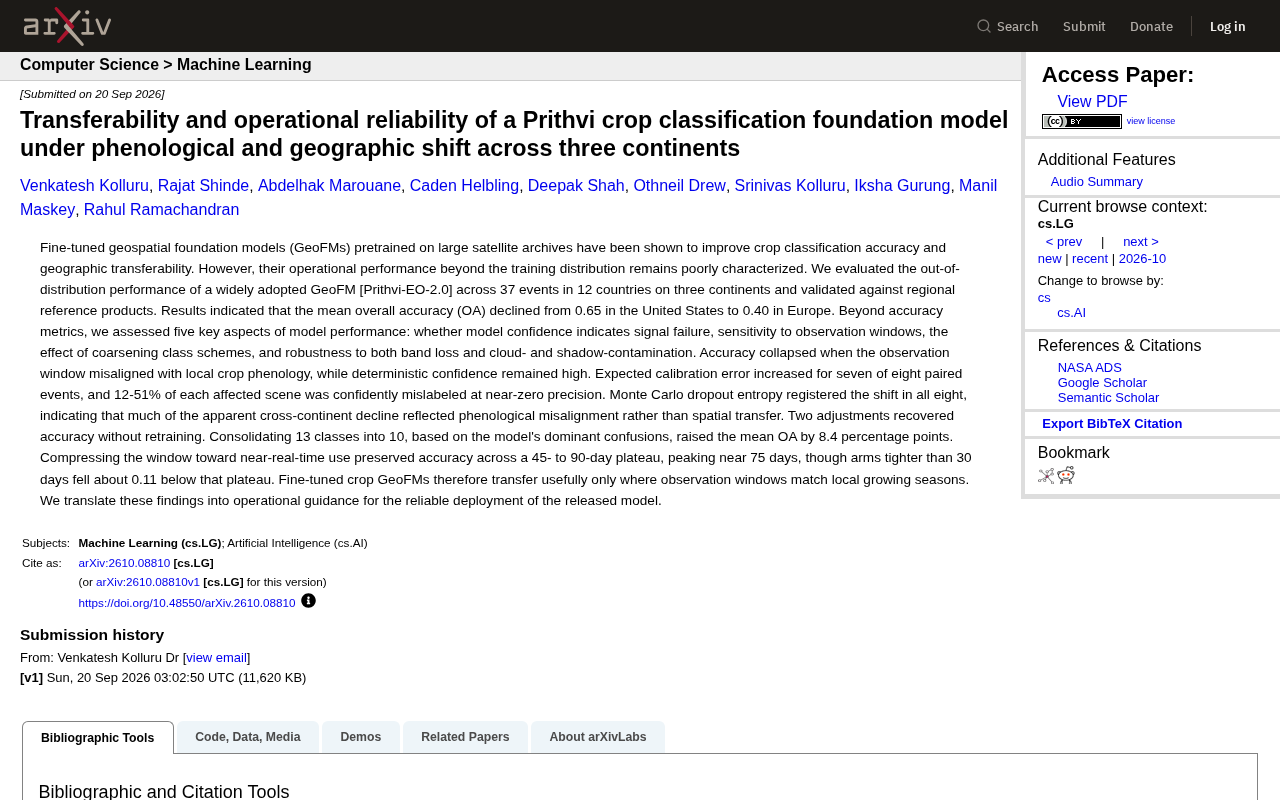
Geospatial foundation models (GeoFMs) have attracted high expectations in recent years, demonstrating solid accuracy and cross-regional transfer capability on crop classification tasks after fine-tuning. Yet one critical question has long been overlooked: how do these models actually perform when deployed in real-world scenarios outside their training distribution? A recent study published on arXiv (arXiv:2610.08810) offers a remarkably sober answer — it systematically evaluates the out-of-distribution (OOD) performance of the widely adopted Prithvi-EO-2.0 model across three continents, 12 countries, and 37 events.
Cross-Continent Transfer: Accuracy Drops from 0.65 to 0.40
The research team applied the model across different regions including the United States and Europe, validating results against regional reference products. The findings are stark: mean Overall Accuracy (OA) slides from 0.65 in the US all the way down to 0.40 in Europe. At first glance, this appears to confirm concerns about cross-regional generalization — change continents, and the model falls apart.
But the real value of this research lies in going beyond the surface-level conclusion of "accuracy degradation" to rigorously dissect the underlying mechanisms. The team evaluated model performance across five dimensions: whether model confidence reflects signal failure, sensitivity to the observation window, the effect of coarsening class schemes, and robustness to missing bands and cloud/shadow contamination.
Prithvi-EO-2.0 is an Earth observation foundation model jointly developed by NASA and IBM. Built on a Transformer architecture, it was self-supervised pre-trained on large volumes of multi-spectral satellite time-series data (primarily from HLS — the Harmonized Landsat and Sentinel-2 dataset) and can be fine-tuned for downstream tasks. Out-of-Distribution (OOD) generalization is one of the core challenges in machine learning, referring to model performance on new data whose statistical properties differ from the training data. For remote sensing foundation models, OOD shifts arise from many sources, including sensor differences, geographic region changes, seasonal and climate variation, and — as this study importantly highlights — phenological timing mismatches. Evaluating OOD performance is fundamentally different from evaluating standard validation set accuracy: the latter remains highly consistent with the training distribution and cannot reflect a model's actual reliability in real-world global deployment scenarios.
The Real Culprit: Phenological Misalignment, Not Spatial Transfer
The study's most counterintuitive finding is this: the cross-continental accuracy drop is largely not caused by "spatial transfer" itself, but by phenological misalignment.
When the observation window doesn't align with local crop phenology, accuracy collapses directly. More dangerously, the model's deterministic confidence remains high at the same time — meaning the model "fails confidently." The data shows that Expected Calibration Error (ECE) increased in seven out of eight event pairs, and in affected scenarios, 12%–51% of areas were confidently mislabeled by the model with near-zero accuracy.
This is a serious warning for real-world deployment: operators who rely solely on model output confidence to assess result reliability may be systematically misled. The research team used Monte Carlo dropout entropy as an alternative metric and found that it successfully captured distribution shift in all eight events. In other words, deterministic confidence can deceive you, while Bayesian-style uncertainty quantification can genuinely detect signal failure.
Phenology refers to the seasonal growth stages plants go through over the course of a year, including emergence, jointing, heading, grain filling, and maturity. Phenological calendars vary significantly across regions and crop types — for example, the heading stage of winter wheat in the Northern Hemisphere and the grain-filling stage of maize in the Southern Hemisphere may fall within the same calendar month. Surface reflectance spectra captured by satellite remote sensing change dramatically with phenological stage: the same soybean field can look spectrally like two entirely different crops during emergence versus maturity. When a model is trained on time-series data collected during a specific phenological window in North America, then directly applied to Europe or the Southern Hemisphere, the input time-series features may be completely misaligned with the training distribution — not because the land itself changed, but because the "timing of observation" is wrong. This is precisely why distinguishing between "spatial transfer failure" and "phenological misalignment" as two separate failure modes matters: spatial transfer failure means the model lacks generalization to the surface characteristics of a new region, while phenological misalignment is a problem that can be largely fixed through engineering (calibrating the observation window) without retraining.
Two No-Retraining Adjustments That Can Recover Accuracy
The study provides two directly actionable engineering recommendations — critically, neither requires retraining the model.
Merging Confused Classes
Based on the model's primary confusion patterns, the team consolidated 13 categories into 10, yielding a direct mean OA improvement of 8.4 percentage points. The logic is pragmatic: rather than forcing the model to distinguish crop types it consistently confuses, accept a coarser classification granularity at the application level and gain substantial accuracy in return.
Calibrating the Observation Window
The other adjustment is compressing the observation window for near-real-time applications. The study found that the model maintains accuracy across observation windows of 45 to 90 days, with this performance plateau peaking at around 75 days. However, compressing the window below 30 days causes accuracy to drop approximately 0.11 below the plateau level. This provides a clear operational boundary for business scenarios that require rapid outputs.
Expected Calibration Error (ECE) is a standard metric for measuring the reliability of model confidence. A perfectly calibrated model, when outputting "80% confidence," should statistically be correct 80% of the time in the long run. Lower ECE indicates better alignment between confidence and actual accuracy; rising ECE means the model is expressing high confidence that its actual accuracy doesn't support. Monte Carlo Dropout (MC Dropout) is a lightweight Bayesian approximation method: Dropout layers are kept active during inference, and multiple forward passes are run on the same input, using the variance across outputs to estimate prediction uncertainty. Unlike point-estimate confidence, MC Dropout entropy can capture the degree to which a model is "internally inconsistent" about a given input, thereby issuing early warnings when the model is about to produce systematic errors. The comparison between these two metrics is one of the methodological highlights of the study: the former fails under distribution shift, while the latter successfully identified signal failure in all eight test events.
Implications for Operational Deployment
This research translates its experimental findings into an actionable deployment guide. The core conclusion can be summarized in one sentence: fine-tuned crop GeoFMs can only transfer effectively when the observation window aligns with the local growing season.
This conclusion carries broad relevance for the entire remote sensing AI deployment field. It reminds practitioners:
- Before cross-regional deployment, you must first verify the crop phenological calendar of the target region — not simply assume the model "has seen similar scenarios and will work";
- Never blindly trust a model's point-estimate confidence; introduce uncertainty quantification methods such as MC Dropout to detect potential systematic failures;
- Class scheme and observation window are two near-zero-cost tuning levers that should be tried before resorting to retraining.
The "universality" narrative around foundation models is often oversimplified. This study uses real-world data from three continents to demonstrate that so-called generalization failure sometimes has nothing to do with the model's spatial transfer capability, but rather with the misalignment between input data and real-world phenological rhythms. Understanding the true root cause of failure is far more valuable than simply labeling a model as "not generalizable enough."
Related articles

AgentCore in Practice: Connecting Custom Tools and MCP Servers to Agents
DebuggerCafe tutorial shows how to connect custom tools and MCP servers to Amazon Bedrock AgentCore agents, covering tool contract design, MCP reuse, and production concerns.

816B Parameters Scores Only 39? The Real Cost-Effectiveness of the Open-Source LLM Parameter Race
Meta's 816B Muse Spark Open scores just 39 on Artificial Analysis, while 180B Qwen3.8-Flash-Next scores 40. This article analyzes 11 open-weight models' parameters vs. scores, exploring the real impact of activated parameters, quantized size, and deployment cost.

Aerial Manipulators: The Next Step for Drones from 'Seeing' to 'Changing'
Starting from a Reddit discussion, this article analyzes the technical challenges, potential applications, and deployment bottlenecks of aerial manipulators, exploring the key challenges for drones moving from environmental perception to physical manipulation.