Cross-Device AI Agent Collaboration: The Real Challenges and Future Possibilities of Multi-Agent Teamwork

Cross-device AI agent collaboration remains largely unsolved, with copy-paste and GitHub still the dominant workarounds.
A power AI user running Claude Code, Hermes, Codex, and Grokbot for different tasks finds cross-device, cross-harness agent collaboration nearly impossible. Current methods — copy-paste, GitHub handoffs, intra-harness messaging — are either too limited, one-directional, or locked to closed ecosystems. This reflects a structural gap in the AI application layer: as users mix and match models by task, multi-agent workflows are already a daily reality, but ecosystem fragmentation keeps agents siloed. Standardizing cross-harness, cross-ownership communication protocols is emerging as the next key battleground for AI productivity tools.
When you're writing code in Claude Code, running distributed tasks on Hermes, and simultaneously using Codex and Grokbot, a very practical question starts to emerge: can these AI agents — scattered across different devices and runtime environments (harnesses) — collaborate directly with each other like members of a team?
This question came from a Reddit user who runs Claude Code, Codex, and Hermes simultaneously and recently started experimenting with Grokbot. In practice, he found that cross-device, cross-harness agent collaboration is currently almost impossible to achieve — and this turns out to be a shared pain point for many power AI users.
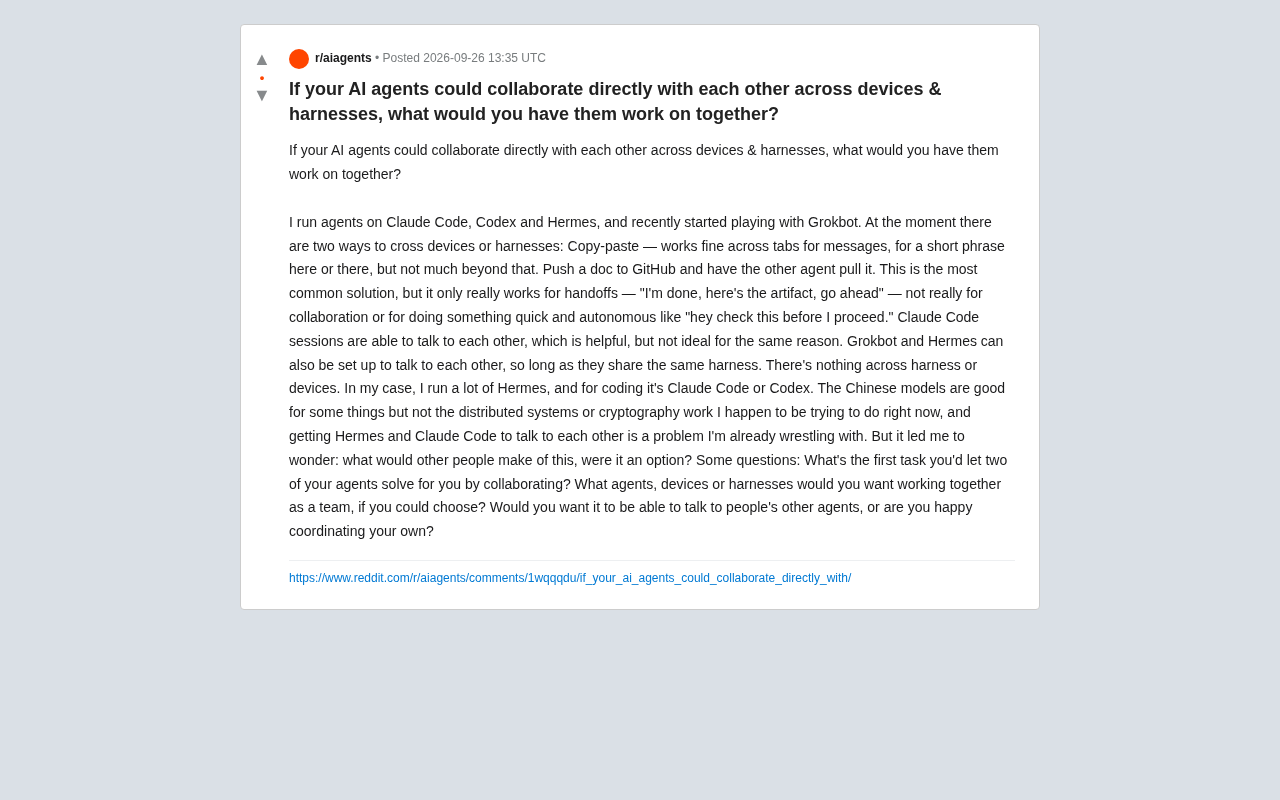
Existing Cross-Agent Collaboration Methods Fall Short
This user mapped out the current ways to get different agents to "communicate" and was candid about their obvious limitations.
Copy-Paste: Only Handles Fragments
The most primitive approach is copying and pasting between browser tabs. Sending a single message or short phrase works fine, but the moment you need to transfer complex context or large amounts of content, this manual relay completely breaks down. At its core, it's not collaboration — it's just a human acting as a messenger between two AIs.
GitHub as an Intermediary: Good for Handoffs, Not Collaboration
The most common solution today is pushing a document to GitHub and having another agent pull it. The author points out this only works for "handoff" scenarios — meaning "I'm done with my part, the output is here, you take it from here."
But it can't support real collaboration, and it certainly can't handle fast, autonomous, on-the-fly requests like "hey, before I continue, can you quickly check this for me?" Handoffs are one-directional and asynchronous; collaboration requires bidirectional, low-latency exchange — which document-passing fundamentally can't deliver.
Intra-Harness Conversation: Locked to Closed Ecosystems
The author notes that multiple Claude Code sessions can communicate with each other, which does help. Grokbot and Hermes can also be configured to talk to each other — but only if they share the same runtime environment (harness). The moment you cross harness boundaries or device boundaries, there's no ready-made solution.
Harness (runtime environment) refers to the host framework that runs an AI agent, including tool-calling interfaces, context management, task scheduling, and other core infrastructure. Claude Code's harness is defined by Anthropic; Hermes and Grokbot each have their own runtime architectures. Agents within the same harness can share message queues, file systems, or memory space, making communication nearly frictionless. Cross-harness communication, however, means crossing different authentication systems, data format standards, and network boundaries — and there's currently no industry-recognized standard protocol for handling this layer of interoperability. This closely mirrors the historical challenge of "service-to-service communication" in the microservices era — solutions like REST, gRPC, and message buses took years to standardize, and multi-agent collaboration protocols will likely go through a similar evolution.
A Real-World Scenario: Where Cross-Environment Collaboration Gets Stuck
This user's workflow is fairly representative: most tasks run on Hermes, while coding is handed off to Claude Code or Codex.
He was also candid about model selection — certain Chinese models perform well on some tasks, but aren't the right fit for his current focus areas of distributed systems and cryptography. Getting Hermes and Claude Code to talk directly to each other is exactly the problem he's wrestling with.
This case highlights a reality that often gets overlooked: as users start choosing different models and tools based on task characteristics, "multi-agent" is no longer a theoretical concept — it's an everyday workflow. But the fragmentation of the tool ecosystem forces these powerful agents to operate in isolation, unable to combine their strengths.
Three Open Questions Worth Thinking About
The author doesn't offer answers — instead, he raises several thought-provoking questions, which is precisely where discussions like this find their value.
What Would the First Collaborative Task Be?
If two agents could truly collaborate directly, what's the first thing you'd want them to tackle together? At its core, this question is asking: which tasks remain impossible to automate because of the capability limits of any single agent?
What's the Ideal "Team Composition"?
If you could freely choose, which agents, devices, or runtime environments would you want on a team? For example, using a reasoning-focused model for planning, a coding-focused model for implementation, and another for review — this kind of role specialization is a direct mirror of how human teams collaborate.
Do You Need Your Agent to Talk to Someone Else's?
The final question is the most forward-looking: do you want your agents to be able to communicate with someone else's agents? Or is coordinating the agents under your own account enough? This touches on a much bigger question — whether agents need a universal, cross-ownership communication protocol.
The Industry Signal Behind All This
This discussion from an individual developer actually reflects a demand pattern that's taking shape at the AI application layer. When model capability is no longer the only bottleneck, "how to get multiple specialized agents to collaborate efficiently" becomes the next value gap to fill.
The industry has already seen some related exploration — various multi-agent frameworks, and protocol attempts aimed at standardizing inter-agent communication. But based on this hands-on user's feedback, truly seamless cross-harness, cross-device collaboration is still stuck at the primitive stage of "using GitHub as a relay" and "manual copy-paste."
For developers building AI workflows, this is both a pain point and an opportunity — whoever can first bridge agent collaboration across different ecosystems may hold the keys to the next generation of AI productivity tools.
Note: This article is based on a single Reddit thread. The opinions and workflow scenarios described all come from the original poster's personal experience and have not been cross-verified against other sources.
The industry currently has several major approaches to standardizing multi-agent communication. MCP (Model Context Protocol), proposed by Anthropic, aims to unify the interface between models and external tools/data sources — but its design focus is "model-to-tool" connectivity rather than peer "model-to-model" communication. Multi-agent frameworks like AutoGen (Microsoft) and CrewAI coordinate multiple models within a single runtime, and excel at orchestrating hierarchical "supervisor-executor" structures, but similarly struggle to cross the boundaries between different product ecosystems. Closer to the vision of "cross-ownership communication" are open standard drafts like Agent Protocol, which attempt to define universal HTTP interfaces between agents — though ecosystem adoption remains limited. The shared limitation of all these approaches is that they require all participating parties to actively adapt, and the willingness of commercial agent products to interoperate is far more constrained by business interests than by technical feasibility.
Related articles

Gemini 4 Argon Hands-On: AI Builds Board Games, Constructs Temples, and Trains Robots Autonomously
Gemini 4 Argon hands-on roundup: AI autonomously builds a desk racetrack and temple in Blender, writes a ray tracing engine, trains a humanoid robot to sink 7 shots, plus API pricing and developer access.

The Magic Octagonal Coin: Why Only 9% of People Can Predict Its Flip?
Only 9% of people can correctly predict the Magic Octagon coin flip. This article explains its spatial rotation mechanism, common cognitive pitfalls, and a new hypothesis based on Relevance Theory, exploring the limits of human spatial reasoning.

Sam Altman: AI Is Entering the Era of Scientific Discovery — Math Breakthroughs Will Replicate in Biology and Energy
Sam Altman says AI is entering the era of scientific discovery — math breakthroughs will replicate in biology, materials science, and energy to help develop new drugs and energy sources.