Cube Forms: A Form Tool Built for AI Agents to Fill Directly

Cube Forms lets AI Agents create and fill forms directly via MCP or HTTP, no browser or CAPTCHA needed.
Cube Forms is a new product ranked #18 on Product Hunt, proposing that forms can be created and filled directly by AI Agents. Traditional forms rely on CAPTCHAs, mouse events, and multi-step sessions, creating friction for Agent automation. Cube Forms lets Agents submit structured data via MCP or HTTP, supporting Claude Code, ChatGPT, and Cursor, turning forms from UI components into API endpoints. It also preserves human-Agent collaboration through the same link. Use cases include registration, waitlist, bug reports, and sales inquiries. It's currently free, developed by Bonan Kou. Its competitor is developers' self-built Agent form scripts, but MCP protocol evolution, data privacy, and demand scale remain to be validated.
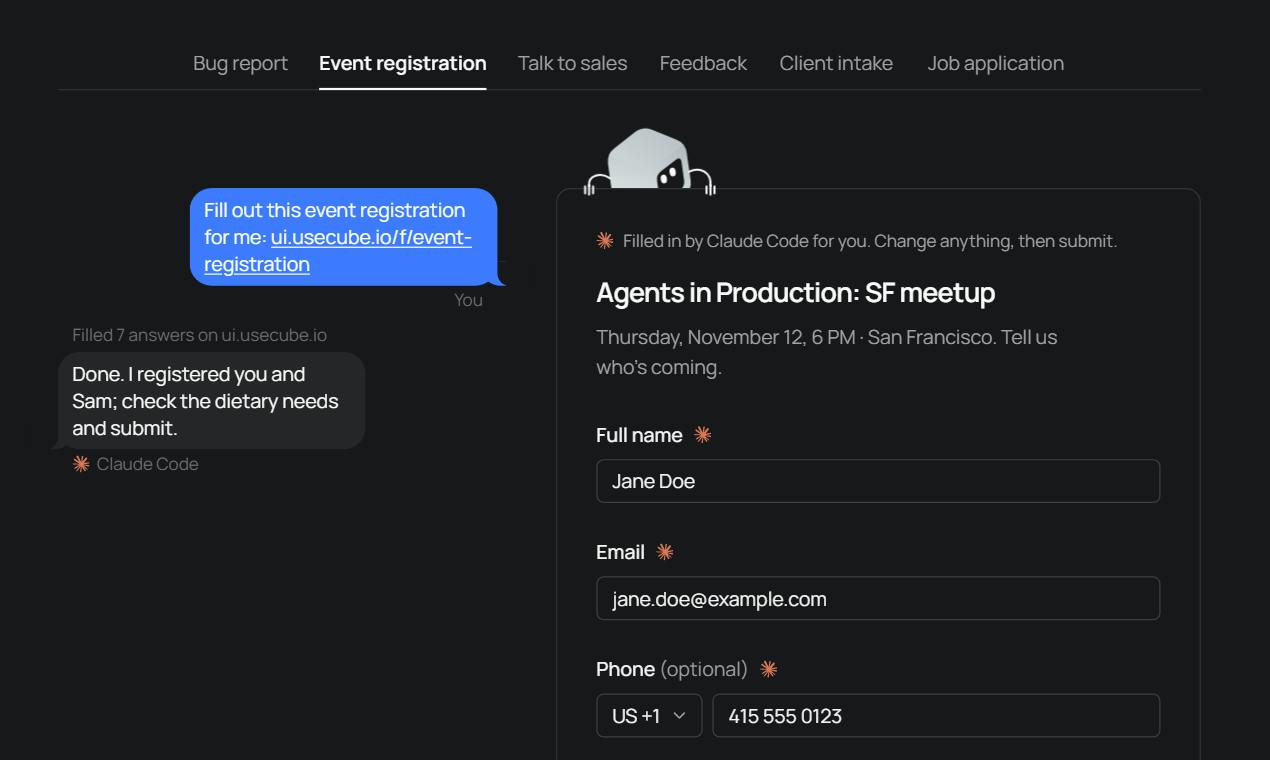
Forms—the most basic interactive component of the internet—are getting a redesign for AI Agents. Cube Forms, a new product ranked #18 on Product Hunt, puts forward a straightforward proposition: forms aren't just for humans to fill out; they can also be created and filled directly by Agents.
An Overlooked Point of Friction
Over the past two years, the capabilities of AI Agents have expanded continuously: writing code, researching information, operating browsers, calling APIs. But as soon as a workflow reaches the "fill out a form" step, almost every Agent hits a wall.
Traditional forms are designed for human vision and interaction. CAPTCHAs block automated requests, dropdowns and date pickers depend on real mouse events, and multi-step verification requires maintaining browser session state. Agents either give up or degrade into clumsy browser automation scripts with questionable reliability.
Cube Forms' entry point is simple: since Agents are the new "users," why not make forms natively support Agents?
CAPTCHA (Completely Automated Public Turing test to tell Computers and Humans Apart) is a common means of preventing automated programs from abusing forms and interfaces, with typical implementations including Google reCAPTCHA and Cloudflare Turnstile. Its core principle is to distinguish real human users from scripted programs through image recognition, behavioral feature analysis, or interactive challenges. For AI Agents, CAPTCHAs constitute a structural barrier: Agents lack real interactive behavior in the sense of "mouse" and "vision," and even with multimodal models for image recognition, they struggle to pass behavioral feature detection. Beyond CAPTCHAs, controls like dropdowns, date pickers, and file uploads also depend on real DOM event chains (such as mousedown, focus, input, etc.). Browser automation tools must simulate these events one by one to complete filling, and any single failure breaks the entire flow. The compounding of these friction points makes traditional forms the most fragile link in Agent automation workflows.
An Agent-First Form Protocol
Cube Forms' core capability is enabling AI Agents to directly create forms and fill in content via MCP (Model Context Protocol) or ordinary HTTP requests. The official description explicitly lists mainstream Agent environments like Claude Code, ChatGPT, and Cursor—no browser, no CAPTCHA.
This means Agents no longer need to simulate human clicks, but instead complete data submission through a structured protocol. For developer toolchains, this is a pragmatic shift: downgrading forms from "UI components" to "API endpoints," so Agents can fill them like calling a function.
Applicable scenarios cover common business needs: registration, waitlist, bug reports, and sales inquiries. These are all high-frequency, structured form types well-suited to automation.
MCP (Model Context Protocol, Model Context Protocol) was proposed and open-sourced by Anthropic at the end of 2024, aiming to establish a unified connection standard between AI models and external tools and data sources. Before MCP, every time an external service (database, API, file system) was integrated, developers had to write customized adapter layers for different Agent platforms, causing severe fragmentation. MCP uses a client-server architecture: the Agent runtime acts as an MCP Client, external services are exposed as MCP Servers, and both sides communicate through standardized JSON-RPC messages. This means that as long as a service implements an MCP Server, it can be directly invoked by all Agent environments that support MCP—similar to how USB-C unified peripheral interfaces. For form tools, integrating MCP means no longer needing separate integrations for each platform like Claude and Cursor; one implementation covers the entire ecosystem. This also explains why Cube Forms lists MCP as its primary integration method.
A Hybrid Model of Human-Agent Collaboration
Cube Forms doesn't go to the extreme of "Agents completely replacing humans." With the same link, after an Agent fills it out, a human can still open it at any time, check what the Agent filled in, modify any field, or simply fill it out from scratch themselves.
This design acknowledges a reality: Agent-submitted results need human review. In scenarios like sales inquiries and bug reports, Agents may miss context or make inaccurate judgments, and human intervention is a necessary quality checkpoint.
From a product positioning perspective, Cube Forms tries to find a middle ground between "pure automation" and "pure manual work"—Agents handle the tedious initial filling, and humans handle final confirmation and correction.
Free Strategy and Ecological Niche
Cube Forms is currently completely free, developed by Bonan Kou. It received 68 votes and 8 comments on Product Hunt, ranking #18—a product with moderate popularity but clear positioning.
Its competitor isn't Typeform or Google Forms, but the Agent form-handling scripts developers write themselves. For teams building Agent workflows, the value Cube Forms provides lies in saving the effort of building a form backend and protocol adaptation from scratch. The free strategy also helps quickly gather developer feedback and establish usage habits within the MCP ecosystem.
Potential Limitations
Based on currently available public information, Cube Forms is still in an early stage. The MCP protocol itself is still evolving rapidly, and the standardization level of the Agent ecosystem is limited. Issues such as data storage after form submission, privacy compliance, and enterprise-level permission management are not elaborated on the product page.
Additionally, the scale of the demand for "Agents filling out forms" itself remains to be validated. If Agent workflows truly become widespread enough to require large amounts of form interaction, such tools will become infrastructure; if Agents remain mostly at the level of conversation and code generation, it may just be an interesting little tool.
For developers building Agent automation workflows who are troubled by the form-filling step, Cube Forms is worth a try. Free, supports MCP and HTTP, and allows human-Agent collaboration—these three points already constitute a reasonable reason to try it.
Enterprise-level form scenarios typically involve requirements such as data encryption, access auditing, GDPR/personal information protection law compliance, and field-level permission control. Traditional form services (such as Typeform and JotForm) already have mature solutions in these areas, while emerging Agent-native form tools tend to prioritize solving the problem of "whether it can be invoked by Agents," with security and compliance capabilities lagging relatively behind. In addition, form data filled by Agents faces additional risks during transmission and storage: if the MCP channel lacks end-to-end encryption, or the form backend doesn't perform input validation, malicious Agents may submit injection-type attack payloads. For teams handling personal user information, payment information, or internal sensitive data, they need to assess data flows and compliance responsibilities themselves before adopting such tools—they can't simply use them in production environments just because they are "free and support MCP."
One-line Summary
Cube Forms lets AI Agents directly create and fill out forms via MCP or HTTP, without browsers or CAPTCHAs.
Paragraph Summary
Cube Forms is a new product ranked #18 on Product Hunt, proposing that forms aren't just for humans to fill out—they can also be created and filled directly by AI Agents. Traditional forms rely on CAPTCHAs, mouse events, and multi-step sessions, becoming friction points in Agent automation workflows. Cube Forms enables Agents to directly submit structured data via MCP or ordinary HTTP requests, supporting mainstream environments like Claude Code, ChatGPT, and Cursor, turning forms from UI components into API endpoints. The product also preserves human-Agent collaboration: humans can check, modify, or fill in forms themselves through the same link. Applicable scenarios include registration, waitlist, bug reports, and sales inquiries. It is currently completely free, developed by Bonan Kou. Its competitor is developers' self-built Agent form scripts, but MCP protocol evolution, data privacy, and demand scale remain to be validated.
Related articles

Huberman's Rational Supplement Guide: A Five-Layer Health Framework and Scientific Decision-Making
Stanford neurobiology professor Huberman proposes a rational supplement framework: behavior and nutrition are the foundation, basic combination supplements serve as insurance, and sleep/hormonal/cognitive directions should stick to single-ingredient experiments. Omega-3 is the top single-ingredient choice, and melatonin is not recommended.

The Unsung Painter Behind Gilded Age Manhattan Interior Design
HN discussion highlights the painter behind Gilded Age Manhattan interiors: he created murals and decorative paintings but was long overlooked as his work was seen as architectural appendage.

Can AI Agents Be Socially Engineered? Understanding Prompt Injection and Tool Permission Risks
Through Invariant Lab's GitHub Issue injection and Brave's AI browser attack, this article analyzes how Prompt Injection induces AI Agents to perform unauthorized actions, and offers protection advice across three layers: least privilege, tool validation, and operation auditing.