Cue: Put On Your AirPods, Mac Automatically Enters Focus Mode

A macOS focus tool that uses putting on AirPods as a physical trigger — built solo with Claude via vibe coding.
Cue is a macOS productivity tool whose core idea is using AirPods as a physical focus trigger: putting in your earphones automatically activates system Focus mode, blocks distracting websites, and starts a timer in the notch area — removing all the headphones restores normal state. The notch also serves as an information hub for playback controls, system adjustments, session history, and animated "tiny buddies." Cue is completely free, privacy-focused, and requires macOS 14 with Apple Silicon. Notably, developer Brandon Ta built it solo using Claude through "vibe coding," earning 101 upvotes and a #4 ranking on Product Hunt.
One person plus AI collaboration — that's all it took to build a macOS productivity tool that climbed to the top of Product Hunt. The core idea behind Cue is simple enough to make you want to try it immediately: put your AirPods in, and your Mac instantly switches into focus mode.
Turning Headphones Into a Focus Switch
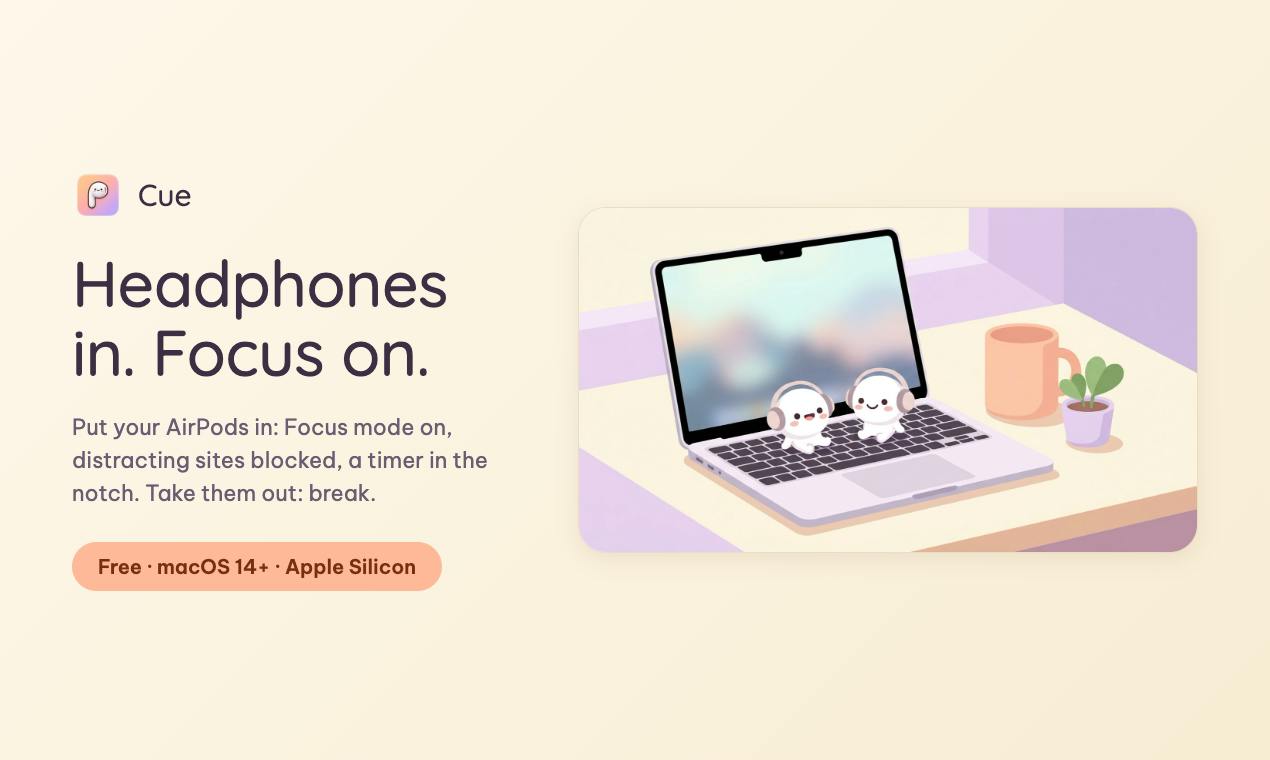
Cue reimagines the role of AirPods — they're no longer just for listening to music, but a physical focus trigger. The moment you put in your AirPods, your Mac automatically activates the system's Focus mode, blocks distracting websites, and starts a timer in the notch area.
When you take your headphones off, everything returns to normal: break time begins, and blocked websites become accessible again. This hardware-state-driven automation eliminates the friction of manually toggling focus mode, making "starting work" an almost unconscious act.
This interaction pattern — binding everyday behaviors to system states — is fundamentally about lowering the threshold for entering a flow state. Compared to traditional Pomodoro apps that require you to actively click start, Cue hands the trigger to an action you already repeat every day.
macOS Focus mode is a system-level feature Apple introduced in macOS 12 Monterey, allowing users to define notification filtering rules for different scenarios, contact allowlists for calls, and linked Home Screen and app behaviors. Developers can detect the current focus state or request a switch via system APIs, enabling Cue to programmatically activate a "Work" focus configuration when it detects AirPods connected. AirPods connection status can be monitored via CoreBluetooth or Core Audio frameworks, combined with input/output device change notifications in AudioSession to determine wearing behavior. The maturity of these system capabilities is precisely what makes products like Cue technically possible.
The Notch as an Information Hub
Cue makes full use of macOS's notch area. Beyond the focus timer, this region serves multiple functions: currently playing music info, volume and brightness controls, custom color themes, session history, and two "tiny buddies" that react to various interactions.
These two little characters are the playful element Cue injects beyond pure utility. They respond to your actions, adding a touch of companionship to what can otherwise be a dry focus session. This kind of anthropomorphic micro-design is rare in productivity tools, yet it's often the key to building emotional attachment with users.
Transforming the notch from a "resented screen cutout" into an information display and interaction hub has been a common exploration among macOS tools in recent years. Cue takes a focused approach here, consolidating playback controls, system adjustments, and focus status all into the same zone.
Privacy, Free to Use, and System Requirements
Cue clearly highlights several key attributes: completely free, privacy-focused, requires macOS 14 or later, and Apple Silicon is required.
For privacy-conscious users, this is a noteworthy selling point. Focus tools typically have access to browsing behavior and usage habit data — Cue's emphasis on privacy means this information stays local rather than being uploaded to the cloud. The free pricing further lowers the barrier to trying it out.
The hardware requirement is worth noting, however — the Apple Silicon restriction means users still running Intel-based Macs cannot experience it. Given that AirPods state detection and notch interaction both rely on newer system capabilities, this limitation is technically justified.
One Developer Plus Claude: "Vibe Coding"
What may be most noteworthy about Cue isn't the features themselves, but how it was built. Creator Brandon Ta openly states in the product description that this app was "vibe-coded" by him alone in collaboration with Claude.
This reflects a new paradigm in indie development: with the help of large language models, a single developer can rapidly turn a spark of inspiration into a complete, shippable product. From monitoring AirPods status and triggering Focus mode to implementing the notch UI — work that once required a team — can now be accomplished by one person working alongside AI.
On Product Hunt, Cue earned 101 upvotes and 4 comments, ranking 4th for the day, spanning the Mac, productivity, and menu bar app categories. That's a remarkable result for a solo project, and it reinforces that lightweight, free, distinctly creative tools can still earn genuine community recognition.
From a product perspective, Cue's value lies in using a clever trigger mechanism to solve the activation friction problem common to focus tools. It doesn't chase feature bloat — instead, it polishes a single core interaction to a high standard. That's a classic path for indie tools breaking through in a crowded market.
"Vibe coding" is a development concept coined by AI researcher Andrej Karpathy in early 2025 that quickly gained traction. It describes an approach where developers no longer review code logic line by line, but instead describe their intent in natural language, let a large language model generate the implementation, and only verify whether the results match expectations. The core shift is moving the focus of programming from "how to write it" to "what do I want." For creators with strong product instincts but limited coding experience, vibe coding dramatically compresses the time from idea to working prototype. The tradeoff is that code maintainability and deep technical understanding tend to suffer — but for personal tools like Cue, where the core value is creativity and experience, the ability to rapidly validate an idea often outweighs code quality concerns.
Related articles

AI New Grad Resume Diagnosis: How to Stand Out for ML/CV Roles?
How can AI/ML new grads optimize their resumes to get interviews? Based on a real Reddit case, this article analyzes project selection, depth display, and structure for ML/CV roles, with actionable revision advice.

OpenAI Opens Up Decision Models as Competition with Jev Heats Up
OpenAI makes its decision model widely available, directly challenging first mover Jev. We analyze the impact on the decision model competitive landscape and key considerations for developers and enterprises.

Startup Growth Secrets: Early Sales Are Not the Key
At Disrupt, experts from Lovable, Polska, and Theory Ventures said early startup growth depends not on early sales but on a repeatable sales process, a clear ICP, team development, and data-driven iteration.