Cuey: Compare ChatGPT, Claude, and Gemini Answers in One Tab
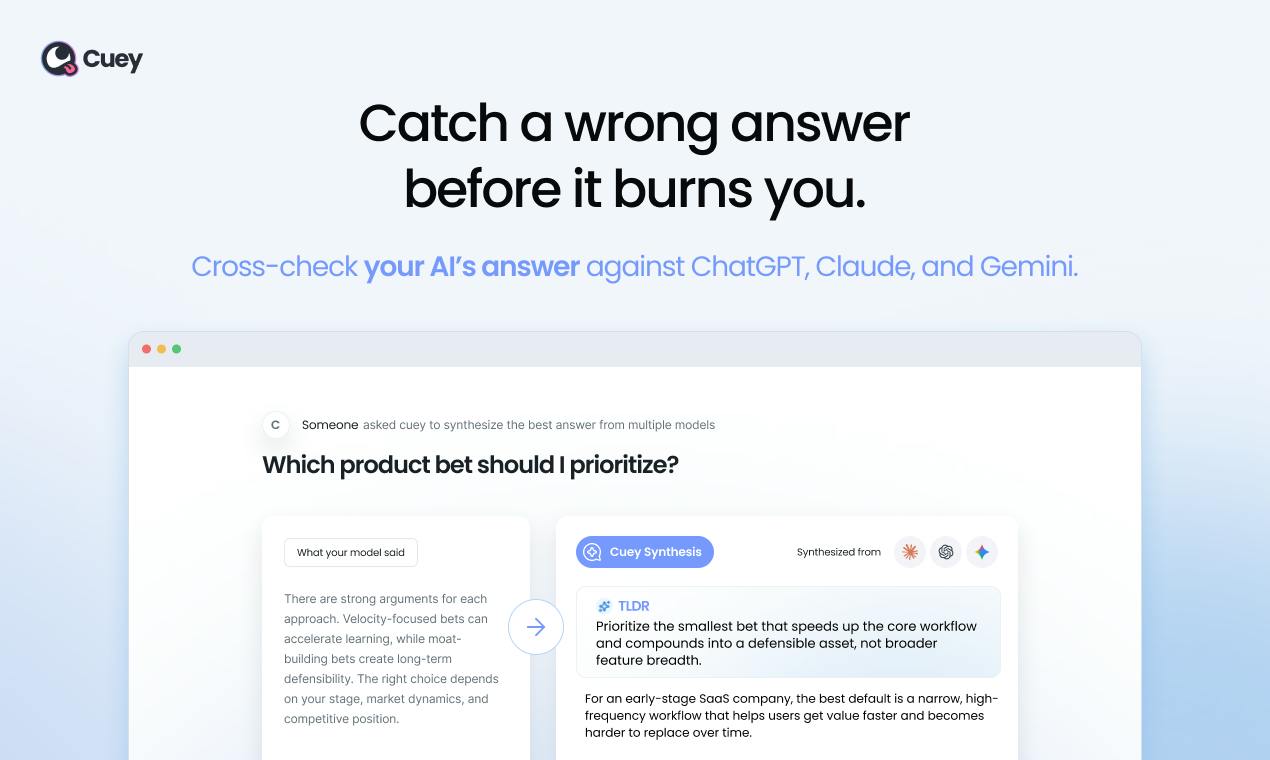
Cuey sends one prompt to 30+ AI models and highlights where their answers disagree.
Cuey is a multi-model AI aggregation tool built around the idea of using "second opinions" to combat LLM hallucinations. Users enter a prompt once, and Cuey automatically distributes it to ChatGPT, Claude, Gemini, and 30+ other models, displaying results side by side while actively flagging where models disagree. This "disagreement highlighting" is its key differentiator. Cuey also supports cross-model context memory sharing and positions a single subscription as a replacement for multiple AI memberships. It earned 104 upvotes and ranked #4 on Product Hunt, confirming real market demand for multi-model cross-validation.
When AI Gives Wrong Answers with the Same Confidence
Large language models have a subtle problem: the tone they use when giving a wrong answer is identical to when they're right. It's nearly impossible to tell in the moment which response to trust — you usually only discover the mistake after acting on it. Cuey, a new tool that ranked #4 on Product Hunt, targets exactly this pain point. It lets you send the same question to ChatGPT, Claude, Gemini, and 30+ other models simultaneously within a single interface, and visually shows you where they disagree.
Cuey's core logic is the "second opinion." Just as major medical decisions benefit from multiple doctors' perspectives, Cuey believes a single model's single answer is never enough for truly important work. The idea sounds simple, but it addresses a genuine blind spot in how people currently use AI.
This phenomenon is technically known as "hallucination" — where a model outputs content that is factually nonexistent or inaccurate, yet delivered in fluent, confident language. The root cause lies in how large language models work: they are fundamentally predicting "the next most likely word" rather than retrieving answers from a factual database. This means that even when a model "doesn't know" something, it won't stop and say so — it keeps generating content that sounds linguistically plausible. Research shows that hallucination rates vary significantly across models and domains — a model that performs reliably on medical questions might frequently stumble on legal details. This is precisely the value of cross-validating across multiple models: when several independently trained models converge on the same answer, confidence naturally rises; when they diverge, that's a signal — there's uncertainty worth investigating.
One Prompt, Multiple Perspectives
Cuey addresses an increasingly common workflow problem. Many power users have already developed a habit of "cross-checking": pasting the same question into ChatGPT, Claude, and Gemini separately, then manually comparing the differences. The process is tedious — it means juggling multiple tabs, copying and pasting repeatedly, and maintaining several subscriptions at once.
Cuey compresses this entire workflow into a single step. Users enter a prompt once, the system automatically distributes it to multiple models, and the results are presented side by side. According to its product description, it connects to over 30 models, covering mainstream options like ChatGPT, Claude, and Gemini, as well as more specialized choices. "One prompt, one place, multiple perspectives" is its most direct value proposition.
Highlighting Disagreements Is the Key Differentiator
Simply displaying multiple answers side by side isn't new — there are already a number of "multi-model aggregation" products on the market. Cuey's claimed differentiation lies in "shows when they disagree" — actively flagging the places where models reach different conclusions. This matters because for the average user, reading three lengthy responses simultaneously isn't easy. The truly valuable information is "where do they contradict each other?" Disagreements are precisely the points that warrant human verification and further judgment.
Multi-model aggregation as a product category already has pioneers like Poe and OpenRouter, but each has a different focus. Poe emphasizes accessing multiple AI assistants through a single interface — more of a "unified entry point" positioning. OpenRouter targets developers with API-level model routing. Cuey's "disagreement visualization" as its core selling point positions it closer to an "AI answer fact-checking tool" than a simple aggregator. In terms of user experience, this means the tool doesn't just lay answers side by side — it actively performs a semantic comparison and surfaces the information most deserving of human attention. Defining and calculating "disagreement" is itself a technical challenge: it's relatively straightforward for factual questions (like a historical year), but for open-ended advisory questions, different phrasing doesn't necessarily represent genuine conflicting viewpoints. This remains an area these tools will need to continuously refine.
Memory That Travels Across Models
Another feature Cuey highlights is that "your memory travels with you," keeping every model informed of your context. This addresses another pain point in multi-model usage: every time you switch to a new model, you have to re-explain your background from scratch. If Cuey can share a unified context memory across different models, users won't need to repeat themselves, and each model can render its own judgment based on the same information — making side-by-side comparisons genuinely comparable.
From a product positioning standpoint, this also creates a layer of stickiness — context memory accumulates on the Cuey platform rather than being scattered across each model's separate conversation history.
One Subscription Instead of Many
For individual users and small teams, Cuey also plays the cost card. Running ChatGPT Plus, Claude Pro, and Gemini Advanced simultaneously means paying three separate monthly subscription fees. Cuey's proposition of "no stack of subscriptions" — aggregating multi-model access through a single entry point — could theoretically reduce that overhead.
That said, there are details worth watching: how the pricing balances against API costs, how generous the free tier is, and which versions of each model it actually calls. These specifics weren't disclosed in the original information, yet they're the key variables determining real practical value.
Is It Worth Paying Attention To?
Cuey earned 104 upvotes on Product Hunt and ranked #4 for the day, spanning the Productivity, Artificial Intelligence, and Tech categories — suggesting genuine market resonance around the need for multi-model comparison. Its thinking is clear and hits a real pain point: AI hallucinations are hard to spot from a single response, and cross-referencing is one of the lowest-barrier verification methods currently available.
For users who regularly rely on AI for important work but worry about being misled by a single model, Cuey is a direction worth exploring. But how well it ultimately delivers on the two core promises — disagreement detection and context synchronization — will need to be tested in real use. The tool's value doesn't lie in how many models it aggregates, but in whether it can genuinely help users more quickly identify the answer they shouldn't blindly trust.
Related articles

Gemini 4 Argon Hands-On: AI Builds Board Games, Constructs Temples, and Trains Robots Autonomously
Gemini 4 Argon hands-on roundup: AI autonomously builds a desk racetrack and temple in Blender, writes a ray tracing engine, trains a humanoid robot to sink 7 shots, plus API pricing and developer access.

The Magic Octagonal Coin: Why Only 9% of People Can Predict Its Flip?
Only 9% of people can correctly predict the Magic Octagon coin flip. This article explains its spatial rotation mechanism, common cognitive pitfalls, and a new hypothesis based on Relevance Theory, exploring the limits of human spatial reasoning.

Sam Altman: AI Is Entering the Era of Scientific Discovery — Math Breakthroughs Will Replicate in Biology and Energy
Sam Altman says AI is entering the era of scientific discovery — math breakthroughs will replicate in biology, materials science, and energy to help develop new drugs and energy sources.