Cultural Reasoning and Robustness in LLMs: A New Evaluation for Sentiment Analysis of Spanish Political Discourse

The paper proposes a culturally aware diagnostic protocol revealing LLM robustness deficiencies in Spanish political sentiment analysis.
The paper addresses LLMs' neglect of cultural context in political sentiment analysis by proposing a diagnostic protocol: it builds Gold and Ambiguous subsets from three human annotation perspectives and a Synthetic subset using sentiment-flipped counterfactuals, model-conditioned perplexity, and LLM-as-a-judge. Comparing proprietary and open-weight models under zero-shot and few-shot settings, it finds annotation ambiguity and counterfactual perturbation reveal failure modes masked by conventional evaluation. GPT-4.1-mini performs most stably, smaller open-weight models degrade notably under perturbation, and few-shot gains are limited. The study releases a Spanish dataset with three-way annotations and a reproducible protocol, advancing evaluation from label-centric to context-aware, though limited by a single language and the realism of synthetic counterfactuals.
Why LLMs Need "Culturally Aware" Evaluation in Political Discourse Analysis
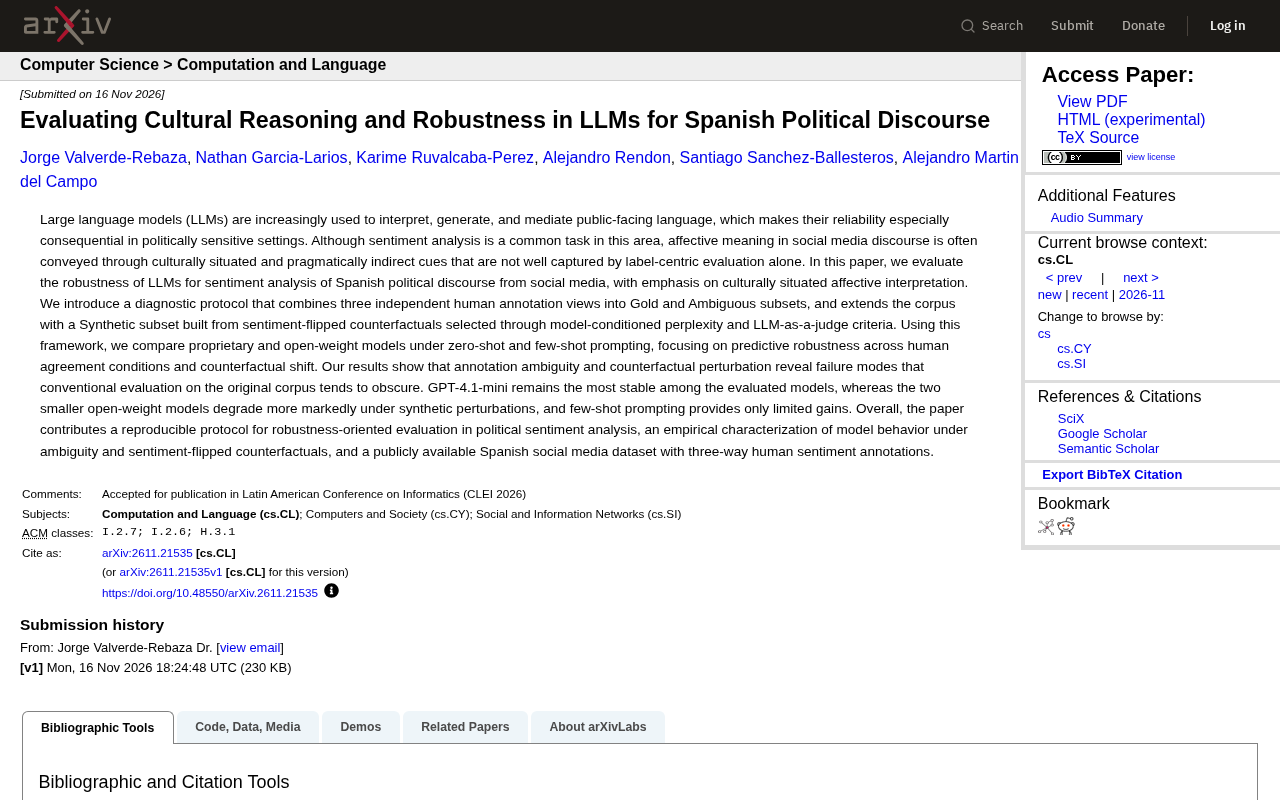
Large language models (LLMs) are increasingly used to interpret, generate, and mediate public-facing language, making their reliability in politically sensitive scenarios critical. Sentiment analysis is a common task in this domain, but emotional meaning in social media discourse is often conveyed through cultural contextualization and pragmatic indirect cues—something label-centric evaluation struggles to capture. A recent paper, Evaluating Cultural Reasoning and Robustness in LLMs for Spanish Political Discourse, addresses this gap by proposing a diagnostic protocol to evaluate LLM robustness in sentiment analysis of Spanish-language political social media discourse, with particular attention to culturally situated sentiment interpretation.
Diagnostic Protocol: Three Human Annotation Perspectives and Synthetic Counterfactuals
One of the paper's core contributions is a diagnostic protocol that combines three independent human annotation perspectives into Gold and Ambiguous subsets, and extends the corpus with a Synthetic subset. This synthetic subset is built on sentiment-flipped counterfactuals, selected via model-conditioned perplexity and LLM-as-a-judge criteria. The design aims to go beyond conventional evaluation and reveal failure modes under ambiguity and counterfactual perturbation.
The protocol's reproducibility is a highlight: it offers a standardized pipeline for robustness evaluation that can be applied to political sentiment analysis. The paper also releases a Spanish-language social media dataset with three-way human sentiment annotations, providing a valuable resource for future research.
Model-conditioned perplexity refers to the perplexity score a language model itself assigns to a given text, used as a basis for filtering or ranking samples. In this study, it is used to select, from sentiment-flipped counterfactual candidates, the perturbed samples that the model considers "most natural/plausible," so that the diagnostic set better reflects the input distribution the model actually encounters, rather than counterfactuals constructed purely by hand-crafted rules. This approach incorporates the evaluated model's internal probability distribution into the data construction process, making robustness testing more targeted.
LLM-as-a-judge is an evaluation paradigm that uses large language models in place of human annotators or rules for quality judgment. Here it is used to perform secondary filtering or scoring on the synthetic counterfactual subset, determining whether perturbed texts remain semantically coherent and whether the sentiment flips are reasonable. This paradigm is low-cost and scalable, but it carries risks of judge bias and sharing the same origin as the target model, so the paper combines it with perplexity metrics rather than relying on it alone.
Model Performance: Proprietary vs. Open-Weight Models
Under zero-shot and few-shot prompting, the researchers compared proprietary and open-weight models, focusing on prediction robustness across human agreement conditions and counterfactual shifts. Results show that annotation ambiguity and counterfactual perturbation reveal failure modes that conventional evaluation tends to mask on the original corpus.
Specifically, GPT-4.1-mini performed most stably among the evaluated models, while two smaller open-weight models degraded more noticeably under synthetic perturbation. Few-shot prompting yielded only limited gains, indicating that simply adding examples is insufficient to address culturally situated understanding and counterfactual robustness. This finding has cautionary implications for real-world deployment: in politically sensitive scenarios, model selection must balance stability against cultural adaptability.
Zero-shot and few-shot prompting are two basic settings for evaluating LLM task capability. Zero-shot provides no examples and relies solely on instructions for the model to perform sentiment classification; few-shot includes a small number of annotated examples in the prompt, expecting the model to imitate the annotation pattern through in-context learning. This study adopts both settings to distinguish the model's inherent cultural reasoning ability from its ability to temporarily adapt from examples. The limited few-shot gains suggest that culturally situated understanding and counterfactual robustness are difficult to compensate for by adding a few examples—they are deeper model capability issues.
Implications and Limitations: Next Steps in Cultural Reasoning Evaluation
The study emphasizes the value of annotation ambiguity and counterfactual perturbation as diagnostic tools. Conventional sentiment analysis evaluation often assumes labels are clear and consistent, but in real social media discourse, sentiment expression often depends on cultural background and pragmatic implicature, leading to legitimate disagreement among annotators. By explicitly modeling this ambiguity, the paper reveals behavioral differences between "human-consistent" and "human-divergent" conditions, pointing toward more fine-grained evaluation.
However, the study has limitations. The synthetic subset is based on sentiment-flipped counterfactuals; while it can test robustness, it may not fully align with real-world sentiment shifts. Moreover, the evaluation covers only Spanish political discourse, and generalizing conclusions to other languages and cultures requires caution. Future work could extend to multilingual scenarios and explore richer annotation methods for cultural cues.
Overall, the paper contributes a reproducible protocol, empirical characterization of model behavior, and a public dataset to robustness evaluation in political sentiment analysis, advancing the shift of LLM cultural reasoning evaluation from label-centric to context-aware.
Sentiment-flipped counterfactual refers to a perturbed version of an original sample in which the sentiment polarity is reversed (e.g., from negative to positive) while keeping the text superficially fluent and contextually plausible, producing a version semantically similar to the original but with the opposite label. Its purpose is to test whether the model truly relies on semantic and cultural cues for judgment, or merely on surface vocabulary or annotation shortcuts. If the model's predictions on counterfactual samples change correctly in line with the label flip, it demonstrates some robustness; if predictions remain unchanged or become confused, it exposes fragility. The method's limitation is that manually constructed flips may not correspond to sentiment shifts that naturally occur in real social media.
One-line Summary
The paper proposes a culturally aware diagnostic protocol that reveals robustness deficiencies in LLMs for sentiment analysis of Spanish political discourse.
Paragraph Summary
Addressing LLMs' neglect of cultural context in political discourse sentiment analysis, this paper proposes a diagnostic protocol: it combines three human annotation perspectives to build Gold and Ambiguous subsets, and uses sentiment-flipped counterfactuals, model-conditioned perplexity, and LLM-as-a-judge to construct a synthetic subset. Comparing proprietary and open-weight models under zero-shot and few-shot settings, it finds that annotation ambiguity and counterfactual perturbation reveal failure modes masked by conventional evaluation. GPT-4.1-mini performs most stably, two smaller open-weight models degrade noticeably under perturbation, and few-shot prompting yields limited gains. The study releases a Spanish dataset with three-way annotations and a reproducible protocol, advancing evaluation from label-centric to context-aware, though it is limited by a single language and the realism of synthetic counterfactuals.
Related articles

Jensen Huang Returns to Nvidia: The Power Game Behind an "Aggro Reset"
Nvidia's board reappointed Jensen Huang as CEO less than two weeks after his scandal-driven resignation. This analysis explores the board's decision-making, Trump's political intervention, media power failure, and market reaction behind the dramatic return.

Why Voice AI Can't Understand Kenyans' Everyday Conversations
Swahili speech recognition hits 3.24% error on read text, but everyday Kenyan speech mixes English, Sheng slang, and accents—leaving mainstream voice AI struggling.

Data Centers Build Their Own Natural Gas Plants: AI Compute's Breakout Around a Decade-Long Grid Wait
Grid interconnection approvals can take a decade, so xAI and others are building off-grid natural gas plants to power AI clusters. This article analyzes the drivers, costs, and impact of behind-the-meter generation on AI infrastructure.