Cursor Major Update: Build and Deploy Full-Stack Apps Inside the IDE

Cursor now lets you build and deploy web apps directly in the editor, with cloud agents handling the backend.
According to a tech channel, AI code editor Cursor has launched a major update enabling developers to build and deploy complete web apps directly within the editor. New "cloud agents" take over backend tasks like hosting, databases, and user authentication, letting the entire flow from coding to launch happen in one interface without switching to third-party services like Vercel or Supabase. This signals AI coding tools evolving from "assisted coding" to "assisted delivery," especially benefiting indie developers and small teams. However, the video omits key details on pricing, implementation, privacy, and compatibility, and lacks quantified efficiency data—so wait for official docs and testing before adopting.
The AI code editor Cursor is pushing beyond the boundaries of "writing code." According to a recent reveal from a YouTube tech channel, Cursor has launched a major update that allows developers to build and deploy complete web applications directly inside the editor. This means the entire process—from writing code to shipping the app—can be completed within a single interface, without switching back and forth between multiple tools.
From Code Editor to Application Delivery Platform
In the traditional development workflow, after writing code, developers still need to handle a series of deployment steps such as hosting, database configuration, and user authentication—often relying on third-party services like Vercel, Supabase, and Firebase. The core of Cursor's update is internalizing these steps. According to the video description, Cursor's new "cloud agents" can take over backend capabilities such as hosting, databases, and user authentication, letting developers complete the entire journey from concept to a live app within a unified interface.

The video emphasizes that this is "no longer just about writing code," but about managing the entire application lifecycle. For developers, the most direct value is workflow simplification—no more frequent tool switching or manual deployment pipeline configuration, freeing up time for more creative work.
Cloud Agents Take Over Backend Complexity
The technical highlight of Cursor's update lies in the design of its cloud agents. According to the video, these agents handle capabilities that typically require independent service providers, such as hosting, databases, and user authentication.

This means developers can focus on business logic and frontend experience, while the setup and operation of backend infrastructure is automatically handled by Cursor's cloud agents. For indie developers and small teams, this "all-in-one" experience significantly lowers the barrier to full-stack applications. Interestingly, the video does not disclose the specific technical implementation details of the cloud agents, the database types supported, or the authentication schemes—information that awaits further clarification from Cursor officially.

Cloud Agents are the backend service abstraction layer introduced in Cursor's update. In the context of AI programming tools, an agent usually refers to a program entity capable of autonomously executing multi-step operations based on natural language instructions. Cursor's cloud agents extend this concept into the infrastructure domain: through interactions within the editor, developers can trigger agents to complete operations such as resource creation, configuration, and deployment—without directly operating cloud consoles or writing deployment scripts. This design encapsulates backend complexity as a declarative service, lowering the barrier to full-stack development. However, the reliability, observability, and failure recovery mechanisms of cloud agents still need real-world validation.
The Practical Impact on Developer Workflows
The speed improvement "from concept to live app" is the most emphasized selling point of this update. In the traditional model, going from an idea to an accessible online service involves multiple steps—environment configuration, deployment scripts, domain binding, database migrations—each of which can become a bottleneck. Cursor converges these steps into the editor, which in theory can significantly shorten delivery cycles.
The video poses a thought-provoking question: how much time can this save you each day? The answer depends on project complexity, but for developers who frequently validate prototypes or build small web apps, the gains could be substantial. That said, the video itself is promotional in nature and provides no benchmarks or real case data to quantify the efficiency improvements, so readers should stay rational when evaluating it.
Full-stack application delivery typically involves frontend static asset hosting, backend API runtime environments, database persistence, user identity authentication (such as OAuth, JWT), and domain and SSL configuration. Traditionally, these capabilities are handled separately by hosting platforms like Vercel and Netlify, backend-as-a-service (BaaS) providers like Supabase and Firebase, and authentication services like Auth0. Cursor attempts to integrate these scattered steps into a single IDE interface; its value lies in reducing context switching and configuration overhead, but it also means developers need to trust the editor's ability to manage underlying resources.
Competitive Landscape and Future Direction
Cursor's move is seen as a signal of intensifying competition among AI programming tools. As code generation capabilities become increasingly commoditized, incorporating deployment and operations into the editor ecosystem has become a new direction for differentiation. At the end of the video, it notes that Cursor "moves fast" and encourages viewers to follow for daily tech updates.
For the developer community, the questions that need attention include: the cloud agents' pricing model, data privacy and compliance, compatibility with existing tech stacks, and lock-in risk. None of this key information is covered in the original video, so it's advisable to wait for Cursor's official documentation and real-world feedback before making adoption decisions.
Overall, Cursor's update represents a clear signal of AI programming tools evolving from "assisted coding" to "assisted delivery"—the boundaries of the editor are extending across the entire application lifecycle.
Vendor Lock-in refers to the risk of developers becoming overly dependent on a platform's proprietary interfaces or services, resulting in high migration costs. When Cursor simultaneously handles code editing, deployment, and database management, the coupling between applications and the Cursor ecosystem rises significantly. Developers should pay attention to whether cloud agents support standard protocols (such as SQL, OpenID Connect), whether configurations and data can be exported for migration, and whether pricing is transparent. Before these details are officially disclosed, it's advisable to be cautious with critical projects and prioritize trials in prototypes or non-core business.
One-line Summary
Cursor's update enables building and deploying web apps directly in the editor, with cloud agents handling backend capabilities.
Paragraph Summary
According to a tech channel, AI code editor Cursor has launched a major update allowing developers to build and deploy complete web apps directly inside the editor. The new "cloud agents" take over backend steps like hosting, databases, and user authentication, enabling the entire flow from coding to launch in a single interface without switching to third-party services like Vercel or Supabase. This is seen as a key signal of AI programming tools evolving from "assisted coding" to "assisted delivery," especially benefiting indie developers and small teams. However, the video does not disclose key details such as pricing, technical implementation, data privacy, or compatibility, and the content is promotional with no quantified efficiency data—so it's best to wait for official documentation and real-world testing before evaluating adoption.
Related articles

Mysterious Synchronized Disturbances Hit Global Power Grids — German Team Finds the Culprit
Mysterious synchronized power drops hit grids worldwide. A German team found the culprit. This article explains the coordinated disturbances, the research breakthrough, and what it means for grid monitoring and operations.
NVIDIA Board Investigates Espionage Ca…
NVIDIA Board Investigates Espionage Case: CEO's Admission of Extramarital Affair Sparks Internal Turmoil
NVIDIA's board has launched an espionage investigation following the CEO's admission of an extramarital affair. This article analyzes the background, corporate governance logic, and potential impact on NVIDIA, noting that current information is limited and should be viewed rationally.
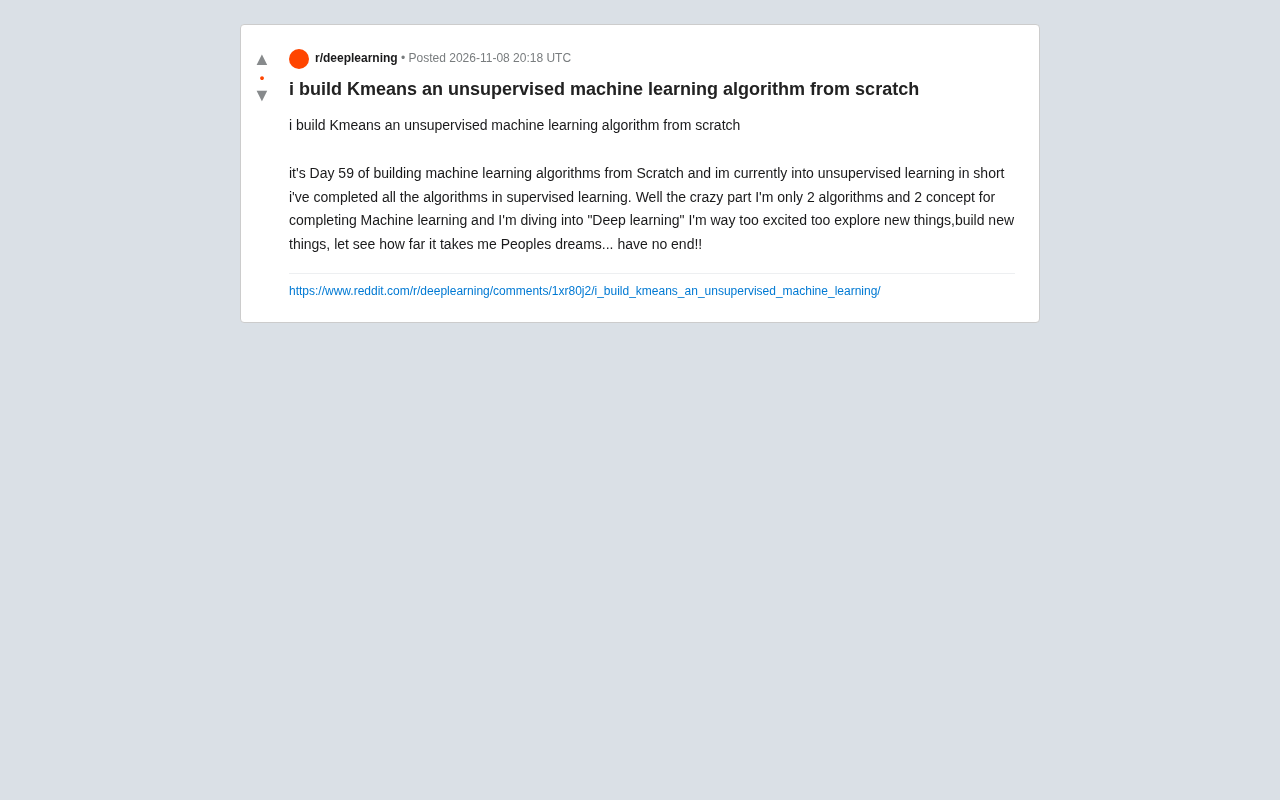
Writing K-Means from Scratch: One Developer's Journey into Machine Learning
A developer shares day 59 of writing K-Means from scratch: finishing all supervised learning algorithms and entering unsupervised learning, covering K-Means++ initialization, vectorized distances, convergence and empty clusters.