D2C Design-to-Code Full Pipeline Explained: The New Design-Development Paradigm That Top Tech Companies Ask About in Interviews
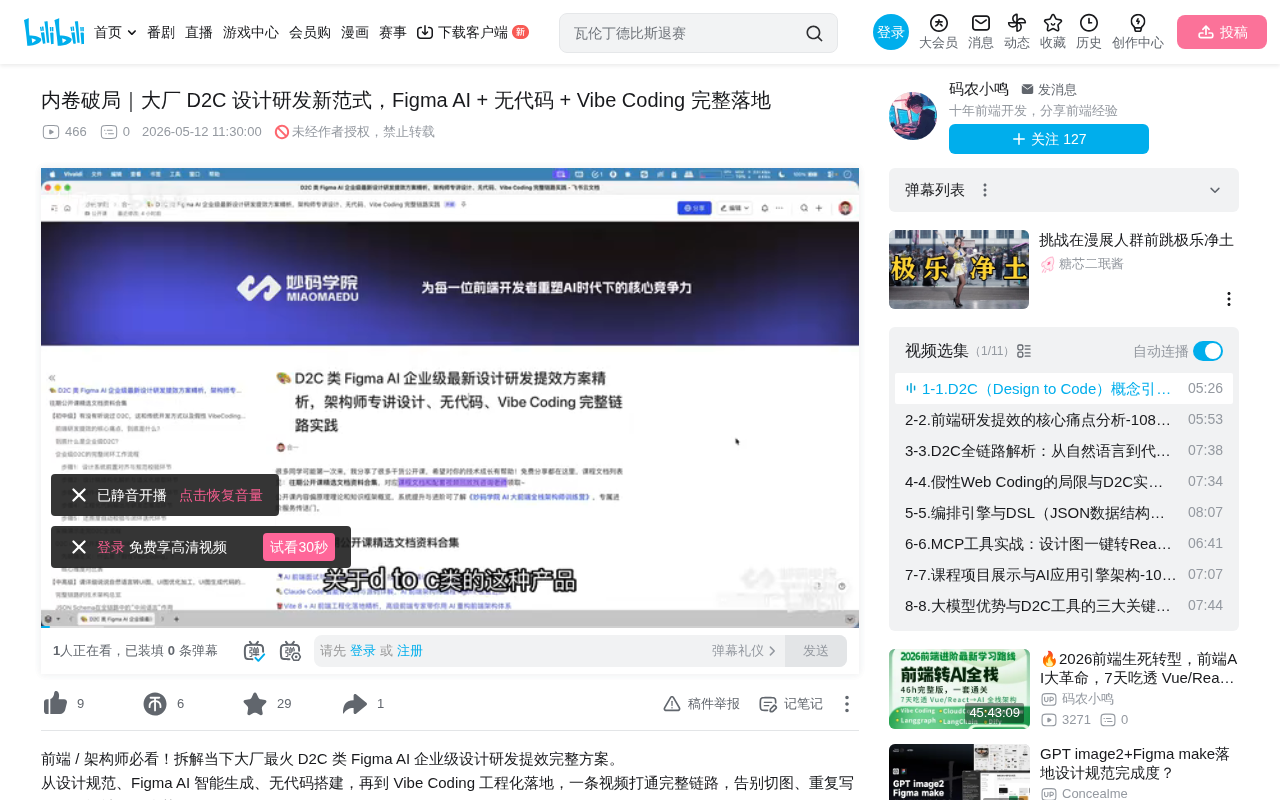
D2C (Design to Code) leverages LLMs to reshape the frontend development workflow end-to-end.
D2C (Design to Code) achieves end-to-end automation of the "natural language → UI design → frontend code" pipeline through large language models. Compared to traditional development and Vibe Coding, its structured conversion pipeline offers controllable, high-quality advantages. This article systematically covers D2C's technical principles, engineering practices, and career value across four dimensions: conceptual evolution, comparison of three development paradigms, interview question breakdowns, and enterprise-grade implementation strategies.
What Is D2C? Why It's Reshaping Frontend Development Workflows
D2C, short for Design to Code, is one of the hottest technical directions in AI-powered frontend productivity over the past two years. Its core objective is straightforward: automatically convert design mockups into runnable frontend code, fundamentally shortening the collaboration cycle between designers and developers.
Tracing D2C's evolution, it grew out of earlier no-code/low-code platforms. That generation of products aimed to lower development barriers through visual drag-and-drop, enabling non-technical users to build simple applications. The concept of No-Code/Low-Code platforms dates back to the early 2010s, represented by Mendix, OutSystems, and others. Gartner once predicted that by 2025, 70% of new applications would be developed using low-code/no-code technologies. However, the core limitation of that generation was that they were essentially "assembly of prefabricated components" — support for complex interactions, custom UIs, and deep business logic was very limited. The generated code often deviated significantly from professional engineering standards and was difficult to integrate into existing tech stacks and CI/CD pipelines.
D2C represents a qualitative leap beyond this foundation — leveraging large language models' capabilities in natural language understanding, task decomposition, and tool invocation to achieve end-to-end automation of the "natural language → UI design → complete code" pipeline. Specifically, breakthroughs in three dimensions of large language models (LLMs) are the key drivers behind D2C's leap: First, Natural Language Understanding (NLU) — models can accurately parse vague requirements like "build an e-commerce homepage with search functionality," extracting page structure, functional modules, and interaction intent. Second, Task Decomposition — models can break complex UI generation tasks into subtasks such as layout planning, component selection, and style configuration, executing them progressively. Third, Tool Use / Function Calling — models like GPT-4 and Claude support calling external APIs and tools, such as directly invoking the Figma API to create design nodes or calling code generators to output component code for specific frameworks. The synergy of these three capabilities elevates D2C from "pattern matching" to "semantics-driven" intelligent conversion.
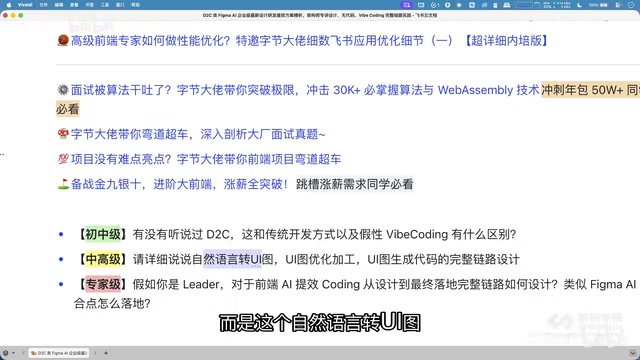
Currently, leading tech companies like Alibaba and ByteDance are heavily investing in D2C product development. Alibaba launched imgcook as early as 2019, using computer vision and deep learning to identify UI elements in design mockups and automatically generate frontend code for frameworks like React/Vue. During Taobao's Double 11 shopping festival, it achieved over 79% automatic code generation rate for modules. ByteDance, building on their widely-used internal Semi Design system, has constructed an automated mapping pipeline from design specifications to code components, combined with their proprietary large model capabilities to explore deeper design intent understanding. These industrial-grade practices demonstrate that D2C has moved beyond the proof-of-concept stage into deep-water territory of large-scale application, making it an extremely high-frequency topic in frontend engineering interviews — interviewers expect candidates to not only understand the concepts but also grasp the real-world implementation challenges and engineering trade-offs.
D2C, Traditional Development, and Vibe Coding: An In-Depth Comparison of Three Paradigms
Efficiency Bottlenecks in Traditional Frontend Development
In the traditional workflow, after designers deliver mockups, frontend engineers must pixel-by-pixel recreate visual elements as code. This process is both time-consuming and prone to fidelity issues. Even more problematic, every design revision means rework on the development side, and the back-and-forth communication costs are extremely high.
Why Vibe Coding Still Falls Short
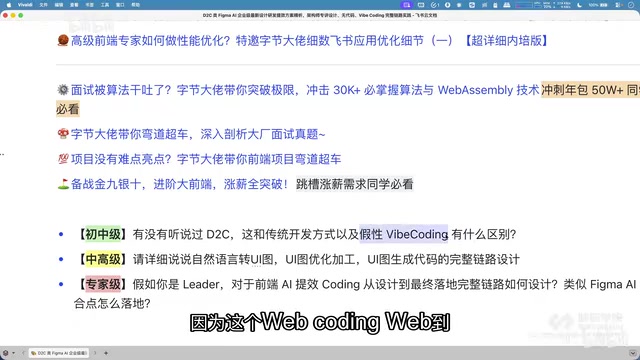
Many teams are already experimenting with Vibe Coding to accelerate development — essentially feeding design mockups to AI coding tools and letting them generate code directly. But in practice, a critical flaw emerges: AI's visual understanding of design mockups suffers from extensive hallucinations.
AI Hallucination is one of the core challenges in the large model domain, referring to models generating content that appears reasonable but is actually incorrect or non-existent. In Vibe Coding scenarios, visual hallucinations are particularly prominent: models might misidentify a decorative icon as an interactive button, incorrectly nest two visually adjacent but logically independent blocks within the same container, or randomly generate 12px or 16px spacing where designers carefully specified 8px. The deeper issue is that current multimodal models' understanding of UI design mockups remains at the pixel-level visual recognition layer, lacking deep comprehension of Design System semantics — they cannot distinguish whether a card component is meant to display products or user reviews, resulting in generated code with serious deficiencies in semantic HTML tags, accessibility attributes (ARIA), and component reusability. The common industry complaint is "AI writes a pile of spaghetti code."
D2C's Structural Advantage
The real competitive edge of D2C products lies in building a structured conversion pipeline with explicit intermediate states:
- Natural Language → UI Design: LLMs understand user product requirements and automatically generate initial interface designs
- UI Design Refinement: Fine-tuning in professional design tools like Figma to ensure design quality
- UI Design → Usable Code: Converting design mockups into high-quality frontend code through structured parsing
Each stage has clear input and output standards, and results at every step can be inspected and corrected. This avoids the uncontrollable risks of Vibe Coding's "end-to-end black-box generation" approach.
Frontend Interview Essential: Three-Level D2C Problem Breakdown and Answer Strategies
If you're preparing for frontend or AI product interviews at mid-to-large tech companies, D2C is almost guaranteed to come up. Below are three typical questions organized by increasing difficulty with recommended approaches.
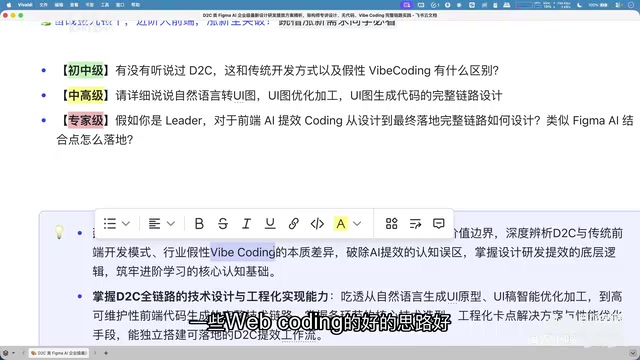
Junior-Mid Level: Conceptual Understanding
Interview Question: Are you familiar with D2C? How does it differ from traditional development?
Key points: First explain D2C's definition and its role in frontend productivity, then compare the respective issues with traditional development and Vibe Coding, and finally articulate D2C's differentiated value.
A practical interview tip: When the interviewer asks about Vibe Coding, first explain the basic concept clearly, then proactively point out its limitations, naturally leading into D2C as a more mature solution. This "contrast + elevated thinking" answer structure effectively demonstrates your technical judgment.
Mid-Senior Level: Solution Design
Interview Question: Describe the complete pipeline design from natural language to UI mockup to automatic code generation.
This question tests your systematic understanding of the full D2C pipeline. The key is to thoroughly explain the technical approach for each of the three stages:
- Natural Language → UI Design: How to use LLMs for requirement understanding and UI layout planning, how to handle ambiguous requirements
- UI Design Refinement: How to apply structured annotations and componentization in Figma, ensuring machine-readability of design mockups
- UI Design → Code Generation: How to parse the layer structure and style information of design mockups, establishing mapping relationships with frontend components
Expert Level: Zero-to-One Implementation
Interview Question: If you were responsible for building a D2C product from scratch, how would you design the entire pipeline?
This level requires product architecture vision — the ability to benchmark against industry leaders like Figma AI and deliver a complete, executable implementation plan covering technology selection, system architecture, team division, and delivery cadence.
Figma AI + No-Code + Vibe Coding: Enterprise-Grade D2C Implementation
Four Core Modules of the Technical Architecture
A production-grade D2C product's technical architecture typically consists of the following modules:
- Design Parsing Layer: Interfaces with design tool APIs (like Figma) to extract structured data including layer hierarchy, style properties, and component relationships
- AI Semantic Understanding Layer: Uses large models for deep understanding of design intent, identifying layout patterns, interaction logic, and business semantics
- Code Generation Layer: Outputs frontend code that conforms to team coding standards based on parsing results and semantic understanding
- No-Code Builder Layer: Provides a visual editing interface supporting secondary adjustments and fine-tuning of generated results
Implementation Strategy with Figma AI as the Core Entry Point
As the UI design tool with the highest global market share, Figma's open REST API and plugin ecosystem serve as critical infrastructure for D2C technology implementation. Figma's file structure is essentially a Node Tree, where every design element — whether text, rectangles, images, or component instances — is a node carrying precise position coordinates, dimensions, style properties, and constraint relationships. Figma AI's capabilities in design intelligence are already quite mature, making it a natural choice as D2C's core entry point with inherent ecosystem advantages:
- Design Phase: Leverage Figma AI's Auto Layout, intelligent component recommendations, and other features to ensure design mockups have good structural characteristics from the source. Auto Layout is a core feature Figma introduced in 2019 that lets designers organize layouts using logic similar to CSS Flexbox, meaning layout information in designs can map to frontend Flex layout code with almost no loss
- Parsing Phase: Obtain the complete node tree of design mockups through the Figma Plugin API, including critical data like Auto Layout information, Design Tokens, and constraint relationships. Design Tokens are the "variable" concept in design systems, abstracting visual properties like colors, font sizes, and spacing into reusable named tokens (e.g., color-primary, spacing-md), making style mapping between designs and code more precise and maintainable
- Generation Phase: Convert structured design information into componentized frontend code, leveraging the no-code platform's template system to improve generation quality and consistency
- Optimization Phase: Introduce Vibe Coding as a "last mile" supplementary approach for handling complex interaction logic and custom business requirements
Four Key Principles for Implementation
When actually pushing a D2C product forward, several principles directly determine the final outcome:
- Structure First: The standardization level of design mockups determines the upper bound of code generation quality — this is the foundation of the entire pipeline
- Component Mapping: Establish clear one-to-one correspondence between design components and code components, reducing information loss during conversion
- Progressive Generation: Output page skeletons and layout code first, then gradually fill in style details and interaction logic, rather than attempting everything in one shot. This strategy borrows from the "multi-pass" approach in compiler design, dividing the code generation process into multiple stages executed sequentially — the first pass generates the page skeleton determining overall HTML structure and Flex/Grid layout declarations, the second pass fills in style details mapping Design Tokens to specific CSS variables or Tailwind CSS class names, and the third pass injects interaction logic including state management and event bindings. Each layer's output can be independently verified and corrected, preventing errors from propagating downstream and causing complete rework, while also reducing the complexity of each individual generation task so the LLM maintains higher output accuracy at every stage
- Human-AI Division of Labor: Let AI handle 80% of repetitive reproduction work, leaving the 20% requiring creative judgment and complex logic to engineers
Summary: What D2C Means for Frontend Engineers' Careers
D2C doesn't represent AI replacing developers. Instead, through the structured pipeline of "design → understand → generate → optimize," it liberates both designers and engineers from massive amounts of repetitive reproduction work, allowing both sides to invest their energy in more valuable creative work.
For frontend engineers, deeply understanding D2C's design philosophy and technical implementation path is both a differentiator in current interviews and a key capability for maintaining competitiveness in the AI era. Whether you're preparing for interviews or looking to drive AI-powered productivity improvements within your team, mastering D2C's full-pipeline design thinking will open new career opportunities for you.
Related articles
Deep Dive into AI Agent Skill Design: …
Deep Dive into AI Agent Skill Design: Engineering Practices from Anthropic and Perplexity
A deep dive into Skill design philosophy from Anthropic's Claude Code team and Perplexity's Agent team, covering the Tax Test, Gotchas Flywheel, progressive disclosure, and Eval-First practices for building high-quality AI Agent skill systems.
Deep Dive into OpenAI's Official GPT-5…
Deep Dive into OpenAI's Official GPT-5.6 Prompting Guide: The Shift from Manual to Automatic
A deep dive into OpenAI's official GPT-5.6 Sol prompting guide: conciseness-first, outcome-oriented design, autonomy boundaries, tool routing, and reasoning intensity tuning.
 Deep Dives
Deep Dive into How OpenClaw (Open-Source Crayfish) AI Agent Works
Deep analysis of OpenClaw AI Agent internals: System Prompt, tool calling, SubAgents, Skill system, memory, and Context Engineering explained.