Dana White's Entrepreneurial Philosophy: Why You Can't Build a Real Business Working From Home

Dana White breaks down the extreme operating system behind scaling UFC from $2M to a top-tier sports empire.
In a wide-ranging interview, UFC President Dana White draws on his experience scaling the UFC from a $2 million acquisition to a top-tier sports league to share a strikingly clear entrepreneurial framework. He argues remote work can't replicate the creative collisions of in-person teams; that entrepreneurship means solving an endless stream of problems daily; that core teams must be bound by loyalty and shared vision, not just compensation. He rejects victim mentality, insists manifestation requires action, and uses a signal-vs-noise filter to stay focused. On risk, he reverse-engineers decisions from the worst-case scenario — arguing the real failure is the regret of never having tried.
UFC President Dana White shared a wealth of candid — and at times provocative — insights about entrepreneurship, team building, risk, and mindset in a lengthy interview. He took a fighting organization purchased for $2 million and scaled it to what he describes as a "$50 billion" enterprise. The logic behind those results is worth more to any founder than the numbers themselves.
The Controversial Claim: "You Can't Build a Successful Business From Home"
Dana White's most controversial line: "This generation of young people thinks they can build a successful business from home. They can't. It's not possible." He himself still walks into the office every morning at 8:30 and regularly works until 7, 8, or even 10 at night.
His reasoning isn't a simple endorsement of hustle culture — it's about the creation of what he calls "accidental value." "When you get great people in a room together and they start talking, things come out that you never could have predicted. A lot of great ideas come from everyone being in the same place." In his view, remote collaboration can't replicate the creative spillover that comes from high-density, in-person collision.
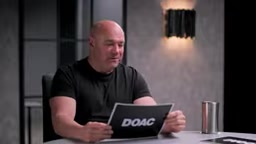
He also pulls no punches when puncturing the romanticized image of entrepreneurship that many young people carry. A lot of people say they want to start their own business because they want to "set their own schedule and have weekends off." Dana's response is blunt: if you're starting a business because you want more free time, you've chosen the wrong path. The reality is that "when you own your own business, there are no days off — no birthdays, no Christmas, no Thanksgiving. Every single day, there's something bad that needs your attention."
The Essence of Entrepreneurship: Solving Problems Every Day
Dana defines the core skill of an entrepreneur simply: find solutions to problems every single day. He paints a vivid picture of a typical morning — two razors break, a sensor warns him of a flat rear tire on the way to the office, and his response is to "not pull over, just keep driving." Then he arrives at work to find a long list of problems waiting for him.
"That's life. You get up, and life is standing right there ready to punch you in the face." He believes that truly hardcore work isn't his own sleep-deprived busyness — it's the construction worker laying asphalt in 115-degree Las Vegas heat. He even required his college-aged son to work at U-Haul and spend time at a paving company, specifically to help the next generation understand "what real hard work actually feels like" and to combat what he despises most: the entitlement mindset.
"Nobody owes you anything" is a belief he returns to repeatedly. He recalls a childhood friend who complained that his father had "stolen" a million dollars saved for him — and the young Dana's inner reaction was: that money was never yours to begin with. You never earned it.
A note on "entitlement": In English-language business and education circles, "entitlement" is a frequent term of criticism. It refers to the psychological assumption that one naturally deserves rewards, opportunities, or advantages without the corresponding effort. In an entrepreneurial context, it typically points to the attitude of expecting success while being unwilling to do the foundational, unglamorous work. Dana's critique carries specific cultural weight: in the U.S., Baby Boomer parents commonly accumulated wealth for their children, and social media has amplified the success stories of a small number of young founders — leading some young people to develop unrealistic expectations about early-stage resource scarcity and the intensity of work required. Sending his son to work at U-Haul and experience physical labor is, at its core, an attempt to use embodied experience to reset that psychological baseline — to ensure the next generation feels the weight and value of labor before receiving any "head start."
Team and "Family": Loyalty Over Numbers
Dana considers his greatest "superpower" to be choosing the right people around him. When the company started, he was doing everything himself with only two employees. He gradually built a team by looking for people who possessed three qualities simultaneously: talent, relentless work ethic, and alignment with the vision.
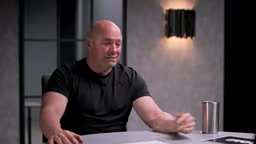
On the idea that "the company is family" — a phrase many CEOs have criticized as hollow — Dana offers his own version. During the pandemic, he gathered all his employees and promised he wouldn't lay off a single person: "During the most terrifying moment in human history, lay people off? No. The CEO's job is to figure out how to keep the company running and take care of everyone." He believes that the people who missed their child's first steps and skipped games for the company are precisely the loyal ones who deserve to be treated like family.
"If you don't have loyalty, what do you have?" He compares UFC to a warship: "My team and I either sink together or we don't sink at all." This framing of business as war and the core team as fellow soldiers forms the foundation of his team philosophy. He also acknowledges, however, that not every role requires a "killer" — nine-to-five employees are just as necessary for a company to function. The key is that the inner circle of close collaborators must be "serious players."
Mindset: Reject Victim Mentality, Don't Look in the Rearview Mirror
Dana's stance on the idea that your upbringing determines your destiny is crystal clear. His father was an absent alcoholic, and his mother raised him and his sister alone. He doesn't hide this history, but he flatly refuses to play the victim. "People who say they had no role models growing up — no, you did. You just didn't look at them the right way. Every person in your life is a role model, some good and some bad."
He calls the past the "rearview mirror" and is explicit: "F*** the rearview mirror." "What happened a few hours ago means nothing now. What's next? What's next?" This almost obsessive forward orientation leads him to claim he has zero regrets.

On manifestation, Dana is a firm believer — but he insists on the complete picture: "When you decide who you are, what you want to do, and what you want to achieve, and then you wake up every day and work toward it, you cannot fail." He uses a precise analogy to cut through a common misconception: making a vision board without taking action is like sitting in a car with the navigation set but never pressing the gas. "You're not going anywhere."
A note on manifestation: The concept Dana repeatedly references has become widely popular in entrepreneurship and self-improvement circles, rooted in books like The Secret and the Law of Attraction. Its core premise — that focusing on the outcome you desire will draw it toward you — has long been criticized for encouraging passive wishful thinking over action. Dana's framing directly corrects this misreading: he breaks manifestation into two inseparable components — a clear intention (knowing who you are and where you're going) combined with daily, sustained action. Only when both are present does the cycle complete. His "navigation without stepping on the gas" analogy dismisses pure vision-boarding outright. This "demystified" take on manifestation is, in practical terms, closer to a combination of goal-setting and execution discipline than to anything mystical.
Risk, Focus, and "Signal vs. Noise"
The interview keeps returning to one theme: don't be afraid to take risks. At 19, Dana walked away from a hotel job with a 401k, full health insurance, and a stable paycheck — at a time when everyone told him entering the fight business was stupid. His logic came down to calculating the "worst case" — the worst that could happen was he'd go back to working for someone else. "That's not a bad worst case. The truly bad worst case is that you never tried, and you're lying there at 45 thinking, 'What would have happened if I had?'"
In an era of information overload, Dana places enormous value on focus. He invokes Kevin O'Leary's "signal vs. noise" framework, blocking out most mainstream media covering the sport — "they get everything wrong, it's a pure waste of time" — while paying close attention to the hardcore fan base, because he considers himself the ultimate end user. He says he focuses on just three things every day, but refuses to say what they are, calling it "part of the formula."
From UFC to Zuffa Boxing, Power Slap, and a massive broadcast deal with Paramount, Dana has redefined his competition as the NFL, MLB, and NBA — the top-tier North American sports leagues. Faced with skepticism that "boxing won't work," his response is characteristically consistent: "Nothing is impossible. At UFC headquarters, the one word you're not allowed to say is 'no.'"
The real value of this interview isn't in the valuations — which are hard to verify anyway. It's in how a serial entrepreneur has built his own operating system: reject victim mentality, bind your team with loyalty, use worst-case thinking to reverse-engineer risk, and use focus to filter out noise. This approach isn't for everyone — Dana himself admits, "My life is not for everyone" — but it offers a reference point that is extreme enough to be genuinely clarifying.
A note on "Signal vs. Noise": This framework was popularized by Canadian businessman and investor Kevin O'Leary, widely known from the U.S. version of Shark Tank. Its core insight is that in an information-saturated environment, the vast majority of content competing for your attention is "noise" — repetitive, distorted, or irrelevant to actual decision-making. The "signals" that genuinely affect your judgment are rare. In practice, the framework requires decision-makers to actively build filtering mechanisms rather than passively absorbing everything — accepting the tradeoff of potentially missing some fringe information in exchange for dramatically improved focus. Dana White's application at UFC is a telling example: he blocks mainstream combat sports media while placing high value on direct feedback from hardcore fans, because he has concluded the former is systematically wrong while the latter is a reliable signal source. This kind of deliberate "information subtraction" is especially worth considering in entrepreneurial contexts — when outside advice, market noise, and competitive signals all flood in simultaneously, the ability to distinguish which feedback truly deserves a response often determines the ceiling of your execution.
Related articles

A Single Prompt Triggers a Global PHP Security Storm: Is AI a Savior or a Hidden Risk?
A single AI prompt triggered a global PHP security crisis affecting Wikipedia and the Internet Archive. This article reviews the incident, analyzes the OpenAI-Amazon controversy, and explores the security paradox of lowered vulnerability discovery barriers in the AI era and developer response strategies.

When AI Is Taken Away: How Reliance on Shortcuts Undermines Your Problem-Solving Resilience
A study of 1,222 people found that after using AI to answer questions, once AI was removed, people gave up on more problems than a control group that never used AI. The article analyzes the impact of AI reliance on learning resilience and metacognition, and explores design implications for AI learning tools.

Carta and NewView Partner to Let Startup Employees Cash Out Equity Early
Carta and NewView Capital partner to simplify startup tender offers, helping employees sell equity early. Analysis of the mechanism, liquidity pain points, and impact.