Databricks Genie: The AI Analytics Assistant That Tripled a Marketing Team's Data Usage

Databricks Genie uses natural language queries to break down data barriers, tripling marketing team data usage.
Databricks' conversational AI analytics assistant Genie lets non-technical users query data in plain language — no SQL or analyst wait times required. According to Databricks, marketing teams using Genie saw a roughly 3x increase in data usage frequency. This growth reflects not just more queries, but a release of long-suppressed demand that high access barriers had previously stifled. The article distills the core logic of successful enterprise AI adoption: target real pain points, empower rather than replace, and measure impact through behavioral metrics. It also cautions that NL2SQL tools depend on strong underlying data quality and governance.
The Data Problem Facing Marketing Teams
Almost every marketing team aspires to be "data-driven," but reality often falls short of that ambition. Getting a trustworthy answer typically means waiting in line for a data analyst, writing complex SQL queries, or toggling between multiple dashboards. This friction turns data from a "basis for decisions" into an "afterthought" — marketers make their calls first, then think about validating them with data.
Databricks is trying to break this deadlock with an AI analytics assistant called Genie. According to the company, after introducing Genie internally, their marketing team's data usage frequency increased by roughly 3x. Behind that number lies a significant reduction in the barrier to accessing data.
What Is Genie
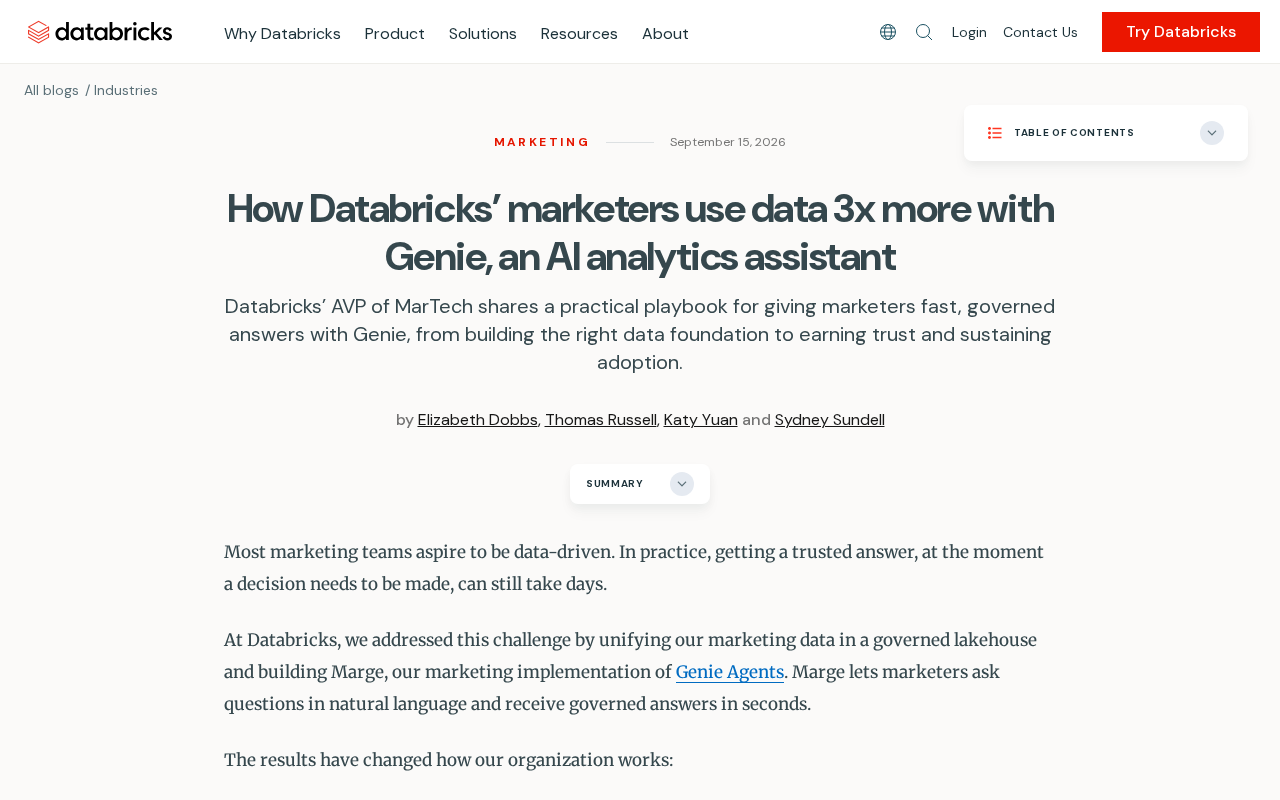
Genie is a conversational AI analytics assistant built by Databricks. Its core capability is enabling non-technical users to ask questions of their data in natural language — no SQL skills required, no data team dependency. A marketer can simply ask, as if in a chat, "Which channel had the highest conversion rate last quarter?" and Genie will interpret the intent, generate the query, and return the results.
This type of tool belongs to the rapidly growing category of "Natural Language to SQL" (NL2SQL) applications. Its value isn't in replacing data analysts, but in offloading the high volume of repetitive, exploratory data queries from specialists — empowering business teams to get the information they need on their own.
The Key to Lowering the Barrier
For marketing teams, the biggest obstacle has never been a lack of data — it's the high cost of accessing it. When answering a simple question requires cross-departmental coordination and days of waiting, most people default to acting on intuition. Genie's significance lies in compressing that waiting period to seconds, fundamentally changing how teams interact with data.
NL2SQL (Natural Language to SQL) is a class of technology that automatically converts a user's natural language input into structured database queries. The core challenge is understanding business semantics — the same business question may map to entirely different table structures and field names across different companies. Early NL2SQL products had limited accuracy and frequently produced incorrect queries when dealing with multi-table joins, time windows, or complex aggregations. The dramatic improvement in large language model (LLM) capabilities in recent years has significantly addressed this problem, making it possible for such tools to move from "lab demos" to real-world business scenarios. Databricks Genie's approach is to allow enterprises to define a business semantic layer on top of their own data warehouse — including metric definitions and common filter conditions — which guides the model to generate queries that better reflect actual business intent, improving both accuracy and trustworthiness.
What Does a 3x Increase in Data Usage Actually Mean
The "3x increase in data usage" metric is worth unpacking. It's not simply about more queries being run — more importantly, it reveals a suppressed demand. When access becomes easy enough, people's actual appetite for data far exceeds what was previously visible.
The reason marketing teams "didn't use data much" before had a lot to do with the high barrier causing them to proactively give up on many checks and explorations they could have done. What Genie unlocked was precisely this latent demand that had been held back by friction. This also signals something important for enterprises: when assessing data culture maturity, the usability of tools may matter more than the richness of the data itself.
Lessons for Enterprise AI Adoption
The Genie case offers a textbook example of how AI can take hold within an enterprise: the most valuable AI tools are often not the most technically impressive ones, but those that precisely eliminate a specific friction point in a concrete workflow.
For teams evaluating AI analytics tools, this case offers a few takeaways:
- Focus on real pain points: Genie solves the specific problem of "slow data access" — it's not about vaguely "introducing AI."
- Empower, don't replace: The tool is positioned to help business users self-serve, while freeing analysts from trivial queries to do higher-value work.
- Measure impact with behavioral metrics: Behavioral data like 3x usage is a far more reliable indicator of a tool's real value than subjective satisfaction scores.
Limitations to Keep in Mind
Natural language query tools are not a silver bullet. The accuracy of query results depends heavily on the quality and governance of the underlying data — vague or ambiguous questions can yield misleading answers. Organizations rolling out these tools still need to establish appropriate data governance and result validation mechanisms to avoid the trap of "convenient-seeming" tools driving poor decisions.
Data Governance refers to the systematic practice of managing the definition, quality, access permissions, and usage standards of an organization's data assets. For NL2SQL tools, data governance is especially critical: if the underlying data has inconsistent definitions (the same metric defined differently across tables), ambiguous field meanings, or missing historical records, even a syntactically correct query can return misleading results. Before deploying such tools, organizations typically need to establish a unified Metrics Catalog and data dictionary that clearly identifies the authoritative source for each core business concept. This is the foundational prerequisite for ensuring that "self-service analytics" conclusions are actually reliable.
Conclusion
The experience with Databricks Genie demonstrates that AI's most immediate value inside an enterprise may be hiding in plain sight — in the everyday friction points that have long been overlooked. When accessing data becomes as easy as sending a message, teams will naturally make decisions based on data more frequently and proactively. That, perhaps, is how "data-driven" actually becomes a reality.
Related articles
DeepSeek Harness in Practice: Building a Low-Cost AI Coding Powerhouse
Learn how to transform DeepSeek's open-source harness using Claude Code, Bright Data scraping, and vision models to build an AI coding workflow costing just half a cent per task.
Overseas Developer Tests: DeepSeek Already Rivals Opus — Stop Waiting for the Next Model
An overseas developer finds DeepSeek V4 Pro rivals Opus 4.8 at a fraction of the cost. Learn how DeepSeek + BrightData compares to Claude Code for building SaaS.
DeepSeek V4.1 Flash Hands-On: Can a Small-Activation New Architecture Top the Open-Source Charts?
DeepSeek V4.1 Flash deep dive: new MoE encoder-decoder architecture, 552B total params, tiny active params, reduced KV cache. Open-source on Hugging Face. Full hands-on test from BrowserOS to 3D printing.