datasette-agent-sprites: A Deep Dive into the AI Agent Sandbox Execution Plugin

datasette-agent-sprites plugin enables secure AI Agent command execution in a sandbox environment
Simon Willison has released the datasette-agent-sprites 0.1a0 plugin, enabling Datasette Agent to securely execute commands within the Fly Sprites sandbox environment. The sandbox is built on Firecracker microVM technology, offering strong isolation, ephemeral execution, and low latency to prevent AI Agents from endangering production systems with malicious code. While still in early experimental stages, the project represents a significant open-source exploration in secure AI Agent execution.
Overview
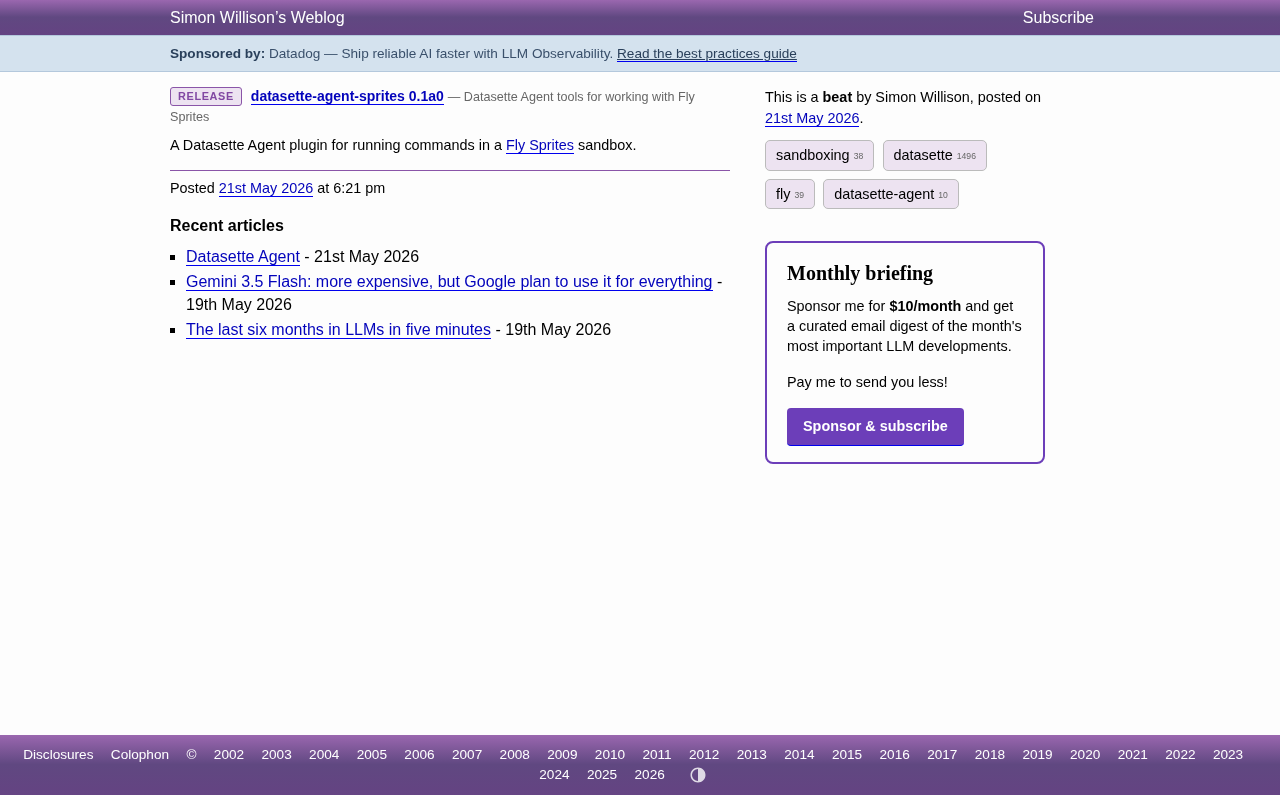
Simon Willison has released datasette-agent-sprites 0.1a0, a plugin designed specifically for Datasette Agent that enables safe command execution within the Fly Sprites sandbox environment. This early release marks a critical step forward for the Datasette ecosystem in the area of secure AI Agent execution.
What Is Datasette Agent?
Datasette is an open-source data exploration and publishing tool created by Simon Willison. Born in 2017, it was originally designed to quickly transform SQLite databases, CSV files, and JSON files into browsable web interfaces with auto-generated REST APIs. Over the years, Datasette has accumulated more than 150 community plugins covering data visualization, authentication, export functionality, and more. Simon Willison is also the co-creator of the Django framework and holds significant influence in the open-source community.
With the rapid rise of the AI Agent concept, Datasette has introduced the datasette-agent series of tools. One of the core capabilities of AI Agents is "Tool Use" (also known as Function Calling) — where large language models can proactively invoke external tools based on task requirements, including executing code, querying databases, and calling APIs. This capability was formally standardized by OpenAI in 2023 through the Function Calling interface, with Anthropic, Google, and other major model providers following suit shortly after. The datasette-agent series builds on this mechanism, allowing LLMs to directly query and analyze databases managed by Datasette, enabling "natural language-driven data exploration."
However, letting AI Agents execute commands directly introduces significant security risks: Agents could potentially run malicious code, modify system files, or access sensitive data. This is precisely where sandbox technology becomes essential.
Fly Sprites Sandbox: A Technical Breakdown
Fly Sprites is a lightweight sandbox service provided by Fly.io, designed specifically for the secure execution of untrusted code.
About the Fly.io Platform: Fly.io is a cloud infrastructure company founded in 2017, built around the core philosophy of "deploying applications to edge nodes closest to users." It supports rapidly converting Docker containers into lightweight virtual machines and distributing them across more than 30 data centers worldwide. In recent years, Fly.io has actively expanded into emerging areas like AI inference and secure execution, with the Sprites service being a concrete product of this strategic direction.
Underlying Sandbox Technology: Sprites uses a micro-VM approach based on Firecracker. Firecracker was originally developed by AWS for its Lambda and Fargate services and can boot a complete Linux kernel environment in milliseconds, combining the speed of containers with the strong isolation of traditional virtual machines — offering more thorough security isolation compared to container solutions built on Linux namespaces/cgroups.
Fly Sprites offers the following core advantages:
- Strong Isolation: Each command runs in an independent micro-VM, completely isolated from the host system
- Ephemeral: The environment is destroyed immediately after execution, leaving no trace
- Low Latency: Leveraging Fly.io's global edge network, VMs boot extremely quickly
datasette-agent-sprites brings this sandbox capability into the Datasette Agent ecosystem, allowing Agents to execute arbitrary commands in a controlled environment without posing any threat to production systems.
Technical Significance and Use Cases
Secure Code Execution Environment
In scenarios where AI Agents interact with data, they frequently need to run data processing scripts, install dependencies, or execute analysis tasks. Through the Fly Sprites sandbox, these operations are strictly confined within safe boundaries — even if the Agent generates problematic code, it won't affect the main system.
This design also reflects the "Principle of Least Privilege" from security engineering: an Agent should only be granted the minimum permissions necessary to complete its current task, and any operations beyond that scope should be blocked or require human confirmation. Implementing this principle in AI Agent architectures is a core topic of shared interest in both academia and industry.
Capability Extension Through Plugin Architecture
This plugin embodies a pragmatic design philosophy: progressively granting AI Agents more capabilities through a plugin architecture while maintaining security as a baseline. Developers can confidently let Agents execute more complex tasks without worrying about security boundaries being breached.
Still in Early Exploration
The version number 0.1a0 (alpha) indicates the project is still in an early experimental stage. True to his approach of rapid iteration and open development, Simon Willison invites the community to expect more complete features and a smoother developer experience in future releases.
Industry Trends in AI Agent Secure Execution
This project reflects an important direction in current AI tool development: sandboxed secure execution. As more AI Agents need to interact with real systems — executing code, manipulating files, calling APIs — how to empower Agents while maintaining security boundaries has become a core engineering challenge.
Several similar approaches already exist in the industry:
- OpenAI Code Interpreter (now called Advanced Data Analysis): Achieves secure execution through a fully isolated Python sandbox, with each session using an independent container that cannot access the internet;
- Anthropic Computer Use: Controls a virtual desktop environment through screenshots and operation instructions, providing controlled computer operation capabilities;
- datasette-agent-sprites: Offers the open-source community a self-hostable, customizable alternative — particularly important for teams that prioritize data sovereignty and deployment flexibility.
What all three share in common: they strictly isolate the "execution environment" from the "production environment" and prevent state pollution through ephemeral destruction mechanisms. The unique value of datasette-agent-sprites lies in its open-source, self-hostable nature, enabling teams to control the entire execution chain on their own infrastructure.
Conclusion
Although datasette-agent-sprites is still in its early stages, it represents an important exploration by the Datasette ecosystem toward secure AI Agent execution. For developers interested in the deep integration of data tools and AI, this is an open-source project worth following closely.
Key Takeaways
- datasette-agent-sprites is a plugin that enables Datasette Agent to securely execute commands within the Fly Sprites sandbox
- Fly Sprites is based on Firecracker microVM technology, providing an isolated, ephemeral, low-latency sandbox environment that prevents Agents from executing malicious code
- The version number 0.1a0 indicates the project is in an early experimental stage with continued iteration planned
- The project demonstrates the engineering practice of the "Principle of Least Privilege" in AI Agent architectures
- Compared to commercial solutions like OpenAI Code Interpreter and Anthropic Computer Use, it provides a self-hostable open-source alternative
Related articles
 Tech Frontiers
A Rare Quiet Day in AI: Recursive Self-Improvement Stirs Beneath the Surface
A rare quiet day in AI sees multiple sources go silent simultaneously. Behind the calm, Recursive Self-Improvement (RSI) research continues. What this means for the industry.
 Tech Frontiers
Reve 2 vs. Ideogram 4: A Deep Dive into Layout Control in AI Image Generation
A deep comparison of Reve 2 and Ideogram 4's layout control capabilities, covering technical approaches, real-world use cases, and industry trends for designers and creators.
 Tech Frontiers
In the Weights: Check Your Influence Score in the AI World
In the Weights is an AI influence search engine that quantifies your presence in the AI world with a score. Explore how it evaluates practitioners and what it means for digital identity.