DDR4's Unexpected Comeback Amid the Memory Price Surge: The Ripple Effects of a Supply Chain Crisis

AI data centers are consuming wafer capacity, causing a memory shortage that's bringing DDR4 back as a stopgap solution.
Explosive AI data center demand for HBM and server-grade memory is crowding out consumer-grade wafer capacity, creating structural supply tightness that is driving up prices across the board — from servers all the way to personal computers. Against this backdrop, DDR4 — which was supposed to be fading out — has unexpectedly become a practical buffer for manufacturers due to its mature process nodes, stable yields, and low restart costs. While this "old standard revival" is a stopgap measure, it effectively fills the market gap left by insufficient DDR5 supply, and starkly illustrates how the AI wave is structurally reshaping the semiconductor supply chain.
DDR4's Unexpected Comeback
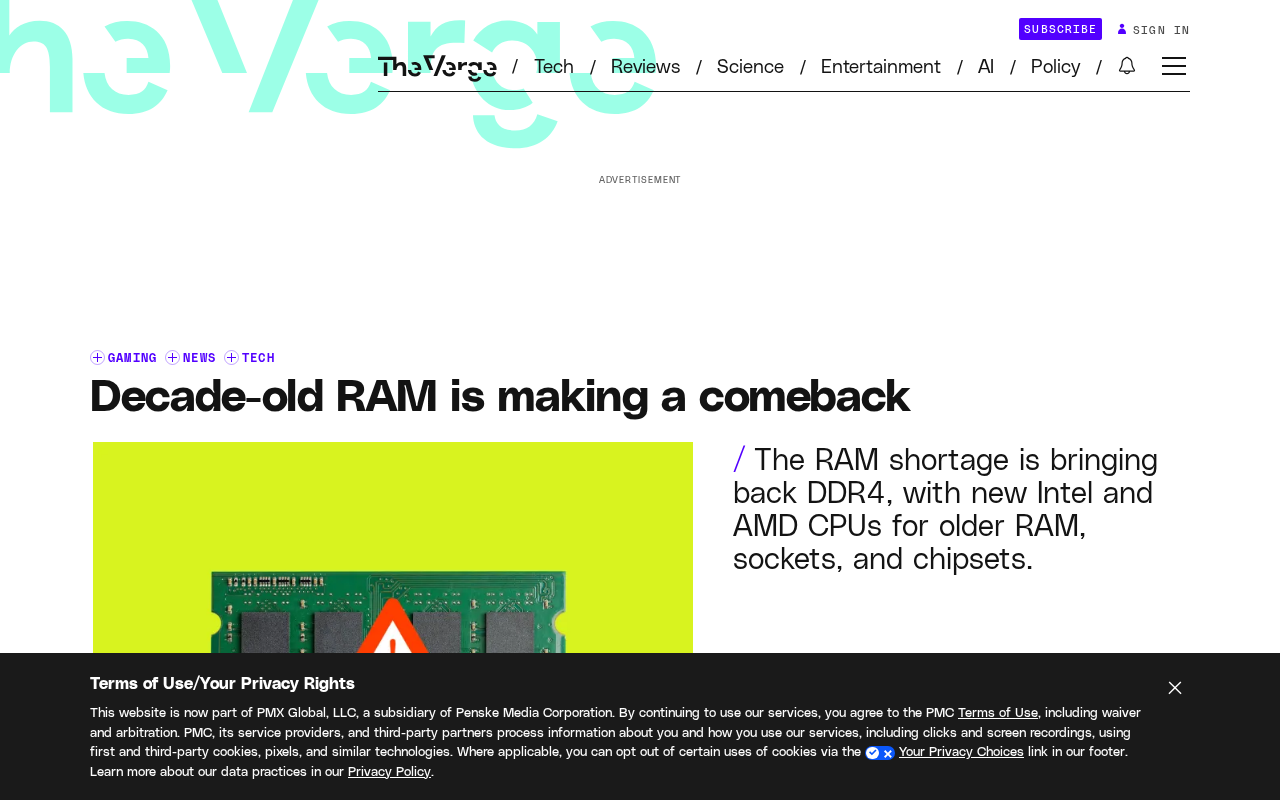
Under normal technology refresh cycles, DDR4 should have been gradually phased out in favor of the faster, more power-efficient DDR5. But the current memory shortage has thrust this older standard back into the spotlight. Manufacturers that had planned to discontinue or scale back DDR4 production are now reassessing their capacity allocation to cope with increasingly tight memory supplies.
This kind of "old standard revival" is uncommon. Typically, memory manufacturers push forward along a path of lower costs and higher performance — once a new generation matures and achieves economies of scale, the previous generation is quickly marginalized. But the current supply-demand imbalance has upended that logic. When new products are in short supply and prices spike, DDR4 — which still commands significant purchasing demand — becomes a practical pressure valve.
Where the Shortage Comes From
The memory shortage is the product of several overlapping factors. AI data centers' explosive demand for High Bandwidth Memory (HBM) and server-grade RAM is consuming enormous amounts of wafer capacity. Memory manufacturers, chasing the higher margins of the data center and AI markets, have been shifting their production lines toward these high-value products — squeezing the supply of consumer-grade memory in the process.
When the most advanced production capacity is prioritized for AI-related chips, structural tension ripples through the entire memory supply chain. Price signals then propagate downstream — from servers to personal computers to embedded devices of all kinds, as rising memory costs begin to affect nearly every product that relies on RAM.
High Bandwidth Memory (HBM) is a stacked DRAM architecture designed specifically for AI accelerators and GPUs. By vertically stacking multiple layers of memory dies interconnected via Through-Silicon Vias (TSVs), it delivers data bandwidth far exceeding that of conventional memory. The HBM3 in NVIDIA's H100, for example, offers a theoretical bandwidth of approximately 3.35 TB/s, whereas standard DDR5 server memory typically delivers under 100 GB/s. HBM production is complex and demands extremely high yields, and it shares wafer capacity with standard DRAM — meaning every additional HBM unit produced comes at the direct expense of conventional consumer or server memory output. As large language model training clusters continue to scale, HBM demand is growing at nearly double-digit rates year over year, making this the fundamental structural driver of the current memory supply chain crunch.
Why DDR4
The logic behind DDR4's comeback is actually straightforward. Compared to DDR5 — which sits at the center of the current capacity battle — DDR4 uses a more mature process node with more stable yields, making the marginal cost of restarting or maintaining DDR4 production lines relatively manageable. In an environment of overall supply tightness, DDR4 represents a cost-effective buffer zone.
For the large installed base of devices still running DDR4 platforms, this is a pragmatic choice. Not every use case demands the performance of the latest memory generation, and the DDR4 ecosystem across enterprise and consumer devices remains enormous. As long as sufficient memory capacity can be procured at a reasonable price, DDR4's "good enough" characteristics are more than adequate to sustain a portion of market demand.
The "maturity" of a memory process node directly determines the economic viability of restarting production. Mainstream DDR4 products have been in mass production at the 1y nm (approximately 14–16 nm) and 1z nm (approximately 13 nm) nodes for years — process parameters are stable, manufacturing equipment is fully depreciated, and per-wafer production costs are significantly lower than those of DDR5, which is still ramping on more advanced nodes. DDR5 volume production is currently centered on the 1α nm (approximately 12 nm) node and beyond, requiring larger equipment investments and longer qualification cycles. For manufacturers, resuming DDR4 production on fully amortized legacy lines requires virtually no additional capital expenditure (CapEx) — just a reallocation of wafer starts — allowing them to respond to market demand quickly. This makes DDR4 the product category with the highest marginal supply elasticity in the current shortage environment.
Impact on the Industry and Consumers
In the short term, rising memory prices are already a reality, and consumers will feel the cost pressure directly when buying a new PC or upgrading their systems. DDR4's return can ease some of the immediate pain, but it is more of a stopgap measure in the face of supply chain imbalance than a technological reversal or shift in direction.
Over a longer horizon, this phenomenon reflects the profound structural reshaping of the entire semiconductor supply chain driven by the AI wave. As compute demand grows exponentially, the allocation of upstream capacity is being redefined — and that pressure propagates down the industrial chain all the way to end users. For DIY enthusiasts, system integrators, and OEMs alike, maintaining flexibility in memory procurement strategy over the coming period may prove wiser than blindly chasing the latest generation.
Conclusion
DDR4's return may look like a technological step backward, but it is in fact the market self-correcting under extreme supply-demand imbalance. It reminds us that technology transitions don't always move in one direction — when supply chains come under pressure, mature and stable older solutions can become the critical pivot that keeps the market functioning. As AI's competition for semiconductor resources continues to intensify, similar supply chain disruptions are likely to keep recurring.
Related articles

Should U.S. College Fraternities Be Banned? A Researcher's Incisive Observations
Why not just ban U.S. college fraternities? A researcher finds the key resistance comes from decision-makers' own fraternity identities and schools' "willful ignorance."

Microsoft Discovery: Accelerating Scientific Discovery with AI Agents
Microsoft's Discovery platform runs specialized AI agents to help researchers screen and prioritize the most promising compounds and experimental paths, reducing experiments and accelerating scientific discovery.

Cambridge Heavy Industries Secretly Develops Desktop-Scale Nuclear Fusion Device
Cambridge Heavy Industries is secretly developing a desktop-scale laser-driven nuclear fusion device, targeting the equipment supply market for fusion power plants. This article analyzes its miniaturization technology path, commercialization logic, and unique positioning in the fusion startup wave.