Deconstructing Clinical Note Evaluation: Objectifying Complaint-Driven Metrics
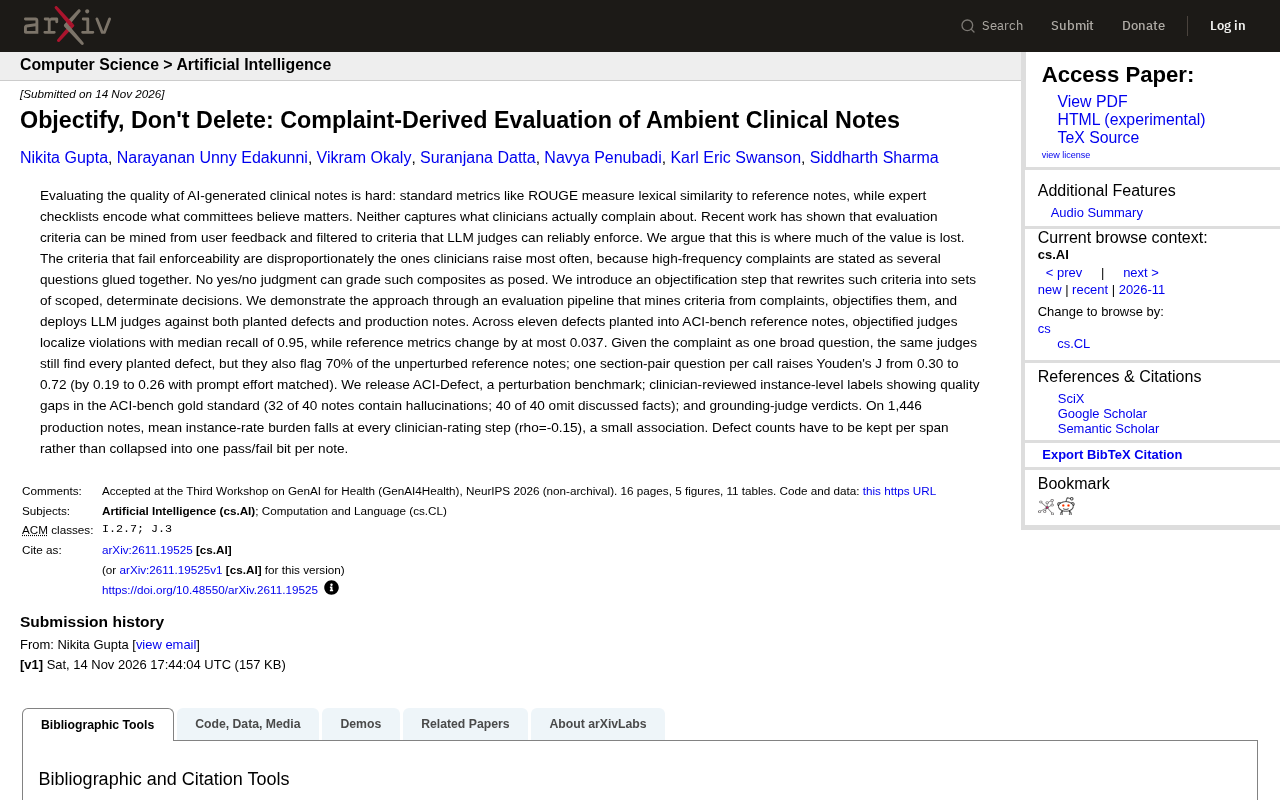
The paper proposes objectifying clinicians' compound complaints into bounded decisions, enabling LLM review to localize defects and significantly reduce false positives.
The article introduces new research on evaluating AI-generated clinical notes. Traditional lexical metrics like ROUGE only measure surface overlap, and expert checklists ossify items—neither captures clinicians' real complaints. The paper notes that when mining evaluation criteria from user feedback, actionability filtering discards high-frequency complaints that appear in compound form. The authors propose an objectification step that decomposes compound complaints into clearly scoped bounded decisions, allowing LLM review to judge item by item and localize violations. Experiments show that after implanting 11 defect types, objectified review achieves median recall of 0.95 while reference metrics change by at most 0.037; broad questions find all defects but falsely flag 70% of unperturbed notes, and objectification raises Youden's J from 0.30 to 0.72. The paper also releases the ACI-Defect benchmark, revealing hallucinations and omissions in the ACI-bench gold standard.
Evaluating the quality of AI-generated clinical notes has long faced a dilemma: lexical similarity metrics like ROUGE only measure surface overlap, while expert checklists ossify the items a committee deems important—neither captures what clinicians actually complain about. A new paper proposes that evaluation criteria can be mined from user feedback, but they must go through an "objectification" step that decomposes compound complaints into decidable questions; otherwise, LLM review either fails or produces false positives.
The Bottleneck of Complaint Mining: Actionability Filtering Drops Key Signals
Recent research can already mine evaluation criteria from user feedback and filter for the parts that LLM review can reliably execute. But the paper points out that this is exactly where value is lost: the complaints clinicians most frequently raise often fail actionability the most—because they appear as compound forms with multiple issues stuck together. A single yes/no judgment cannot score a compound question framed this way, so these high-frequency pain points get filtered out, and the evaluation system drifts away from real clinical concerns.
For example, a clinician might complain that "the note does not accurately reflect medication adjustments and their rationale," which actually involves several separable judgments: whether the adjustment is mentioned, whether the rationale matches the discussion, and whether the timeline is clear. Handing an LLM a broad question directly does not yield a stable, interpretable score.
Actionability filtering refers to the step of screening out items that LLM review cannot reliably judge after mining evaluation criteria from user feedback. Its typical criterion is whether the standard is a clearly bounded yes/no question. Compound complaints with tangled text (e.g., "medication records are inaccurate and lack rationale") contain multiple separable judgments and cannot be covered by a single binary question, so they are usually removed during filtering. The paper notes that while this mechanism is a necessary design for ensuring LLM review reliability, it systematically filters out the pain points clinicians most often raise, causing evaluation criteria to become disconnected from real clinical concerns.
Objectification: Breaking Compound Complaints into Bounded Decisions
The paper introduces an objectification step that rewrites compound criteria into a set of clearly scoped, deterministic decisions. Each decision corresponds to a specific, answerable question—such as "Does the note record a dose change for drug A?" rather than "Is the medication record complete?" This way, LLM review can judge item by item and output violation flags that can be localized to specific text spans.
Objectification is not about deleting hard-to-execute standards but about preserving their clinical intent and converting them into an operational form. The paper demonstrates an evaluation pipeline: mining criteria from complaints, objectifying them, and then deploying LLM review, tested against both implanted defects and production notes.
Bounded decision is the basic unit produced by objectification: a question with a clear scope that an LLM can deterministically judge based on a text span, e.g., "Does the note record that drug A's dose changed from X to Y?" Unlike open-ended "completeness/accuracy" evaluations, a bounded decision requires the entities, attributes, and judgment conditions in the question to be explicitly constrained, making scores reproducible and violations localizable to specific text spans. The paper emphasizes that multiple decisions after objectification still jointly carry the clinical intent of the original compound complaint—they merely convert it into a form the LLM can execute item by item.
Experimental Evidence: Objectified Review Localizes Defects, Reference Metrics Barely Move
After implanting 11 types of defects into ACI-bench reference notes, objectified review achieved a median recall of 0.95 for violation localization, while reference metrics changed by at most 0.037—showing that traditional metrics are nearly insensitive to such defects. This directly addresses the "evaluation is hard" problem: it is not that defects do not exist, but that metrics cannot see them.
More critically, the controlled experiment shows: when the same complaints are given to the same reviewers as broad questions, they still find all implanted defects but also flag 70% of unperturbed reference notes as problematic. This means high recall comes at the cost of many false positives. Changing each call to one segment-by-question format raised Youden's J from 0.30 to 0.72 (from 0.19 to 0.26 under matched prompting effort), indicating that objectification significantly improves discriminative power.
Youden's J (Youden index) is a composite metric for binary discriminative power, defined as sensitivity plus specificity minus 1, ranging from [-1, 1], with 0 meaning no better than random guessing. In evaluation settings, sensitivity corresponds to the ability to identify implanted defects, and specificity to the ability not to falsely flag unperturbed notes. Broad questions can find all defects, but many false positives lower specificity, leaving J at only 0.30; objectified decomposition improves both ends, raising J to 0.72. This metric is used here to directly quantify whether high recall comes at the cost of false positives, reflecting the true usability of review better than reporting recall alone.
The ACI-Defect Benchmark and the Gold-Standard Quality Gap
The paper releases ACI-Defect, a perturbation benchmark, and provides clinician-reviewed instance-level labels, revealing quality gaps in the ACI-bench gold standard itself: 32 of 40 notes contain hallucinations, and all 40 omit facts that were discussed. This finding challenges evaluation paradigms that rely on reference notes—if the gold standard itself is imperfect, the reference value of lexical similarity metrics is limited.
The paper also releases grounding-judge results. On 1,446 production notes, the average instance-rate burden decreases with each step of clinician scoring (rho=-0.15); the association is small but directionally consistent, suggesting a link between complaint-driven metrics and overall clinical judgment. The authors emphasize that defect counts must be retained by text span rather than compressed into a single pass/fail bit per note, otherwise localization information is lost.
ACI-bench (Ambient Clinical Intelligence benchmark) is a public benchmark for ambient clinical note generation, containing real doctor-patient conversations and corresponding reference clinical notes, often used as the evaluation substrate for lexical similarity metrics (such as ROUGE). The paper's perturbation experiments implant defects into ACI-bench reference notes and further find through clinician review that the gold standard itself contains hallucinations and factual omissions. This means that similarity scores computed against ACI-bench reference text rest on a reference frame that is not fully reliable, and evaluation conclusions need cross-validation with instance-level defect annotations.
Implications for AI Clinical Note Evaluation
The core contribution of this work is methodological: evaluation criteria should not be simply discarded during actionability filtering but should be retained through objectification. For teams building clinical note generation systems, this means establishing a conversion process from complaints to decidable questions and maintaining defect records at instance and span granularity. Multi-source cross-validation shows that the paper's findings align with industry discussions on LLM review reliability—broad questions lead to high false positives, and structured decomposition improves discriminative power.
Future directions include automating the objectification process, extending it to more clinical scenarios, and validating the strength of association between complaint-driven metrics and real clinical outcomes. The current rho=-0.15 association is small but provides a starting point for further research.
Related articles

Nvidia CEO Removal Saga: Trump Intervenes Over the Weekend, Jensen Huang Reinstated Monday
Vergecast podcast reveals Nvidia CEO drama: earnings call said he wouldn't return and a new CEO was being sought; Trump intervened over the weekend, with J.D. Vance brokering a security guarantee to the board; Jensen Huang reinstated at 9 a.m. Monday.
Semantic Caching Explained: Reusing the Same Answer for Similar Questions
Semantic caching uses embeddings to judge whether queries are similar in meaning and reuses cached results for similar prompts. This article explains how it works, the difficulty of threshold tuning (such as the risk of misjudging negations), and its applicable boundaries.

How Did Trump Personally Turn Nvidia into the "Twelfth Board Member"?
A YouTube political commentary offers a sharp view: behind Nvidia's market cap milestone, Trump's deep involvement earns him the title of "twelfth board member." The article breaks down the commentator's logic on stock market achievements, the break from small-government tradition, and power display.