Deconstructing LLM "Memory": It's Really Just Context Feeding
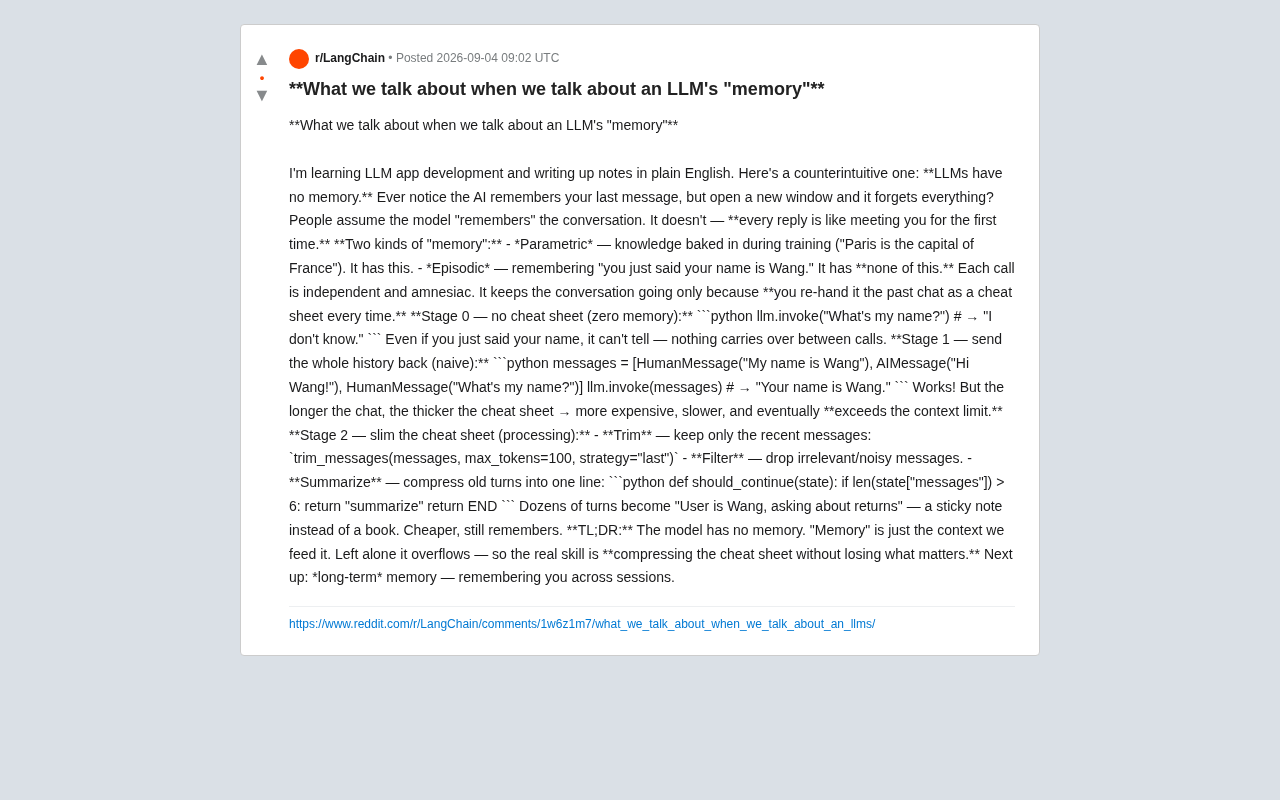
LLM "memory" is just context re-feeding — here's how to manage it efficiently.
Large language models have no built-in memory. What appears as conversational memory is actually the application layer re-feeding historical context to the model with each call. This article deconstructs the illusion, distinguishes parametric memory from episodic memory, and walks through three practical context compression strategies — trimming, filtering, and summarization — to help developers build efficient and cost-effective memory management for LLM applications.
A Counterintuitive Truth: Large Language Models Have No Memory at All
Many people who use ChatGPT, Claude, and other large language models operate under an implicit assumption: that the model "remembers" what you discussed earlier. But the truth is exactly the opposite — LLMs have no memory capability whatsoever.
Have you ever noticed that an AI seems to remember your last message, but the moment you open a new chat window, it forgets everything? This phenomenon reveals a critical fact: for the model, every response is as if it's meeting you for the first time. It doesn't know who you are, and it doesn't remember what just happened.
This article is based on learning notes shared on Reddit by a developer studying LLM application development. It breaks down the true nature of "memory" in plain language and offers practical engineering solutions.
Two Types of Memory: LLMs Have One, but Lack the Other
To understand why LLMs "have no memory," we first need to distinguish between two fundamentally different types of memory.
Parametric Memory: Static Knowledge Baked in During Training
Parametric Memory is knowledge that gets baked into the model's weights during the training phase. Facts like "Paris is the capital of France" or "the chemical formula for water is H₂O" fall into this category. Models do possess this type of memory — it's encoded across billions or even trillions of parameters.
From a technical standpoint, the underlying mechanism of parametric memory is the neural network's weight matrices. During training, the model continuously adjusts these floating-point parameters through backpropagation, encoding statistical patterns from massive text corpora into weight values. This process is analogous to how humans internalize knowledge into long-term memory through repeated learning. Take GPT-4 as an example — its parameter count is estimated to exceed the trillion-scale, and its training data covers vast amounts of internet text, books, and academic papers up to its cutoff date.
But here's the key: parametric memory is static and read-only. Once training is complete, this knowledge won't update based on your conversations — unless you perform fine-tuning or continual pre-training, both of which require additional training pipelines and computational resources. This is also why models have a "knowledge cutoff date."
Episodic Memory: A Capability LLMs Completely Lack
Episodic Memory refers to the ability to remember specific events that just occurred, like "you just said your name is Wang." And this is precisely the capability that LLMs completely lack.
Every API call is independent and amnesiac. The only reason the model can "continue the conversation" is that you feed the previous conversation back to it as a "cheat sheet" every time. In other words, so-called conversational memory is essentially the application layer continuously re-feeding historical context to the model.
Three Engineering Stages of Conversational Memory
The original author used a progressive "cheat sheet" metaphor to clearly illustrate how to build conversational memory at the engineering level.
Stage 0: Zero Memory — No Context at All
llm.invoke("What's my name?")
# → "I don't know."
Even if you told the model your name just one second ago, it can't answer — because no information is carried between two independent calls. This is the LLM's "factory default state."
Stage 1: Sending Full History — Naive but Effective
messages = [
    HumanMessage("My name is Wang"),
    AIMessage("Hi Wang!"),
    HumanMessage("What's my name?")
]
llm.invoke(messages)
# → "Your name is Wang."
Now it works! But problems quickly follow: the longer the conversation, the thicker the cheat sheet. This leads to three direct consequences — higher API costs, slower response times, and eventually exceeding the model's context window limit.
It's worth explaining the technical background of context windows here. The Context Window refers to the maximum number of tokens a model can process in a single inference. A token is the smallest unit of text the model processes — an English word typically corresponds to 1-2 tokens, and a Chinese character usually corresponds to 1-2 tokens. Early GPT-3.5 had a context window of only 4,096 tokens (roughly 3,000 English words), while GPT-4 Turbo expanded this to 128K tokens, and Claude 3 reached 200K tokens. Context windows are constrained by the computational complexity of the self-attention mechanism in the Transformer architecture — standard self-attention scales quadratically with sequence length, meaning that doubling the context roughly quadruples the computational cost. Additionally, API calls are typically billed by token count, so longer contexts mean higher costs per call.
For a real production-grade application, this naive approach clearly isn't sustainable long-term.
Stage 2: Context Compression — Where Real Engineering Wisdom Lies
The real engineering wisdom lies in: how to compress context without losing critical information. The original author presented three common context compression strategies:
1. Trim — Keep only the most recent messages:
trim_messages(messages, max_tokens=100, strategy="last")
2. Filter — Discard irrelevant or noisy messages, keeping only valuable content.
3. Summarize — Condense older conversations into a single sentence:
def should_continue(state):
    if len(state["messages"]) > 6:
        return "summarize"
    return END
Through summarization, dozens of conversation turns can be compressed into a sticky note like "The user's name is Wang, and they're inquiring about a return," instead of an entire book. The result: cheaper, while still retaining key information.
Each of these three compression strategies has its ideal use case and deserves deeper understanding. The trimming strategy is the simplest and most straightforward, well-suited for casual chat scenarios where the most recent conversation is typically most relevant. However, in scenarios that require referencing early critical information (such as a case number mentioned at the beginning of a legal consultation), it can lose important context. The filtering strategy requires designing criteria to distinguish "valuable" from "noisy" messages, which can be implemented through rules (e.g., filtering out pure small-talk) or semantic similarity. The summarization strategy is the most intelligent — it leverages the LLM itself to generate conversation summaries — but this introduces additional API call costs and latency, and the summarization process itself may lose details. In actual production, engineers often combine all three strategies — for example, keeping the original text for the last 5 turns, generating summaries for older conversations, and directly filtering out small talk. Mainstream LLM application frameworks like LangChain and LlamaIndex have these memory management components built in.
Memory Is Not a Model Capability — It's a Context Management Engineering Problem
This perspective is extremely enlightening for LLM application developers. It transforms "memory" from a vague question of "is the model intelligent enough" into a clear context management engineering problem.
Once you understand this, many product design puzzles become easy to solve:
- Why does a long conversation suddenly "forget" what was said at the beginning? — Because once the context window is exceeded, earlier messages get trimmed away.
- Why does the same question get a completely different answer in a new session? — Because the new session has no "cheat sheet" at all.
- Why do some AI products require carefully crafted "system prompts"? — Because these are the "permanent cheat sheet" the model sees every time.
The real technical challenge has never been about giving the model "memory." It's about deciding which information is worth keeping and how to compress it efficiently within a limited context budget. This is also the underlying logic behind the popularity of technologies like RAG (Retrieval-Augmented Generation) and vector databases — they are essentially smarter "cheat sheet management systems."
RAG (Retrieval-Augmented Generation) is an architectural paradigm proposed by Facebook AI Research in 2020. Its core idea is: instead of stuffing all knowledge into the context, retrieve the most relevant snippets from an external knowledge base when needed, then inject them into the prompt. This process relies on vector databases (such as Pinecone, Weaviate, Milvus, etc.) for efficient semantic retrieval. The specific workflow is: first, split documents into chunks and convert them into high-dimensional vectors via an embedding model, storing them in a vector database; when a user asks a question, convert the question into a vector as well, and find the semantically most relevant document chunks through Approximate Nearest Neighbor (ANN) search; finally, concatenate these chunks into the prompt for the model's reference. This approach solves both the limited context window problem and the inability to update parametric memory — you simply need to update the documents in the vector database.
The Next Challenge: Cross-Session Long-Term Memory
Everything discussed in this article concerns short-term memory management within a single session. The next-level challenge is long-term memory: how do you make an AI remember you across different sessions?
This requires introducing external storage mechanisms — for example, persisting user profiles and historical preferences to a database, then retrieving and injecting them into the context at the right moment. This is precisely the frontier that many AI assistant products are racing to conquer.
Current mainstream technical approaches for cross-session long-term memory fall into three categories. The first is user profile persistence, where structured data like user preferences and basic information extracted from conversations are stored in relational databases or key-value stores. The second is memory vectorization, where important conversation fragments are converted into vectors and stored in a vector database, then injected into new sessions through semantic retrieval when they begin. The third is the knowledge graph approach, where entities and relationships are extracted from conversations to build a graph, enabling more precise memory retrieval. OpenAI's Memory feature introduced for ChatGPT in 2024, Google Gemini's memory system, and open-source frameworks like Mem0 are all exploring this direction. The core challenges include: how to automatically determine which information is worth remembering long-term, how to handle memory conflicts (e.g., when a user updates their personal information), and how to strike a balance between privacy protection and personalized service.
Conclusion
Models have no memory — so-called "memory" is simply the context we feed them. Left unmanaged, it will overflow. The real skill is compressing that cheat sheet without losing critical information.
For every LLM application developer, understanding "memory" as a controllable engineering variable rather than a mysterious capability inside a black box is the first step toward building reliable AI applications.
Related articles

OpenAI Declares the AGI Era Has Arrived: Conceptual Controversies and Technical Realities
OpenAI launches GPT-6 Astra claiming the AGI era has arrived, sparking controversy. Deep analysis of AGI definition ambiguity, technical progress realities, industry standards battle, and practical impacts on users and developers.

Vercel AI SDK TogetherAI Adapter 3.0.45 Update Analysis
Analysis of @ai-sdk/togetherai 3.0.45 patch update covering dependency sync, OpenAI compatibility layer architecture, and semantic versioning strategy in Vercel AI SDK.
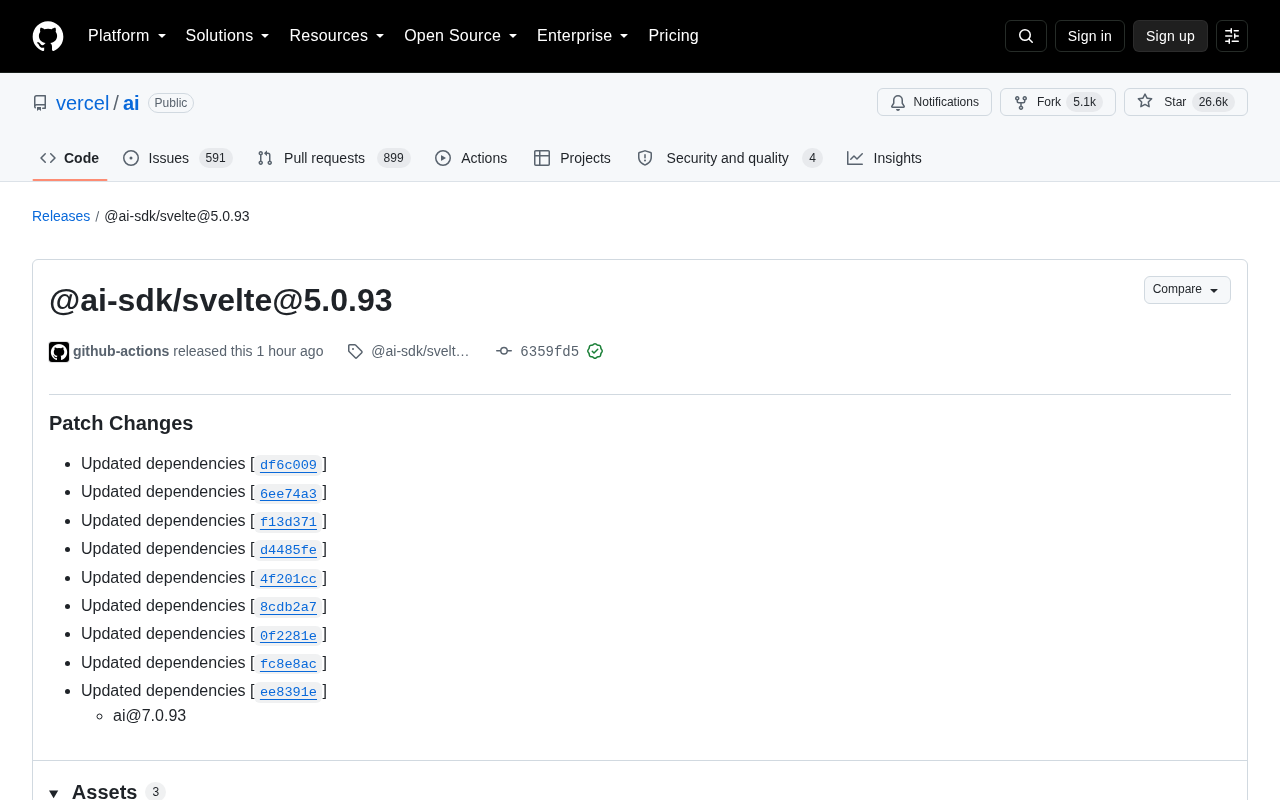
Deep Dive into Vercel AI SDK Svelte 5.0.93 Release Update
In-depth analysis of Vercel AI SDK Svelte 5.0.93 patch update, covering multi-framework adaptation, dependency sync, and automated release pipelines for Svelte AI app development.