Deconstructing Timestamp Permutation: Diagnosing Temporal Dependence in Dynamic Link Prediction

Research disentangles timestamp permutation gaps, revealing training rather than evaluation history as the primary driver.
Timestamp permutation is commonly used to test whether dynamic link prediction models utilize temporal information, but whether performance degradation stems from training or evaluation history has remained unclear. Using a cross-diagnostic design on the MOOC dataset with the TCL model, the study quantifies both contributions: training with original temporal order improves pairwise accuracy by about 8 percentage points compared to shuffled training, while changing only the evaluation history yields a mere 0.03 percentage point change. The authors propose an "input exposure" metric, finding that 68.37% of query inputs remain entirely unchanged after history alteration, explaining the insensitivity to evaluation history. The study also examines explicit time encoding, whose suppression reduces training contrast from 8.03 to 3.64 percentage points, showing it is an important but not sole temporal channel; DyGFormer shows a training contrast of 22.34 percentage points versus only 0.38 for history contrast, further confirming the dominant role of training conditions.
Title
Deconstructing Timestamp Permutation: Diagnosing Temporal Dependence in Dynamic Link Prediction
Meta Description
A new study uses cross-diagnostic design to decompose the performance gap in dynamic link prediction under timestamp permutation, finding that training stage dominates temporal dependence while evaluation history has negligible effect, and introduces an input exposure metric to explain why.
Article Content
Do dynamic link prediction models actually use temporal information? Timestamp permutation is a common testing technique, but the performance gap may stem from training history, evaluation history, or the interaction between the two. A recent study uses a cross-diagnostic design to decompose this ambiguous gap into interpretable components and proposes an "input exposure" metric to measure whether altering history actually affects model inputs.
The Ambiguity of Timestamp Permutation: Training and Evaluation Entangled
In traditional approaches, researchers shuffle timestamps and observe performance degradation to gauge how much the model depends on temporal information. However, this degradation may arise from disruption of temporal information during training, from disorder in the historical sequence during evaluation, or from both. The study quantifies the relative contributions of these two effects using the TCL model (trained with binary cross-entropy) on the MOOC dataset as an example.
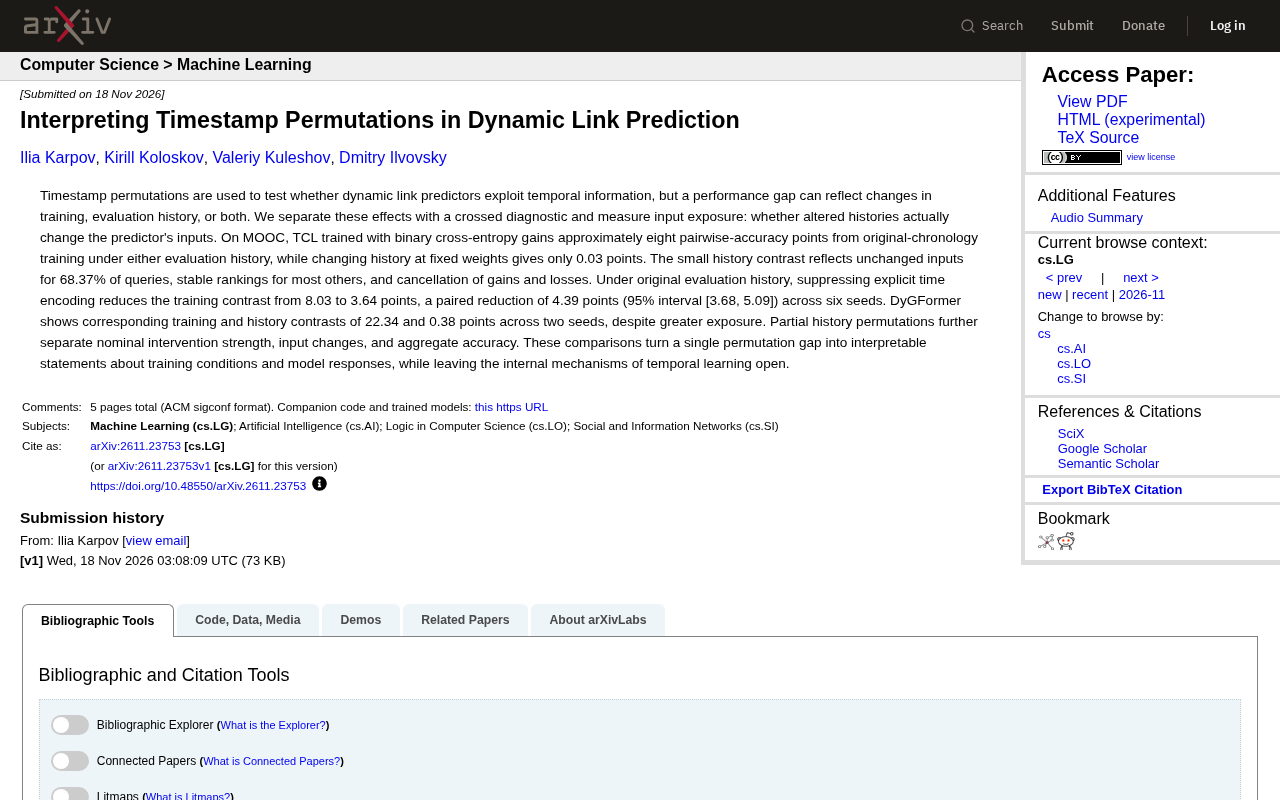
Results show that under the original evaluation history, training with original temporal order improves pairwise accuracy by about 8 percentage points compared to training with shuffled temporal order; while fixing the weights and only changing the evaluation history, performance changes by only 0.03 percentage points. This means the performance gap stems primarily from the training stage's utilization of temporal information, and changes to evaluation history have negligible impact.
Dynamic link prediction is a core task in temporal graph learning: given a graph that evolves over time (with nodes and edges continuously appearing), the model must predict whether an edge will form between two nodes at some future moment. Unlike static link prediction, dynamic models "consume" historical interaction sequences in chronological order during both training and inference, so they should in theory be sensitive to the ordering of timestamps. Common dynamic graph models include RNN-based TGN and Transformer-based DyGFormer, which typically encode each node's recent interaction history as memory or sequence input.
The TCL model in this research context refers to a baseline model trained with a Temporal Contrastive Learning approach, using binary cross-entropy as the primary training objective. It was chosen as the analysis target because its structure is relatively simple and its training objective is clear, making it easy to attribute performance differences to the training and evaluation phases without interference from complex auxiliary losses.
Input Exposure: Does Altering History Actually Change the Input?
The study further measures "input exposure"—the proportion of queries where the model's actual input changes after altering history. In the MOOC dataset, 68.37% of query inputs remain entirely unchanged, and among the remaining queries most rankings remain stable with gains and losses canceling out. This explains why changing evaluation history has negligible impact on overall accuracy: the model inputs are barely touched.
This finding suggests that simply observing performance gaps after permutation may overestimate the model's sensitivity to evaluation history. Input exposure provides a more direct perspective: whether history permutation actually changes the data the model sees.
Pairwise accuracy is a common metric in link prediction evaluation: for each query (a source node and a timestamp), one positive sample and one negative sample are drawn from candidate target nodes to form a pair; if the model scores the positive sample higher than the negative sample, it is recorded as correct, and the proportion of correct pairs is computed. Compared to AUC or MRR, pairwise accuracy is insensitive to candidate set composition and directly reflects the model's "ranking" ability, making it suitable for measuring subtle performance changes induced by permutation interventions.
Input exposure can be understood as an "intervention compliance" metric: in causal inference, we care whether the intervention actually changes the treatment variable; here, the intervention is shuffling the historical sequence, and the treatment variable is the input the model actually receives. If all interactions within a query's history window have identical timestamps or the order is already random, shuffling produces identical input vectors, and that query is "unexposed." Only by examining exposure alongside performance changes can we distinguish between "the model is insensitive to history" and "history was never actually altered"—two entirely different explanations.
The Role of Explicit Time Encoding: Training Contrast Halved
The study also examines the effect of explicit time encoding. Under the original evaluation history, suppressing explicit time encoding reduces training contrast from 8.03 percentage points to 3.64 percentage points, a paired reduction of 4.39 percentage points (95% confidence interval [3.68, 5.09]), based on six random seeds. This indicates that explicit time encoding is an important channel for the model to utilize temporal information, but not the only one—even after suppression, about 3.64 percentage points of contrast remains.
Explicit time encoding refers to the model directly embedding timestamps (or time differences) as features when constructing inputs, concatenating them with node and edge features before feeding into the network, such as Time2Vec or simple scalar encoding of time differences. In contrast, "implicit" temporal information means the model can only indirectly perceive time through the ordering of interaction sequences. The retention of about 3.64 percentage points of training contrast after suppressing explicit time encoding shows that sequence order itself (and the model's inductive bias toward order) constitutes an independent channel for temporal utilization.
Note on confidence intervals and random seeds: the study reports a 95% confidence interval [3.68, 5.09] based on six random seeds, meaning that under repeated training the contrast reduction is likely to fall within this range, ruling out the possibility of a single training run's chance result. This is crucial for the credibility of the conclusions, as deep graph model performance is sensitive to initialization and data splits.
Model Differences: Larger Contrast for DyGFormer
On the DyGFormer model, training contrast reaches 22.34 percentage points, while history contrast is only 0.38 percentage points (based on two seeds). Although DyGFormer has higher input exposure (i.e., more queries' inputs change due to history alteration), its performance sensitivity to evaluation history remains very low. This further confirms the dominant role of training conditions and suggests that different model architectures utilize temporal information in different ways.
Partial Permutation and Future Directions
The study also explores partial history permutation to disentangle the relationship between nominal intervention strength, input changes, and aggregated accuracy. These analyses transform a single permutation gap into interpretable statements about training conditions and model responses, but the authors also note that the internal mechanisms of temporal learning remain to be further revealed.
For practitioners, this study reminds us that when evaluating the temporal dependence of dynamic link prediction models, we need to distinguish the contributions of training and evaluation phases and pay attention to input exposure as a mediating variable. Relying solely on performance gaps after permutation may be misleading.
Key Takeaways
- Performance gaps from timestamp permutation stem mainly from the training stage, with negligible impact from evaluation history changes.
- Input exposure (68.37% of query inputs unchanged) explains the insensitivity to evaluation history.
- After suppressing explicit time encoding, training contrast drops from 8.03 to 3.64 percentage points.
- DyGFormer shows a training contrast of 22.34 percentage points and a history contrast of only 0.38 percentage points.
- Partial permutation analysis helps separate the effects of intervention strength and input changes.
One-line Summary
The study uses cross-diagnostic design to decompose the performance gap from timestamp permutation, finding it stems mainly from training rather than evaluation history.
Related articles

Nothing CMF Buds 2A Drops to $17.89 on Black Friday: A New Low for ANC Earbuds
Nothing CMF Buds 2A wireless earbuds Black Friday deal: just $17.89 on Amazon, about $11 off retail and a record low. ANC earbuds at an entry-level price.

When AI Creation Gets Accused of "Spitting": Hacker News Heats Up Over the Glaude Controversy
A Hacker News post, "Spitting in the Face of Glaude," sparks debate on AI creation transparency and attribution ethics. This analysis examines the blurred creator identity behind the controversy and offers practical advice for AI content production.

Akai Embraces Custom Firmware: MPC Sample 1.4 Lets Users AI-Program Their Sampler
Akai embraces the modding community with MPC Sample 1.4 firmware, supporting vibe-coded custom firmware and effects. We analyze the impact of this open strategy on music hardware and AI-assisted programming.